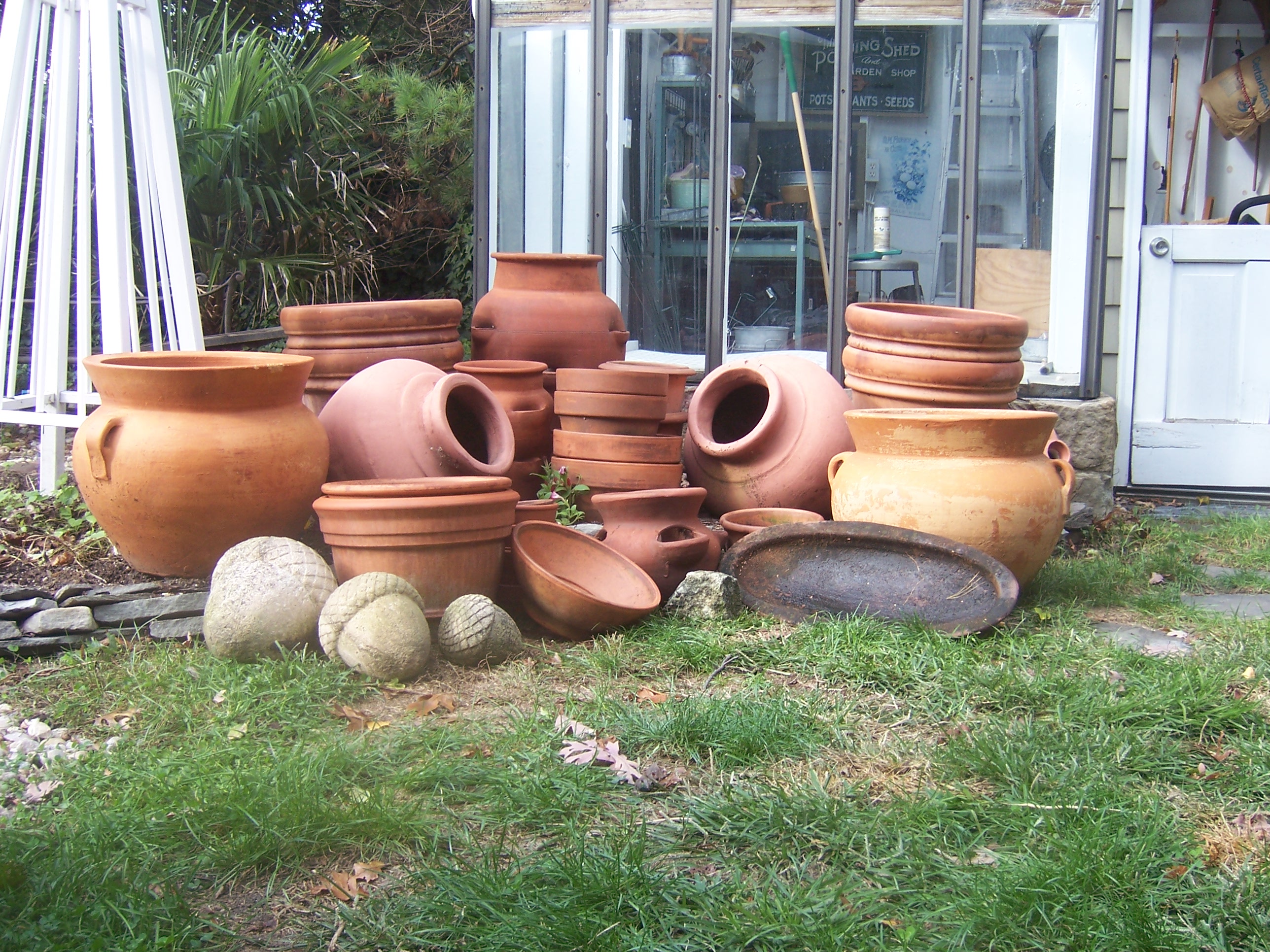
I returned home from my stay in the hospital, feeling much — MUCH — better. Imagine my surprise when I looked into the garden and saw all of the terra cotta pots lined up like the upstairs/downstairs servants on “Downton Abbey” greeting the arrival of the lord of the estate.
Actually, I had arranged them before the health hoopla for a post on my love of terracotta. My idea was to call it a family portrait with some smarmy comment about it beging so hard to get everyone together for a family photo. But with days and days spent in the hospital, as well as all of the doctors and tests, I had forgotten all about that photo shoot and that post. Oh, well. You know what they say about best laid plans.
In any event (and in my own warped mind), it was flattering to think that the terra cotta team thought as much about me as much as I do of them. I really don’t know where this affection for terra cotta began. I just know that I like the color, the feel, the texture, the variety, the warmth, the weathered age. When I see them in the garden, I am reminded of sun-splashed Meditteranean vacations, where whitewashed walls are the perfect backdrop for terra cotta pots overflowing with red geraniums.
Very early last Thursday morning, at about 2:00 a.m., I saw my garden from a whole new perspective. I was wheeled out, backwards, on a gurney. Joe decided to call the ambulance when I told him that I felt pressure on my chest and had difficulty breathing. As a heart patient with 13 stents, that is definitely a scary feeling.
The good news in all this is that I am feeling better, although I am still in the hospital. My heart is strong, but the doctors do not understand how my healthy liver produced enough enzymes to prevent my blood from coagulating. So I am closely monitored and feeling antsy. Joe brought up the laptop, and here I sit. Writing.
It’s been kind of strange the past few days, to be in this hospital room and not be able to walk around the garden, upload photos, update this blog, and visit the sites of so many people I have met through this exercise. How have I passed the time, you ask?
For the sake of saving time, I thought I would combine the final packing practice for Canna and Elephant Ears. Besides, I don’t think I can actually type the words Canna and Elephant Ears one more time.
The process is pretty much the same for both plants. You will need peat moss, some kind of storage container (like brown paper bags), a shovel, and a room that stays relatively dry and evenly cool so that the plants can be lulled into a deep sleep without freezing. If the final storage location is too damp or warm, the plants never get a chance to rest and they are at risk of rotting away — and after so much work getting to this point, that would be a shame.
Step 1: Where Canna are concerned, I double up two brown paper bags and label the outside. I then put a shovel or two of peat moss in the bottom of the bag so the corms have a nesting area.
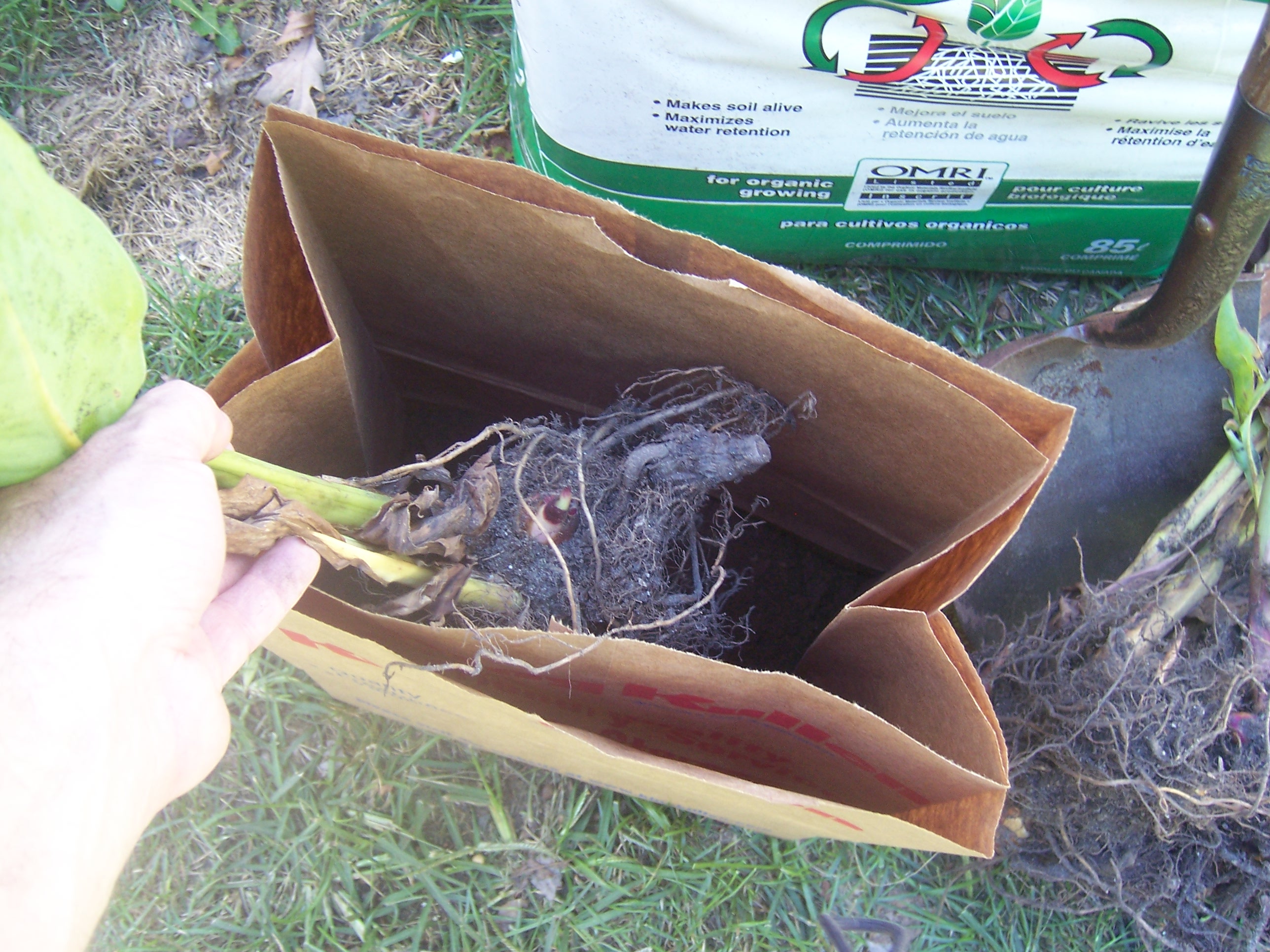
Step 2: I then place the corms (stem and all) into the bag.
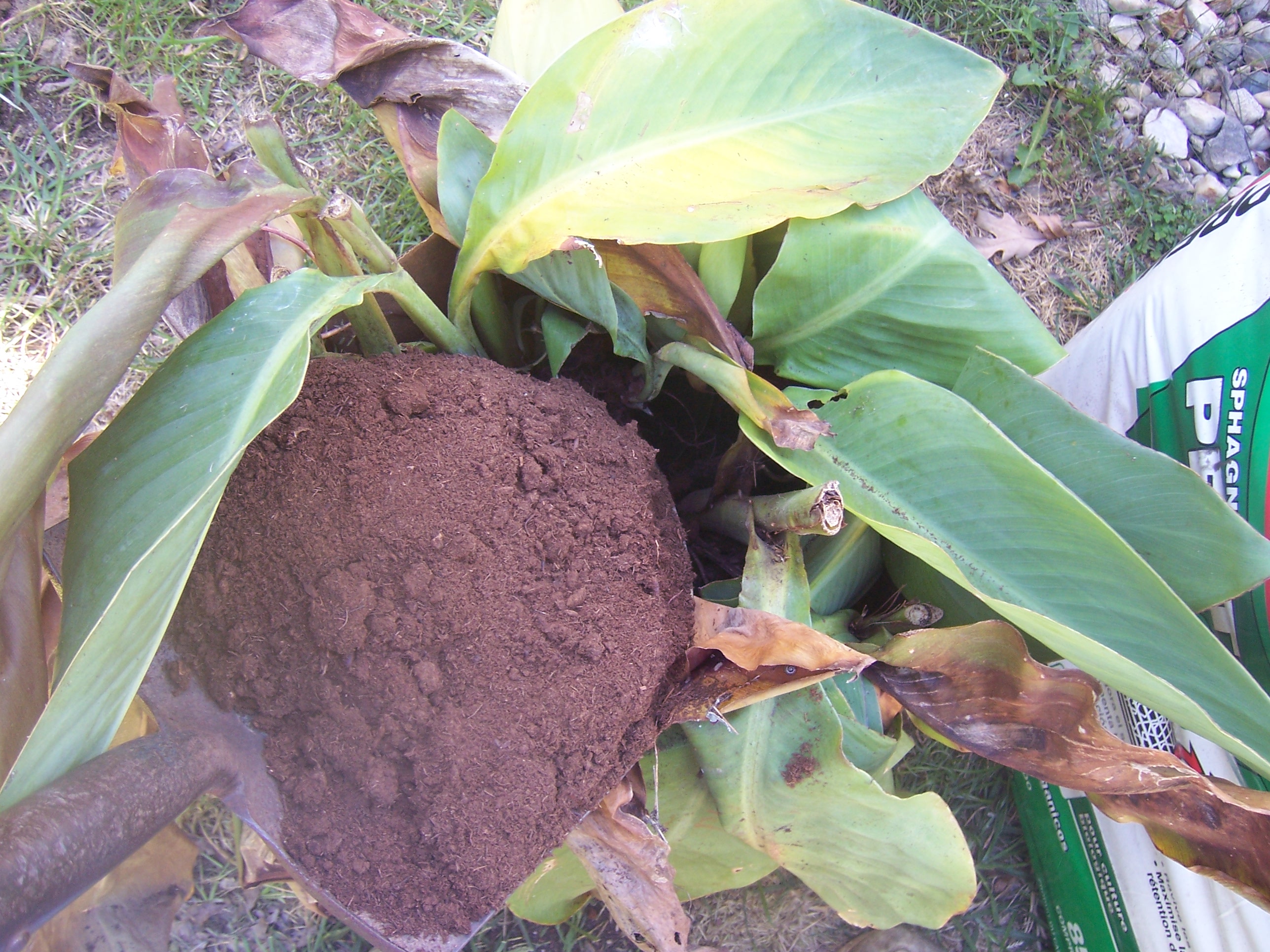
Step 3: I tend to really pack the bags. I’m not sure if this is correct, but it’s likely that I do this for the sake of space, since I have so many corms to pack away. Once the bag is full, I then add more peat moss to the bag, shaking the bag so that the peat moss settles and covers the corms.
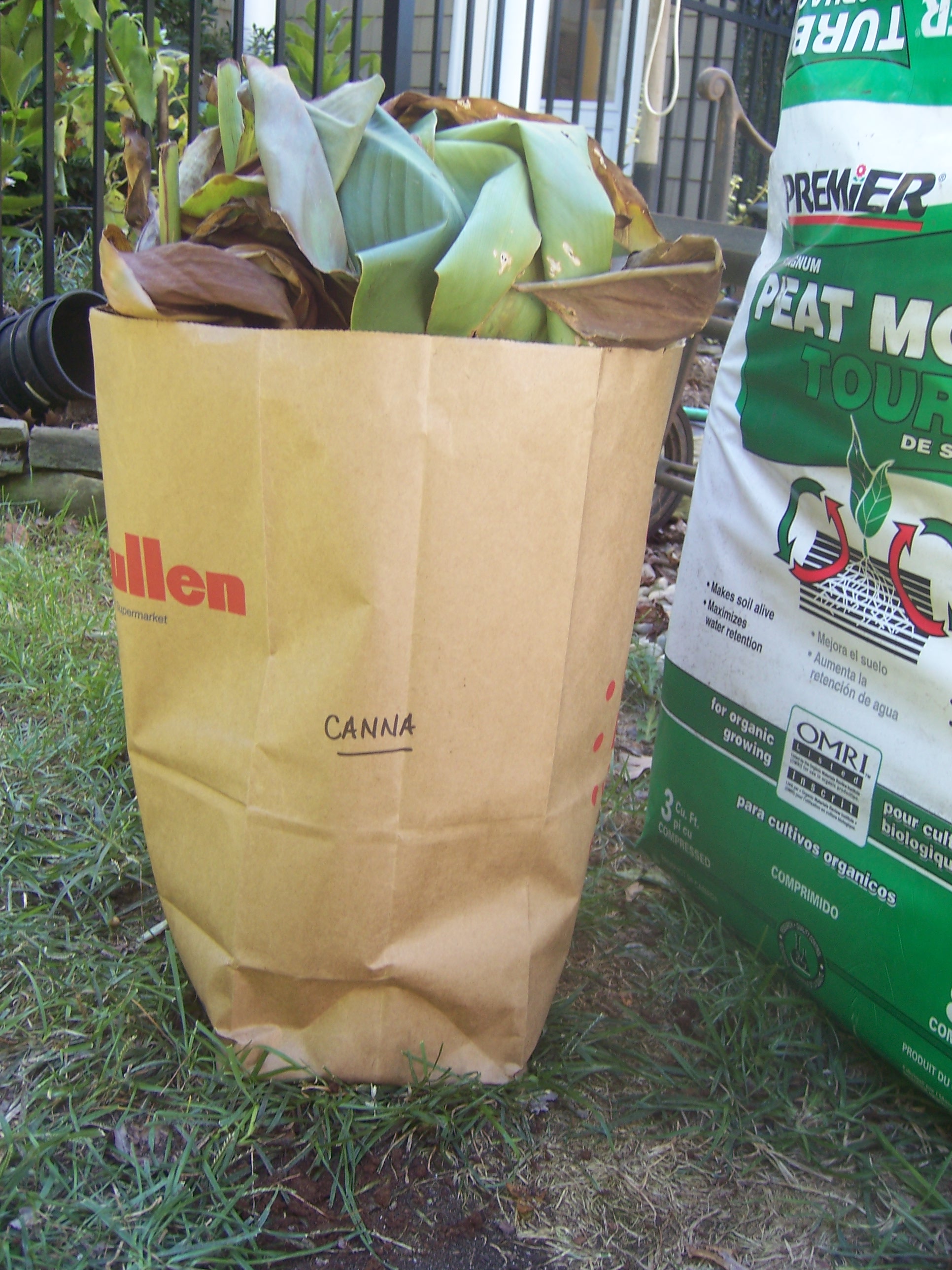
Step 4: Finally, I have something that looks like this.
Now for the Elephant Ears. Last year, I stored the Elephant Ear bulbs in a plastic crate lined with a plastic bag. I’m not sure if this had to do with my loss of energy and wanting to finish the task, needing to save space, or just running out of bags. Either way, it worked. By the way, don’t be surprised if your Elephant Ears have continued to grow since you dug them up.
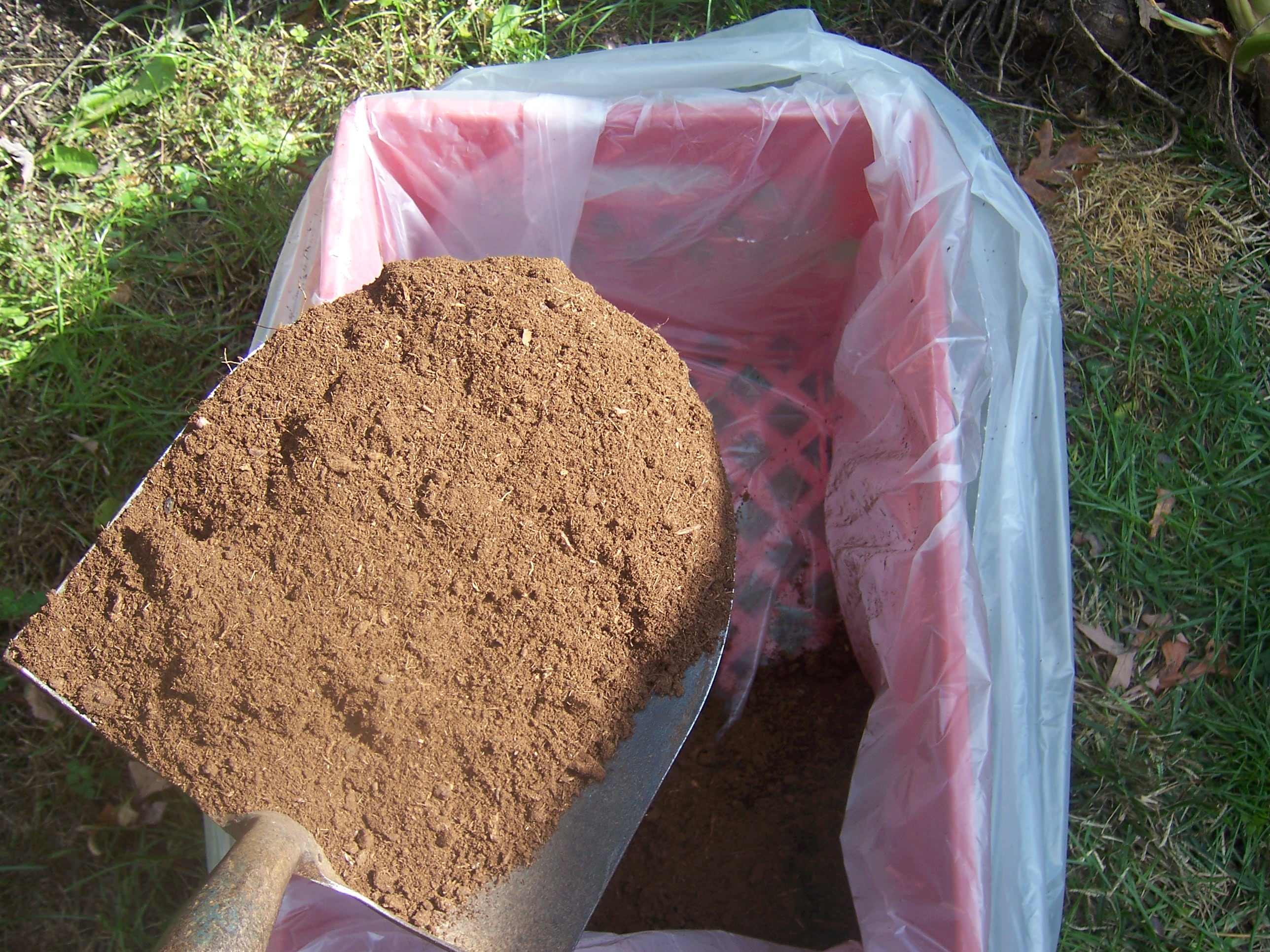
Step 1: Once the crate is lined with a plastic bag, add a few shovels of peat moss into it to give the bulbs a place to rest.
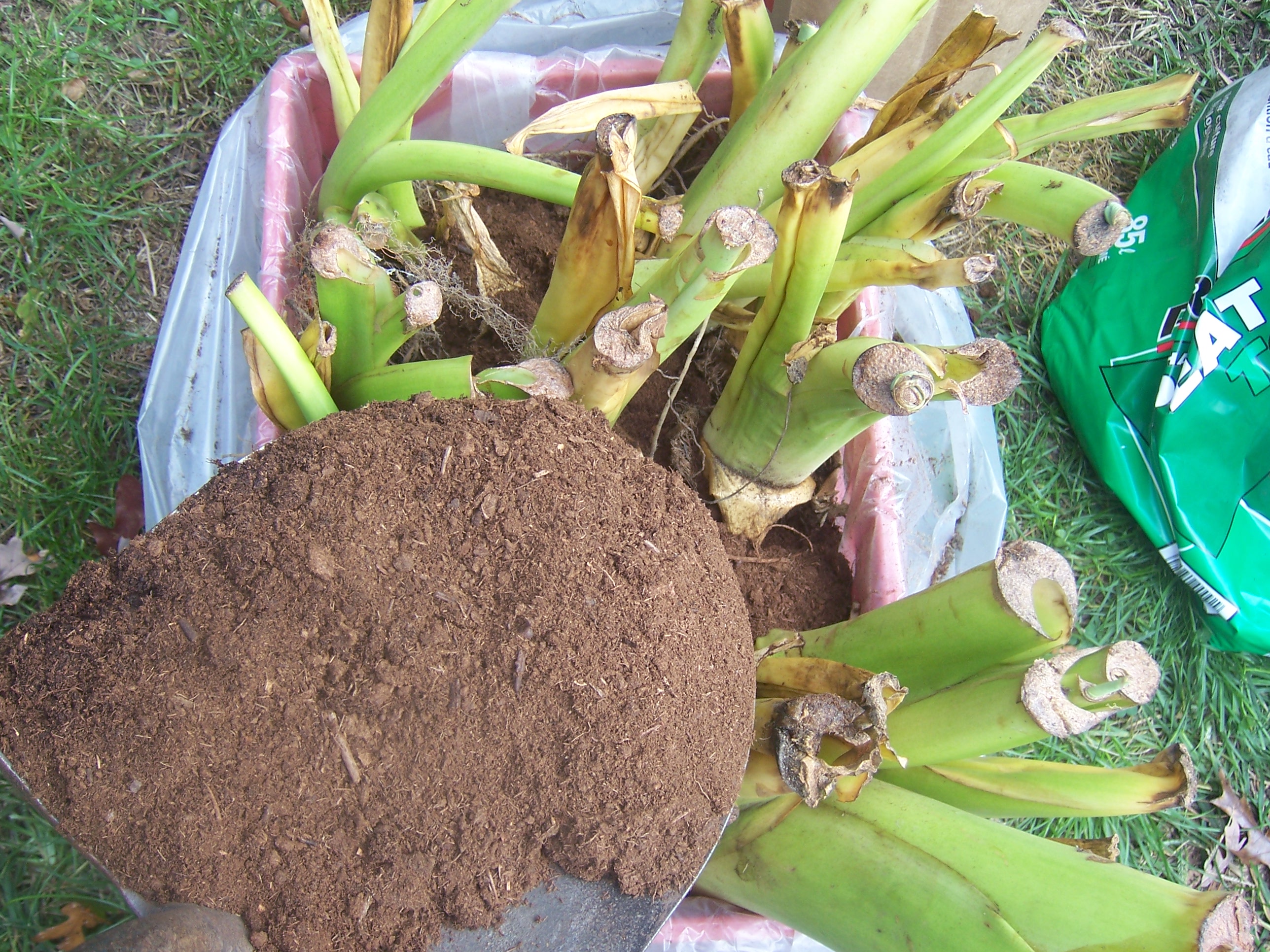
Step 2: Load the Elephant Ear bulbs (stem and all) into the peat moss-filled crate. Again, I tend to pack a lot in there. Then add peat moss to cover the bulbs.
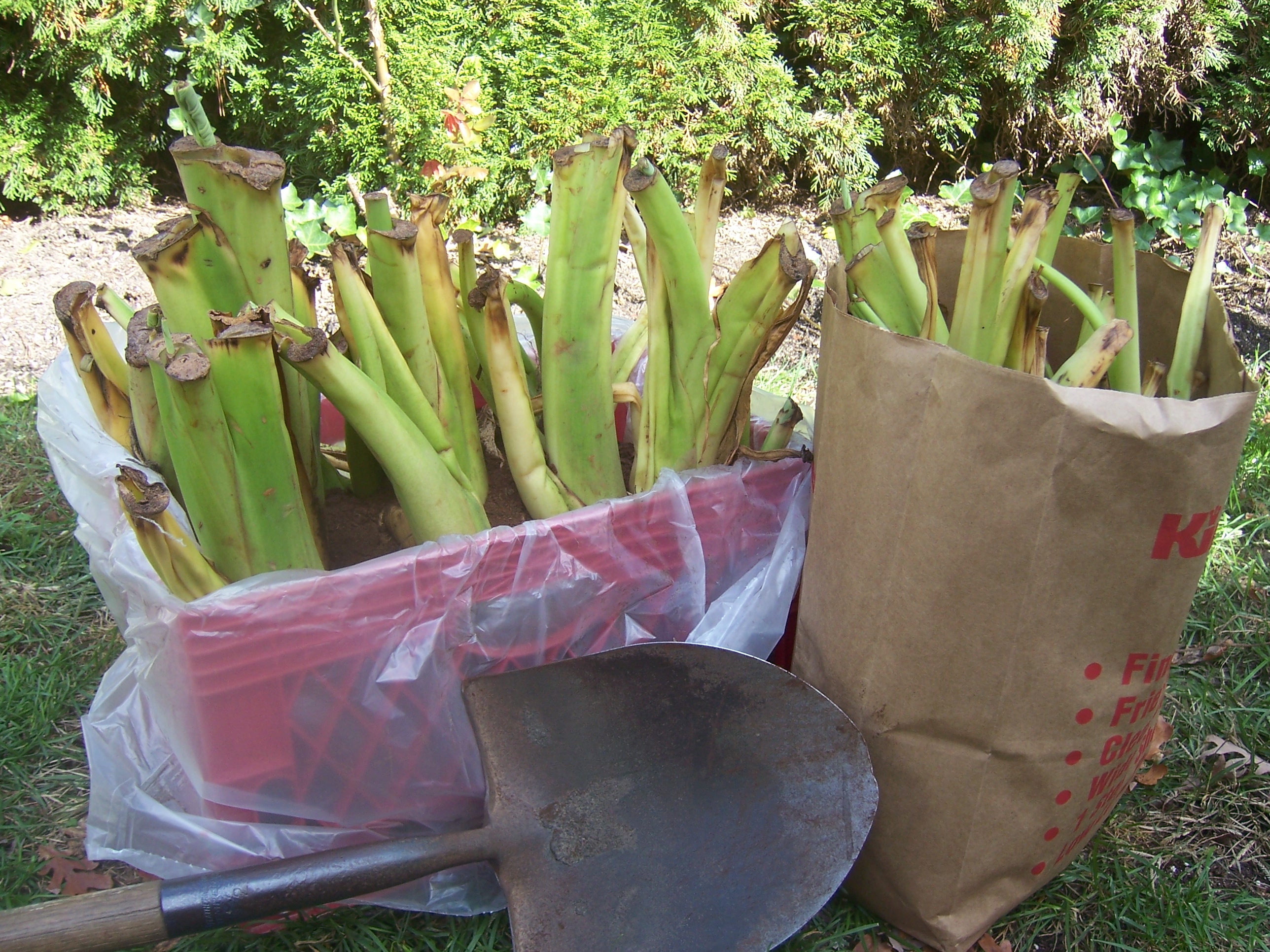
Step 3: Ultimately, this is what I am left with. All that’s left to do now is carry everything into its Safe Room.
The Final Step: Here is the Safe Room — a cement bunker/bomb shelter hidden behind Joe’s closet in the bedroom. Now, anyone who knows me or who has read previous posts understands that I have an active imagination. As my summer plants continue to live, enclosed behind the closet, my mind races back and forth between Edgar Allen Poe’s Fall of the House of Usher and the classic sci-fi film Invasion of the Body Snatchers. So far, the Safe Room is protecting Joe and me. So far. . .
Now that the Elephant Ears are out of the ground, it’s time to turn my attention to the Canna forest that is my yard. The truth is, I never intended to have a Canna forest — things just got out of hand over the years as corms grew and became easy to divide, or I found new leaf patterns or bloom colors and I thought I needed to have three of each.
I live in Zone 6 and I have tried to overwinter some Canna in the ground, but I have had no success. I’ve mulched them and planted them along the south-facing side of the house, but to no avail. So whether you have a few stalks or a forest, this is what you will need if you live in a northern climate and would like to save your Canna for future summers: garden clippers, shovel or pitchfork, stamina.
Step 1: For the sake of this demonstration, I dug the Canna first. You could also trim the stalk and then dig out the corm. Either way, pry up the plant, being careful to not damage the corm with your garden tool.
Step 2: Leave about 8″ – 10″ of stalk. Actually, Canna can grow quite large, so for ease of trimming, it might make more sense to leave the corms in the ground, cut the stalks, and then dig out the plant.
Step 3: As sad as it is to do this job, there is a thrill each time I remove a corm from the ground. See that white bulbous shape and the group of purple-tinged tips peaking through the roots? That’s where next year’s growth will occur. Ah — the promise of next year’s garden! By the way, this is also a good time to remove any excess dirt. Don’t divide the corms; that’s a task that’s safer to do in the spring when you unpack them from their hibernation location.
Step 4: After the corms are out of the ground, I keep them in the potting shed for about a week. The setting is warm enough for them to dry a bit before packing away, but not so hot that they cook. Since I have several varieties, I group them in large plastic containers. I also store them upside down — mostly because my gardening bible, Better Homes and Gardens Complete Guide to Gardening, recommends doing that. I’m not sure of the reason, but I do as I’m told — and my gardening good book has never failed me.
Next Post: Saving Elephant Ears and Saving Canna — Part 2.
With frost rapidly approaching, it’s time to remove my tender Elephant Ears and prepare them for winter storage. My method is something that I have adapted over the years, and it’s based on what I’ve learned after saving dahlias and caladium.
What you will need: garden clippers, a pitchfork or shovel, old clothes, nerves of steel.
Step 1: The first thing to do is cut back the stems. I try to leave about 8″ to 10″ of stem. No matter how many times I have done this, I always feel a little guilty because the leaves have reached their fullest. But, alas, all good things must come to an end. Do not be surprised if there is a gush of water that pours from the stalk after you make your cut.
Step 2: After the stalks are cut, within minutes they begin to “bleed.” If you decide to try this project, be sure to wear old clothes — the brown/red liquid will stain and it does not come out in the wash. I learned this the hard way, and now I have my Elephant Ear cutting outfit.
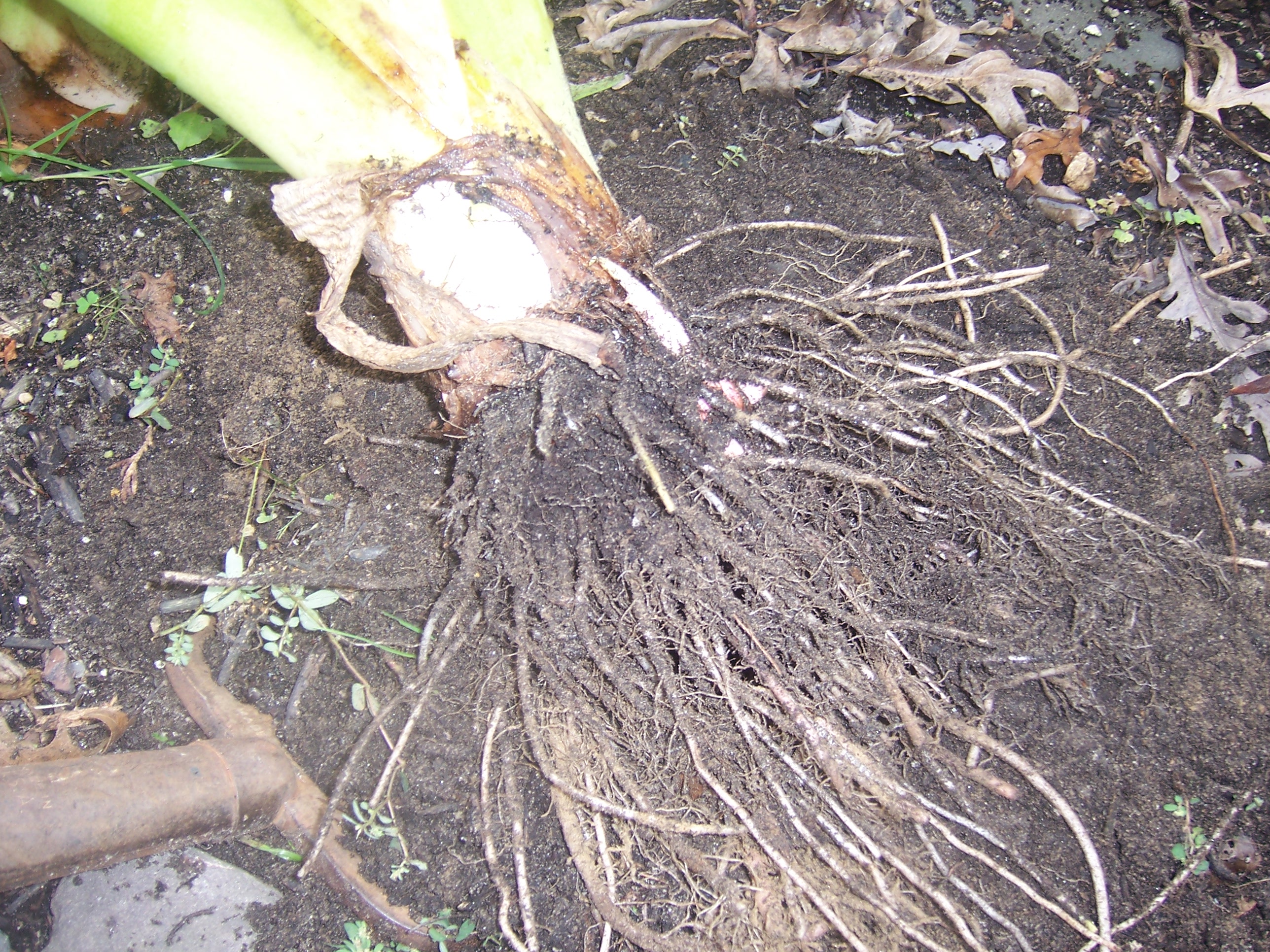
Step 3: Using the pitchfork, I carefully work in a circle, prying up the bulb. Once it feels loose, I gently pull the base upward, revealing the bulb and the wild mass of roots. At this point, I will shake off the excess dirt. You may notice that your main bulb might have smaller bulbs attached. Do not separate these at this time — that task will be much easier in the spring when you replant your bulb.
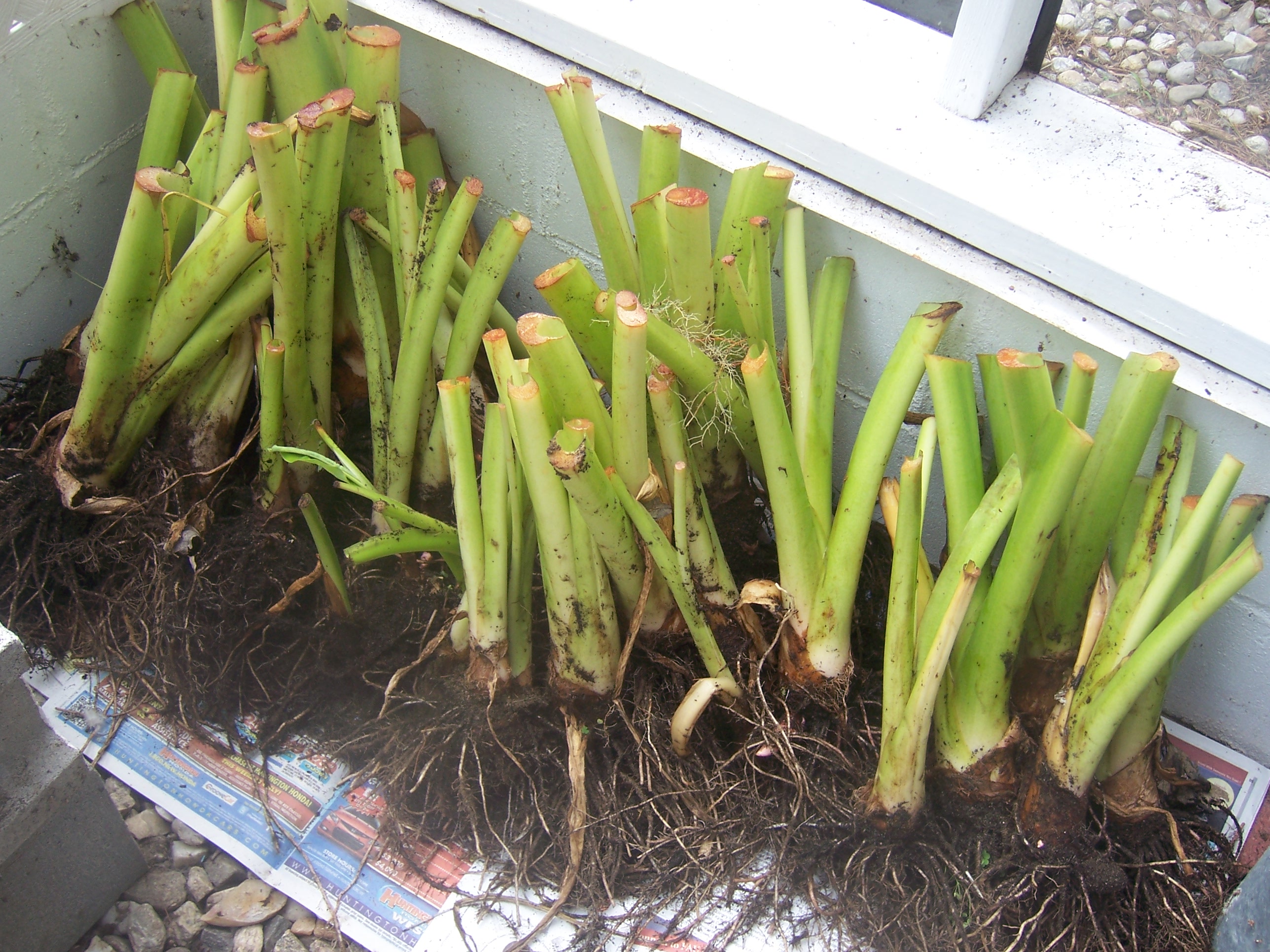
Step 4: Here we have pretty Elephant Ears all lined up in a row. Once the plants are dug, I store them for a little more than a week in the potting shed. It’s warm enough and dry enough for the bulbs to set before they are packed away.
When children recite, “Mary, Mary, quite contrary, how does your garden grow?” perhaps a more appropriate question would be, “From where does your garden grow?” That’s the question I ‘m asking myself this Columbus Day weekend after reading the best-selling new book 1493: Uncovering the New World Columbus Created, by Charles C. Mann. This meticulously researched book examines the world after Columbus set foot in North America.
While Columbus certainly has his critics, there can be no mistaking that his arrival in the New World placed the entire world on the globalization frontier. The author’s position is that much of what we enjoy today can be traced back to what he calls the Columbian Exchange, a means of moving plants and seeds and animals from one part of the world to another part. It is why, for example, that tomatoes arrived in Italy and citrus arrived in Florida. So much of what we take for granted wasn’t always so; and much of it would not be if Columbus had not set the process in motion.
I myself am a bit of a mutt: English, Scottish, German, French, and Italian. My paternal ancestors arrived in North America in 1675; my maternal great-grandfather entered through Ellis Island. While this is my gene pool, I wonder just how diverse and worldly is my garden?
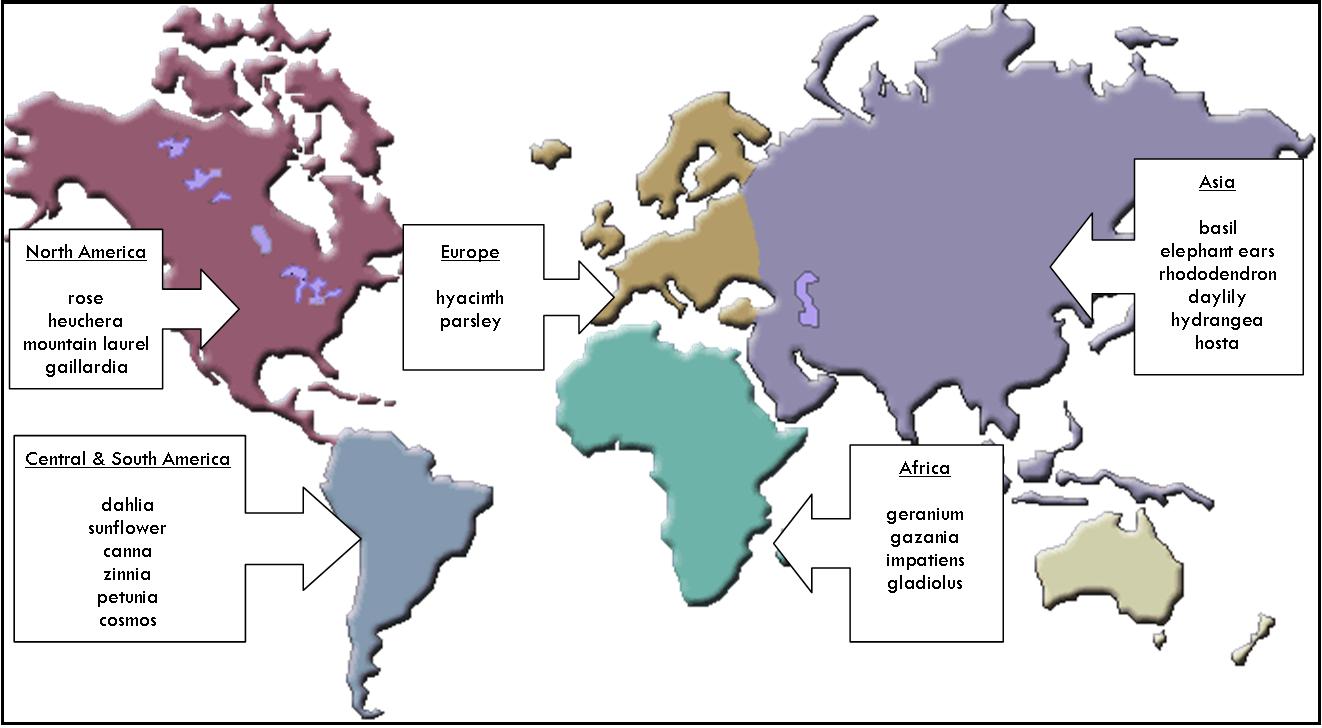
Thanks to the Internet and Google, I learned that what I plant has traveled a long way to be planted. In fact, my garden could be a lesson for world leaders seeking peace. Although it heavily favors Asia and Central and South Americas, there is little conflict in plants from many lands successfully sharing common ground. (Note to self: bring Australia into the mix, but wait until full-out global warming for Antarctica to come into bloom.)
And to think my melting pot only took 518 years — and still counting — to plant.
Happy Columbus Day — and enjoy the weekend in the garden.
This is the end result of a day spent digging and removing Elephant Ears and Canna from the garden, and preparing them for their long winter’s nap.
It’s probably my least favorite day in the garden, and each year, I dread its arrival. The chill in the air is my signal that, “It’s time.” Armed with a pitchfork, clippers, and nerves of steel, I apologetically approach each plant. I want to say, “Believe me, this is going to hurt me a lot more than it hurts you.” I want the plants to understand that my actions are for their own good, so that they may live to see another summer. But in the end, I fear that they’ll see me as a Viking, pillaging and ransacking their cozy beds.
Gardeners, I think, must have a bit of masochism in their blood. Who else would try to trick Mother Nature by planting wrong-zone plants, nurturing them into blooms, and then hacking them down, ripping them from the ground, and storing them over the winter — only to start the process all over again in the spring? Oh, to be content with zone-appropriate material!
Martha Stewart’s new television season has begun on the Hallmark Channel — and I survived the day without tuning in — and that’s a very good thing. I offer up this confession because Martha and I, well, we used to have a thing. Or at the very least, I did.
I remember it like it was yesterday — the day I met Martha Stewart. I never actually met her, physically, but it was my first introduction to Martha style. It was nearly 20 years ago, and I was sitting in my friend’s salon, leafing through magazines. That’s when I came across an issue of Martha Stewart Living.
I took one hit, and I was hooked. I liked the writing. I loved the style. The fonts. The photos. The locales. The recipes. The gardens and flowers — there was so much in that magazine, and with each turn of the page, I felt my world opening up. I saw things I never thought I would see. Articles about terracotta pottery. Photos of bulbs. Handmade wreaths!
Then the fiending started. I found her show (the early version). In my area, it aired on Sunday mornings, and I incorporated it into my Sunday routine. Breakfast. Newspaper. Martha. Crossword puzzle. There was nothing that she couldn’t do. And it was all perfect. She could pot an entire container garden and barely get a smudge on her garden gloves. I, on the other hand, would look like I had been run over by a mulching lawn mower. Continue reading →
For this Not-So-Wordless Wednesday post, I thought I would share the words of others, words that could somehow capture my feelings as I stand in the garden clipping some of the final blooms.
“Sorrow and scarlet leaf,
Sad thoughts and sunny weather.
Ah me, this glory and this grief
Agree not well together.”
Thomas Parson, 1880, A Song for September
The last page in this summer's garden scrapbook.
“For summer there, bear in mind, is a loitering gossip, that only begins to talk of leaving when September rises to go.” – George Washington Cable
There is a definite chatter as I get to work, selecting what’s left among the flowers. Looking at the leggy stems, some of them browned, and the leaves dusted with powdery mildew, I can definitely hear a chorus of pleasantries and goodbyes as the summer guests make their way to the garden gate.
“A late summer garden has a tranquility found no other time of year.” – William Longgood
There is a definite somberness and calmness in the garden today. Perhaps it’s because plants that I have nurtured for so long, some from seed started in February, are leaving after a full season of delivering what was promised — and paying my respects is the right thing to do. Maybe it has to do with the color of the sunlight, warm and golden, fading from the brightness of July. The shadows seem longer, and the colors more muted – and yet, it feels warm and glowing, especially as the sunlight hits the faintest change of color in the leaves overhead. More likely, though, the overwhelming sense stems from a combination of the two — and a little imagination.
“Spring flowers are long since gone. Summer’s bloom hangs limp on every terrace. The gardener’s feet drag a bit on the dusty path and the hinge in his back is full of creaks.” – Louise Seymour Jones
Oh, yes, there’s a lot of dragging and creaking happening by this time of year. I do feel the energy of summer leaving me — or maybe it’s just sympathy pains for the plants. Gardeners, I think, develop a kind of symbiotic (or co-dependent) relationship with their charges. When they sprout, I sprout. When they bloom, I bloom. And when they wither away, a piece of me goes with them also . . .
It’s 8:00 am, and I have swept the walk to my door for the buh-zillionth time, thanks to the squirrels who are ransacking my oak tree for acorns.
They’re also not the neatest nor efficient of eaters. As I sweep, I notice there’s a lot of waste. Mixed in with shards of shells are whole acorns — perfect for tucking away into the nether regions of your cheeks. So I wonder, just what are the squirrels getting so squirrely about?
First, there is the coming winter. There is a belief that you can predict what sort of winter you will have by observing the nuttiness of the squirrel population. It’s as if they are our very own Farmers’ Almanac. If that’s the case, then we are in for an Arctic blast of snow, ice, and below-freezing temperatures — and judging by the acorn debris that is littering my walkway, we may never thaw out. Either that, or my yard will be buried
24 hours later: Not so much.
in an avalanche of acorn shells — Long Island’s very own Pompeii.
Second, I’m concerned about the frenzy. This particular squirrel colony is in hyperactive mode, running and racing up and down trunks, onto branches, nibbling here, nibbling there. The squirrels are not just eating acorns; they are stockpiling them like a cult of the-world-is-ending believers. If they are like this now, what will they be like in December 2012, the notorious date when the Aztecs predicted the world would really end. There may not be enough nuts to satisfy their craving.
Third, and I am completely serious here, I think the squirrels have declared war on us. This nut stuff is just the opening volley. At this time of year, I cannot even stand and have a conversation with my neighbor on the walkway. If I do, I will be
Debris field.
pelted by not only debris, but whole acorns, as well. In fact, I think they are intentionally hurling these whole acorns at me.
You think I’m kidding. Just listen to the sound of a whole acorn falling from the tree and hitting the roof of your car parked on the driveway. It’s like the acorn shot heard ’round the world — and I find it difficult to believe that the velocity is the result of gravity alone. There has to be some squirrel strength behind that acorn. Perhaps the squirrel soldiers have fashioned a sling shot in the upper branches of the tree. Then, “Ready. Aim. Fire.” And each time they hit me or the car, I swear I can hear them giggling.
What to do with my furry frenemies? Trap them and release them to another location? Nah. That only encourages replacements to take up their positions. Cut down the oak tree? Absolutely not. I
Come on, Squirrels. How about a day off?
love the tree more than I dislike the squirrels. For, now I will have to be contented with a broom and a hard hat — and if the neighbors think I’m the nut case . . . Well, we’ll just see who’ll be laughing when the squirrels chase us up into the trees.
In the meantime, a friend found an abandoned baby squirrel and is now rehabilitating it. In addition to sweeping the walkway, I offered to gather acorns to feed this foster squirrel. I must be nuts.





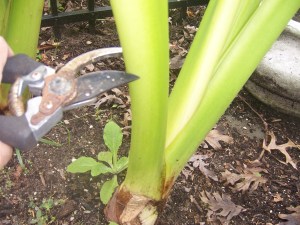 Step 1: The first thing to do is cut back the stems. I try to leave about 8″ to 10″ of stem. No matter how many times I have done this, I always feel a little guilty because the leaves have reached their fullest. But, alas, all good things must come to an end. Do not be surprised if there is a gush of water that pours from the stalk after you make your cut.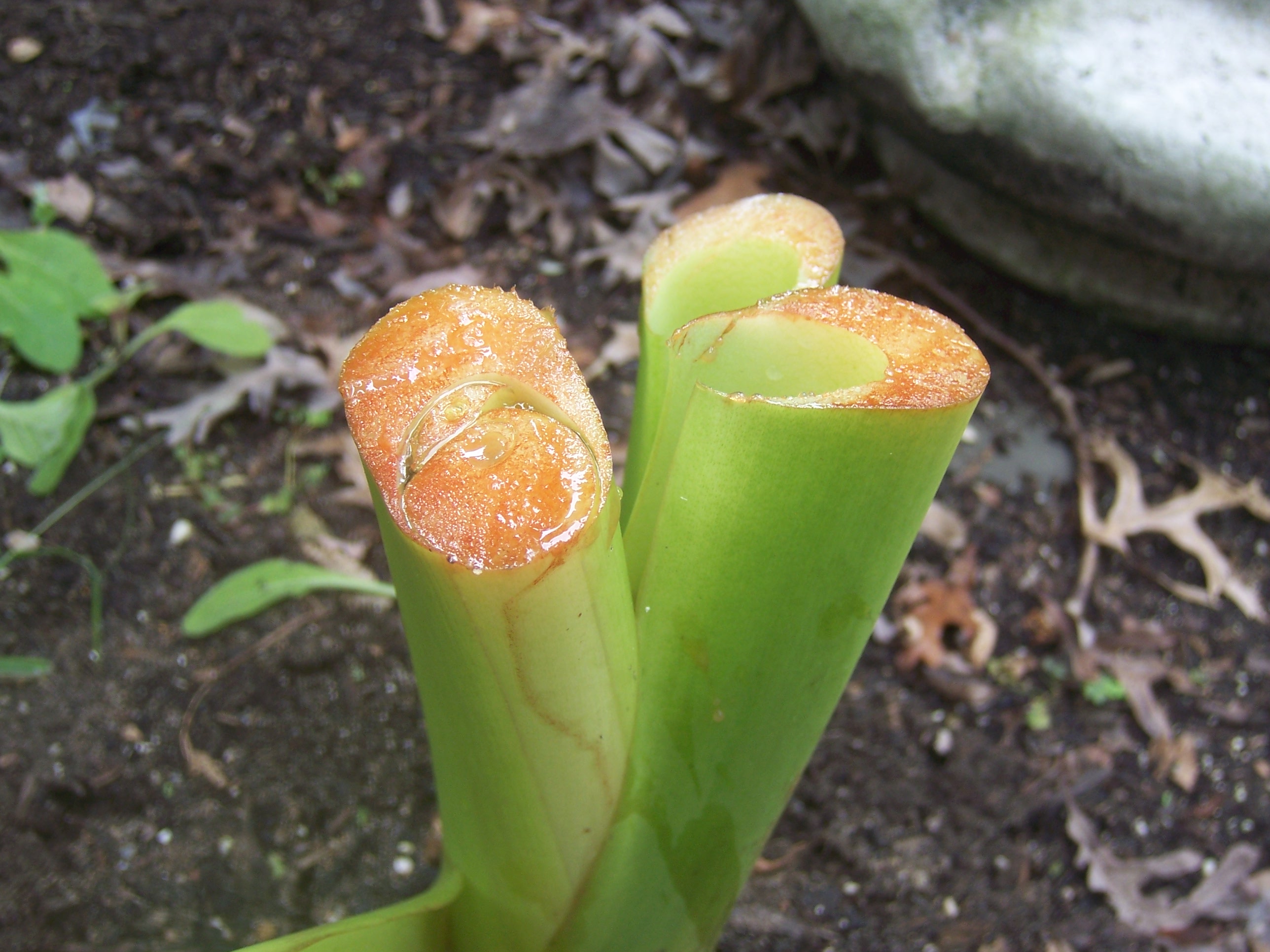





 Nitty Gritty Dirt Man