Wordless Wednesday: Under The Rainbow


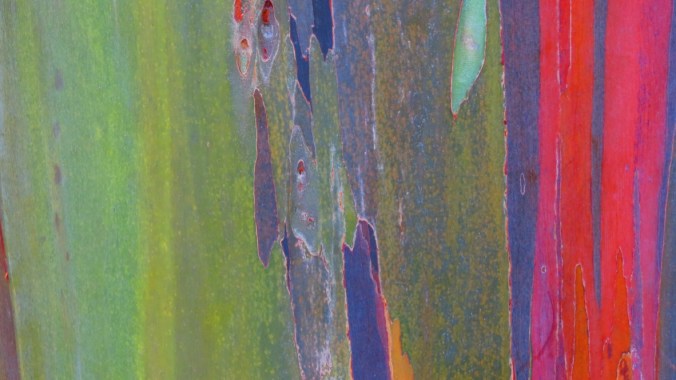
Rainbow Eucalyptus

When it was first founded decades ago, Eucalyptus Gardens, a property in Wilton Manors, FL, was a full-scale nursery. The business eventually folded, and the land fell into disuse.

In recent years, though, some enterprising entrepreneurs have attempted to repurpose the space as a neighborly gathering place for dining and coffee and shopping.

Continue reading

The Ghost Of Spring Present


Bougainvillea

At last, I’m able to sit down and concentrate on part two of my south Florida spring post. You see, for the past week or so, numerous northern friends have traveled south for spring break so they can get a taste of northern summer.

Such is the state of spring in the Sunshine State. Even as I write this, the outdoor thermometer reads 90 degrees in the shade.

Still, my Florida gardening friends have assured me — on more than one occasion — that there are, in fact, subtle signs of spring in zone 10, and if I want to see them, I have to know where to look.

Continue reading

The Ghost Of Spring Past


Hyacinth

I’m not sure when I fell in love with spring, but I have a feeling it began at birth. I’m an April baby, so for all of my life, I anticipated the season with excitement.

Continue reading

Bloomin’ Update 56: Going Bananas!


Banana

Ever since Joe first noticed the flower stem emerging from the crown of our banana tree, I’ve been singing the song “Going Bananas.” Madonna sang it during her Dick Tracey years and it pops into my head whenever I walk by the tree and observe the changes in the inflorescence.

Actually, I don’t even know the words — just the chorus, and even that’s a bit shaky. So all I really ever sing is “I’m going bananas” and then I add a few la-la-las and a couple of boom-chick-a-booms.

Simply put, I’m going bananas because I’m growing bananas.

Banana

Within a few days, the flower stem is pulled downward by the weight of the inflorescence, so that it’s peeking below the dark green foliage and looking a lot like the Audrey II from Little Shop of Horrors.

Banana Fact: This flower stem is actually the plant’s true stem, growing from the rhizome below the ground and pushing its way upward through the false stem or pseudostem, a very fibrous, water-filled stem of tightly packed leaf sheaths.

As it grows, modified leaves or bracts curl back to reveal rows of young fruit.

Banana

Each of these are tipped with a pale yellow female flower. The male flowers are contained in the reddish-brown bud at the end of the flower stem.

Banana

Soon, more and more bananas are revealed. Each bunch is called a hand, and each single banana is called a finger.

Banana Fact: Each hand can have between 10 and 20 fingers.

Banana

I’m so enamored of the plant’s structure, I find myself wanting to photograph it each day.

Banana Fact: because they are derived from a single flower with more than one ovary, bananas — like tomatoes, kiwi, and pomegranates — are berries.

Banana

Banana

The pale yellow flowers begin to fade.

Banana Fact: A banana plant is actually classified as a perennial herb.

Banana

Banana

And all that’s left for me to do is wait for the harvest.  (Notice the smaller male flowers at the bottom of the photo below.)

Banana

Banana

I’m not exactly sure when that harvest will be. All I know is the flower stem will continue to elongate, creating more space between the hands. At some point after that, it will be time to not only remove the fruit, but also the plant itself to make room for the pup that’s already sprouting next to the mother plant.

Banana Fact: Until then, rest assured, I’ll be going bananas.

Sowing The Seeds Of Love


Canna Belgium 2 copy

Again.

Like many of you, I’ve been thinking of Belgium, the residents of Brussels, and those who were struck down by violence.

Again.

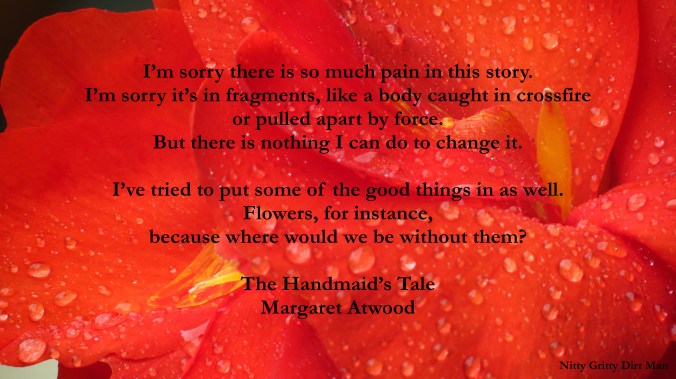
And it’s during these moments when I want to stay in my garden, to bury my hands in soil, to tend to chores, to think, to make sense out of something senseless, to contemplate. I think that’s a big reason why Margaret Atwood’s quote from The Handmaid’s Tale resonates with me.

Where would we be without flowers?

So into the garden I went . . .
Brussels

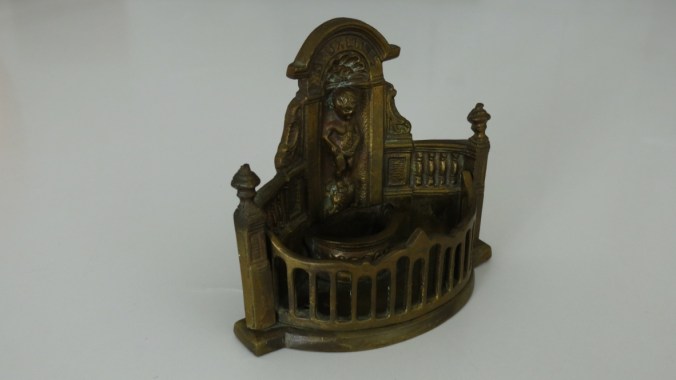
I thought of this small souvenir from Brussels. It belonged to my grandmother for as long as I can remember, one of the tchotchkes on the dresser in my great-grandmother’s bedroom — an odd little metal statue of a small boy urinating.

This is Manneken Pis.

The legend, according to my grandmother, involved a young prince who had gone missing.  His father, the king, swore that if his son were found, he would build a statue to commemorate the moment of his discovery.  And this is how the boy was found.

As a small boy myself, I probably giggled at the story — but that was the story my grandmother told and she was sticking to it.

After the death of my great-grandmother, the small statue stayed where it had always been, on her dresser in her bedroom. When my grandmother sold her house in Queens, NY, and moved to Long Island, Manneken Pis came with her. And after her death, I placed it in a cabinet in my home. It’s now with me in Florida.

When Joe and I visited Brussels about 20 years ago, I was determined to meet the statue with whom I had grown up. On a rainy evening, we found him — a small statue in a tight corner of some twisting streets, still urinating after all these years.  (The umbrella is for the rain — not any other spray!)

Brussels

Although there are many legends surrounding the real statue, one thing is for certain: it’s synonymous not only with Brussels, but with all of Belgium. The real statue is dressed up for various events and has hundreds of outfits — and in recent days, the small boy has helped rally the Belgian people together, his steady stream an indicator of how they feel about terrorism. You can learn more on the CNN website.

According to my father, the souvenir first arrived in my grandmother’s house in the mid- to late-1940s, a gift from two people who’s story is as legendary as that of the statue itself.

During World War II, my grandfather’s cousin was stationed in Belgium, a cook in the kitchen of a US army unit. While there, a young, attractive Belgian woman helped him. They spoke — she told him of her family and their experiences while under Nazi control and of how they were managing as the war rolled to an end. He would pass along food to her so she could feed her family.

Love bloomed in the most hardscrabble of soils. They eventually married, and he brought her to the United States, where they made a life for themselves and raised a family.

As I puttered about the yard, weeding and pruning, it occurred to me: gardening can be hard work.  Being human can be hard work.  Finding the best of times in the worst of times can be hard work.

No matter if it’s an actual garden, a relationship, a community, a nation, a world — there is always work to be done. Seeds need to be sown, plants need our constant attention, and soil needs to be improved.

I know it’s easier said than done, but as gardeners, we must. As human beings, we must. If we don’t, we’ll have a world without flowers . . .

And where would we be without flowers?


Speaking of flowers, where would Belgium be without them?
Brussels

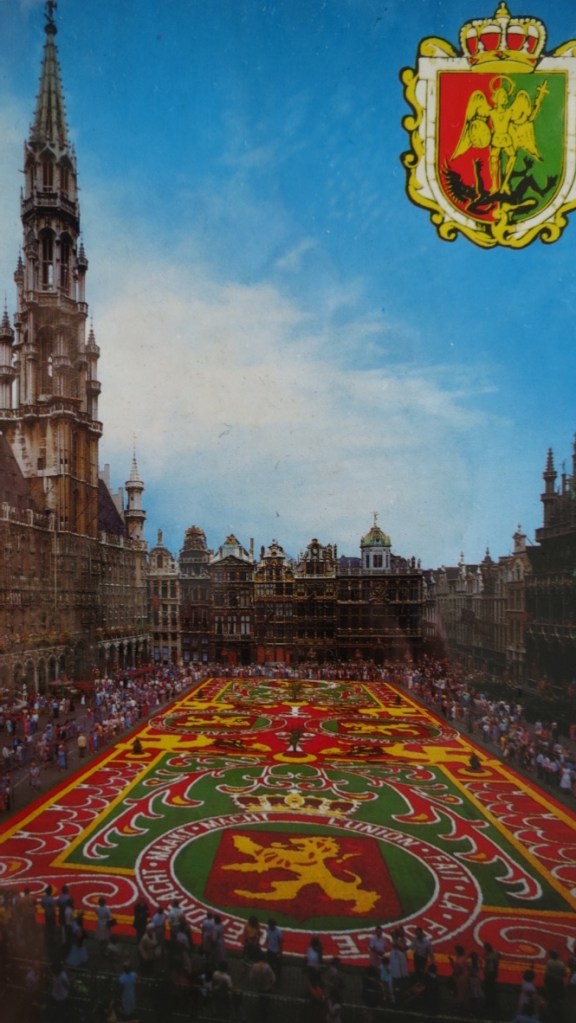
This is a postcard that I purchased while traveling through Belgium all those years ago. It’s an image of the Flower Carpet of Brussels. Every two years, 100 volunteers spend four hours creating the carpet, using thousands and thousands of Begonia Tuberosa Grandiflora.

As chance would have it, the next carpet will be on display this August 12 to 15th — and after recent events, I’m sure the Belgian people will make it all the more special.

Aloe, ‘ow Are You?


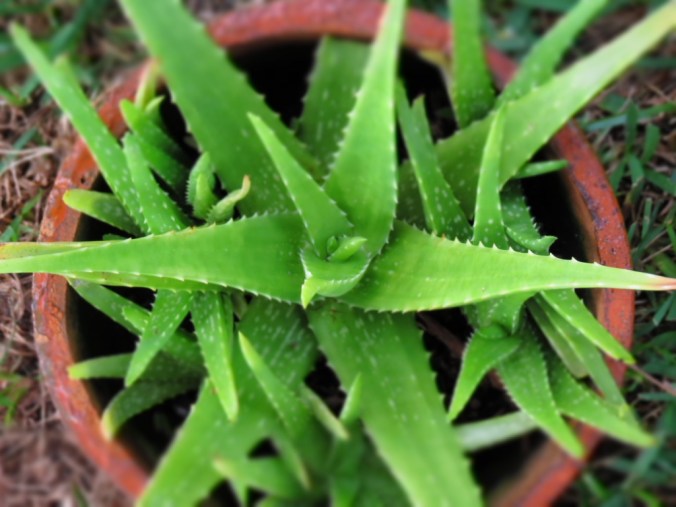
Aloe

I always wanted to be a deejay. When I was younger, I had two turntables, a mixer, and crates and crates of vinyl records.

There was one small problem, though.  I never wanted to get fingerprints or scratches on any of the records — which was why my vinyl collection remained in pristine condition, and the only deejaying was in my own mind.

Still, when it comes to thinking up headlines for posts, I often turn to music for inspiration — and this post about my aloe was no different. I began with “Aloe, I Love You,” courtesy of The Doors — because, I do love this plant.

Mine was a gift from Joe’s sister, Donna. She gave it to me years and years ago — and for those years and years, it was a typical northern houseplant, a solitary presence in a clay pot, brought outside in summer and over-wintered indoors.

I was thrilled to have an aloe — practical and beautiful, medicinal and magical. Each day seems to bring about new wondrous uses for the gel inside each of its pointy, succulent leaves.

The problem is that snapping off an aloe leaf to soothe a burn or an abrasion was never my first thought. No, I’d rather run for a bandage or even a store-bought “aloe” lotion than risk damaging the plant.

It was my deejaying debacle all over again — although this time I knew my being a gardener wasn’t an imaginary mind game. I just didn’t want to take advantage of a plant. I wanted it to be pristine.

But something exciting happened after bringing the aloe to Florida, where this houseplant could stay out all year long. Of course, there was the initial shock, but in time, the green became more vibrant and smaller aloes began to pop up all around the mother plant.

Aloe

My clay pot for one had become my clay pot for many, and I wondered: Is this what aloe is supposed to do?  It actually makes more plants on its own?

Then, Adele arrived with this lyric, “Hello, from the other side” — and I began to contemplate what was happening beneath the soil of said clay pot. In other words: Aloe, from the underside.

Aloe

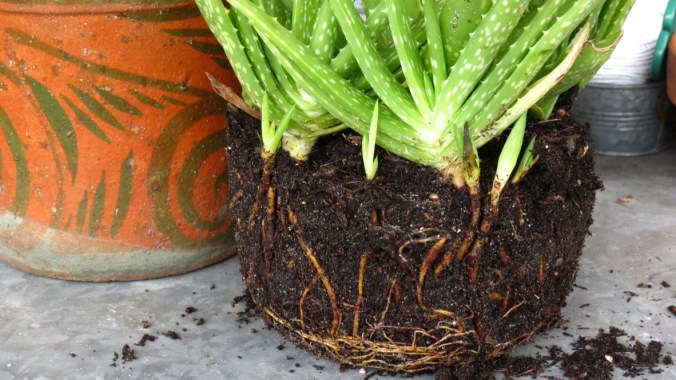
Just like removing a vinyl disc from its sleeve, I gently tapped the aloe from the only home it has ever known. And just like holding a record by its edges and turning it over to examine it for any imperfections, I observed and marveled at what was hidden by the clay pot.

The houseplant I had always counted on to be a solo artist was more like a member of a band.   Once unpotted, the lead singer — for want of a better term — had developed a lengthy root system, each one traveling in a circle to match the shape of the clay pot.

Aloe

It’s at this point that all record and deejaying analogies come to an end. While I may be a deejay in my mind, in reality, I’m a gardener —- and unlike my treatment of vinyl, I wanted to scratch at the soil, to separate the roots and smaller plants a bit, to clip and cut and leave my mark.

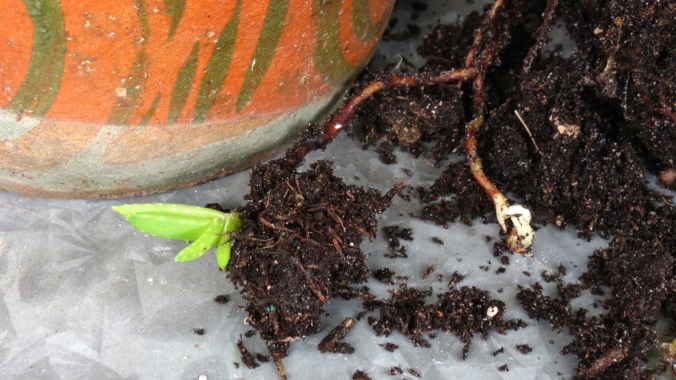
As I began, I first noticed that the thicker roots were actually runners, some of them ending with a small aloe plant — and each of these had its own set of roots and runners.

Aloe

Aloe

The larger of the small aloes were easily separated from the main plant, but the smaller ones needed some clipping.

Aloe

Aloe

Aloe

I lined up pots of all sizes, as well as some hollowed out coconuts, for planting — so that each of the aloes could be a star in their own right — and, in time, fill out and make more plants.

Aloe

Aloe

The aloe that started it all was returned to its clay pot, now a bit roomier, so that it too could once again produce more plants.

Aloe

At the end of the day, when it came time to reflect on what I had learned about aloe propagation and a headline, it seemed to make sense to name this post: “Aloe, ‘ow are you?” It’s really the question I asked myself — with a cockney accent, because a name like aloe kind of begs for that — whenever I looked at the clay pot filled with plants.

That being said, it’s time to bring my tale of aloe to a close — and in the sort-of words written by John Lennon and Paul McCartney: “You say goodbye, and I say aloe.”

Field Trip: Morikami, Part II


Morikami

When I look at a garden — any garden — I find myself looking at it from two perspectives.

Continue reading

Field Trip: Morikami Museum & Japanese Gardens


Morikami Gardens

Recently, I was researching quotes from some of my favorite novels, for no other reason than to post them on my personal Facebook page. I was looking for some inspiring words, the kind that resonated with me, the kind that I could share with others.

Continue reading

A Streetcar Named Dracaena


Dracaena fragrans

“Oh, look,” whispered the sweetest of voices on the slightest of breezes each night when I stepped outside. “We have created enchantment here.”

I thought I was alone, but the powdery scent of perfume had me thinking otherwise. The voice was quite feminine, I imagined, and absolutely southern — dripping with refined charm and long, slow vowels.

Continue reading

Bloomin’ Update 55: Flapjacks For A Sunday Morning


Kalanchoe Flapjacks

There’s something special about Sunday mornings. It’s a time that’s built for reading each section of the newspaper, undertaking the crossword puzzle, and lingering over a breakfast that’s a bit more intricate than an eat-and-run weekday meal.  It’s a moment to pause and breathe.

For today’s Sunday breakfast, I’m serving up some flapjacks.

Continue reading