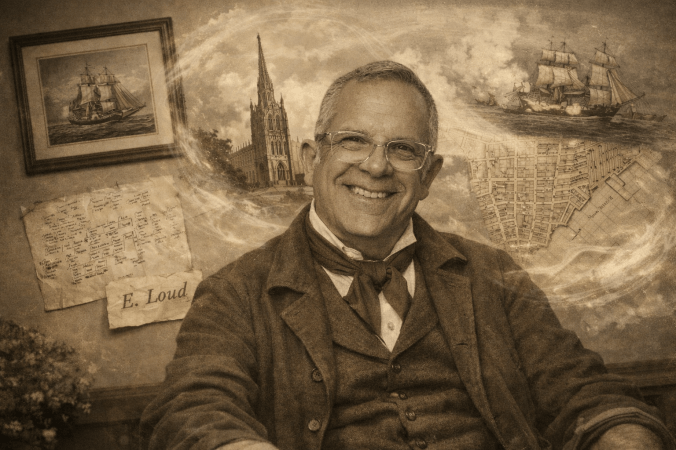
On a mid-summer day in 1755, Jean-Baptiste Guillot, my 7th great-grandfather, looked around him, at the land he farmed and the home he built. He was a proud and content Acadian, living in Ile Saint-Jean, a small Canadian maritime community.
This was the only life he had ever known, since he had been born in Cobequid on nearby Acadia, a French colony first settled in the early 1600s by people eager to escape the religious wars of Europe and the hardships of feudal life and the poverty they brought. Jean-Baptiste still had a difficult time calling it Nova Scotia, the name the English gave to it when they gained control in 1713, as part of the Treaty of Utrecht.
His father, Rene Guillot, my 8th great-grandfather, arrived before 1719, but it was those earlier arrivals that had to make their way in a land of brutal winters, dense pine forests, and rocky coastlines. Fortunately, a local native tribe, the Mi’kmaqs, taught them to hunt, fish, and forage in their new home.
Through determination, the early Acadians survived. They were even able to adapt their European farming techniques to convert saltwater marshes into fertile land. In time, their crops sustained the growing Acadian population and the settlers were able to establish trade routes. Over generations, the Acadians maintained a peaceful and cooperative relationship with their native neighbors, shunned a racial hierarchy, refused to establish a military, and governed through general election assemblies.
It was a peaceful existence, thought Jean-Baptiste, as he remembered the day when he arrived in Ile Saint-Jean with his wife, Marie Madeleine, and their three children, Charles Olivier (my 6th great-grandfather), Elizabeth, and Marie Josephe. Because of their isolated existence, the Acadians had truly become their own entity — culturally, politically, and even genetically.
That was five years ago, and a lot had happened – some bad, some good — in Jean-Baptiste’s life. His wife, Marie Madeleine, died suddenly in 1752, just two years after arriving in Ile Saint-Jean, leaving Jean-Baptiste to raise three small children alone. At the time, the oldest, Charles Olivier, was 10. Now, in 1755, he was married again, to Marguerite, and they had recently welcomed a son, Thomas.
Despite peace at home, there was always tension in the world beyond Ile Saint-Jean, specifically between England and France. At present, the two superpowers were engaged in the French and Indian War, but the Acadians had been walking a tightrope of neutrality. By now, with the British in control of Nova Scotia, they doubted the loyalty of the Acadians.
By summer’s end in 1755, the British had increased the English population of Nova Scotia, and tension between the Protestants and Acadian Catholics was increasing. Very often, new English arrivals were jealous of the fertile tracts of land the Acadians had farmed over generations. To address new tensions with France, the English proposed an unconditional oath of loyalty to George II, grandfather of George III of the American Revolution. Some Acadians took the oath, while others fled to Quebec and Ile Saint-Jean. The majority, though, refused to take such an oath, for religious reasons, as well as for their reluctance to fight the French and their native friends, many of whom had married into their Acadian families.
The British response was swift and brutal. Acadian refugees arrived by boat to Ile Saint-Jean, and Jean-Baptiste, along with other settlers, gathered around them to hear their tales of terror at the hands of the English.
The response from the English was swift and brutal, those who escaped said. The men — husbands and sons — were locked inside the Catholic church, while the women were prevented from entering. The British colonel announced to the men that their lands and livestock now belonged to the Crown. At the same time, the English had started torching the Acadian homes.
As cruel and devastating as this was, the Acadians were then forcibly brought to the harbor and pushed onto English ship – men on one ship, women on another, and children on yet another. The ships were intentionally overloaded and undersupplied — and then sent to separate ports throughout the English colonies in America and the Caribbean, as well as to England and France. Many starved to death, especially as ports refused the refugees entrance and the ships sat there until legal matters could be addressed. The English policy was simple and cruel — the more refugees that died, the less that had to be re-settled.
Jean-Baptiste and his neighbors were horrified to hear of what is now known as Le Grande Derangement, the Grand Expulsion. In today’s terms, it was the first wave of England’s ethnic cleansing of Acadian culture.
For the next several years, life in Ile Saint-Jean managed to carry on. Despite the political tension, crops were planted and harvested, and Jean-Baptiste and Marguerite had two more children, a son and a daughter. Then came word that the English had won another victory, seizing Ile Saint-Jean and renaming it Prince Edward Island. By November 1758, the second wave of Le Grande Derangement reached the Guillot’s doorstep.
The weather was overcast and gray, wind whipping small drops of rain and sleet, when British soldiers did exactly as the refugees from 1755 had described. The Guillots, Jean-Baptiste and his wife and six children, ranging in age from 12 to less than 1, were pulled from their home, which was then set ablaze, and they were marched to the harbor and placed on one of 15 ships. Fortunately, in this wave, families remained together.
Jean-Baptiste, looking at the scene before him, saw cousins and friends, people he had known his whole life, forced onto other ships by armed Red Coats. Hundreds of Acadians were loaded onto each ship. At this point, the English had stopped deporting Acadians to its American and Caribbean colonies, so this fleet was set to make a winter crossing of the North Atlantic to France.
Winter storms, rough seas, and strong winds doomed the voyage before it was fully underway. Several of the ships sank, while others were blown off course and away from the group. Below deck, the Guillots – like the Acadians on the other ships –huddled together in cramped quarters, as the ships rose and plunged with each storm-driven wave.
Illnesses, like dysentery and small pox , complicated by hunger and dehydration, spread through the Acadian refugees packed into the holds of the ships. Death at sea was inevitable for many – including Jean-Baptiste (age 38), along with a daughter (Elizabeth, age 10) from his first wife and all three of his children (Thomas, age 3; Jean-Baptiste, age 2; Euphrosine, age 1) from his second wife.
By the time this ship, one of five, arrived at St. Malo on France’s Brittany coast, Charles Olivier Guillot, my 6th great-grandfather, emerged as a 12-year-old man. Both of his parents were now dead. He had watched his father and four of his siblings die on the voyage and then witnessed their bodies be thrown overboard.
On shore, Charles Olivier looked about, the other battered refugees, some looking as if they carried death with them, gathered on the quay. His stepmother, now widowed and without her own biological children, held the hand of Marie Josephe, his 8-year-old sister. Would Marguerite be able to care for him and Marie Josephe? Where would they live? What work would he do to provide for them?
Although it’s difficult to find answers to these questions, there is little doubt that hardships greeted the Acadians. In that first year in France, there was a spike in Acadian deaths, as more refugees succumbed to physical and emotional damage resulting from the voyage. In addition, local French-born citizens looked at the refugees with suspicion and scorn. It was difficult for the Acadians to find work, their living conditions were often poor and inadequate, and government assistance was meager, at best.
Still, Charles Olivier, along with his sister, Marie Josephe, and stepmother, Marguerite, managed to stay together and survive, settling in the village of Pleudihen, just outside of St. Malo.
In the blink of an eye, it was a November day in 1766, in the village of Trigavou, in Brittany. Charles Olivier Guillot, standing on the steps of the village church, looked back on the odyssey of his life. Somehow, he acknowledged, he had made it to 20 years of age and he was about to marry Madeleine Josephe Boudroux. Within 8 years of this event, he and Madeleine would have three sons, including my 5th great-grandfather, Jean-Michel, and a daughter.
By the time he was in his mid-30s, Charles Olivier was re-established in France, working as a carpenter – and he believed that this would be where he would live the remainder of his days, watching his children grow up, fall in love, and marry. Perhaps, he thought, he would be fortunate enough to be a grandfather… someday.
The Spanish government, though, had another plan. In 1785, needing settlers to act as a buffer between Spanish-controlled Louisiana and English-controlled territories to the east, Spain offered to fund Seven Ships to relocate Acadians to the bayous west of New Orleans.
Charles Olivier and Madeleine talked to one another, as well as to Acadian friends, family, and neighbors. This could be another chance to start fresh, a chance to reconnect with other Acadians who had already made it to Louisiana after Le Grande Derangement. Was the risk worth it, wondered Charles Olivier, since he was well aware of the risks he witnessed when he was 12.
On June 27, 1785, Charles Olivier, along with his wife and their four children, boarded Le St. Remi, the fourth of the Seven Ships, as Famille 26. This, he thought, felt much more auspicious than the last time he boarded a ship at the tips of British bayonets. Yes, he decided, this was better.
In just under three months, Le St. Remi arrived in New Orleans, and the Guillots disembarked. The family eventually settled in Bayou LaFourche, where Spain provided new arrivals with swampy land, livestock, and tools. Although some Spanish Catholics were suspicious of these foreign Catholics, the Acadians relied on skills that served them well for generations, working with enslaved Africans to learn how to live and work in this subtropical environment, as well as with native populations to learn how to fish. For many Acadians, it was a homecoming as they reunited with friends and family, built a community, and celebrated their culture.
Five years later, Charles Olivier looked around him, at the land he farmed and the home he built, just as his father, Jean-Baptiste had done 35 years earlier on Ile Saint-Jean. He was a proud and content Acadian, living in Louisiana, he thought. It may not be as perfect as his childhood on Ile Saint-Jean, but it was home.
Thank you for indulging me with this long ancestry post. I’m experimenting with how I’d like to write about my family’s history. I like the idea of making it read more like a story, rather than a recitation of dates and events. Let me know what you think.
I also wanted to share as much as I could for several reasons.
I knew nothing of the Acadian experience. In fact, I had never even heard of the Great Expulsion. When Ancestry conducted an update, I was notified that Acadia was another area of origin. I think that’s because many geneticists agree that after 150 years of isolated development, the Acadian genome was unique and far removed from its European origins.
My first clue of the Grand Expulsion was when I found Jean-Baptiste Guillot’s name on Find a Grave, and it was listed that he had died at sea. As I delved deeper and deeper, the scale and scope of Le Grande Derangement became too important to not share. Sadly, it all sounded familiar.
Naturally, it was difficult to not think of other instances of human cruelty: the slaughter of Native Americans, the Holocaust, the Rwandan genocide, the intentional targeting of civilians in Ukraine, and what has unfolded in Gaza and Israel. Of course, I also thought of what’s happening in the United States today, as immigrants – legal and otherwise, criminal and otherwise – are swept off of the streets, out of homes and from jobs, church, and immigration court… torn away from the protective arms of loved ones… and sent to detention centers around the world, often with little information provided to family members left behind.
One would think that after centuries of this, humans would somehow know better, would somehow understand the cost of trauma on individuals, especially on children. For a species that’s supposed to be so intelligent, we continue to be incredibly stupid and especially cruel. When will we ever learn?
My other reason for sharing as much as I possibly could was because I was struck by the sheer determination and strength of the Acadian people to survive and move forward.
I’m thinking of Marguerite Bourg. I know I don’t have any genetic connection with Jean-Baptiste Guillot’s second wife, but I remain stunned at the staggering amount of loss she suffered on the journey from Ile Saint-Jean to France… her husband, her three biological children, and one step-child all dying on the voyage, and once on land, having to remain strong to care for and raise her surviving step-children.
Marguerite carried on, remarrying in 1767, in France, and then giving birth to a daughter. The three of them boarded L’Amitie, the fifth of the Seven Ships, and arrived in New Orleans in November 1785.
I’m not convinced that this ability to move from ethnic cleansing to ethnic resilience is strictly an Acadian trait. Perhaps it’s something in the DNA of every life form… the will to survive and live. Maybe humans forget they have that capacity, maybe a piece of it is robbed from them each time they get knocked down… but I think it’s important to remember that we are often stronger than we ever give ourselves credit for. We need to always remember that.
Also, a word about my 8th great-grandfather, Rene Guillot… As of this writing, I don’t know when he was deported from Acadia. Some sources cite that he died at sea, while others have him dying once he reached St. Malo.
Finally, here’s a fun fact to bring this odyssey to a close. When the Acadians settled in Louisiana, they experienced another sweeping change, one that’s evident today.
When they arrived in Louisiana, the Acadians were warmly welcomed by the people already established there, the Creoles — a DNA stew of French, Spanish, African, and Native American ancestries. These neighbors dropped the first “A,” creating a new word: Cadiens. English speakers took it one step further, Anglicizing the word into Cajuns, thereby cementing Acadian culture with Louisiana.


