Part of my education process as a northern gardener living in southern Florida is trying to understand the subtle changes of the seasons. In a subtropical world, where seasons are marked as warm and hot, wet and dry, that is no easy task. Seasonal changes are much — MUCH — more subtle.
Field Trip: Key West Garden Club
Someone once said, “Good things come in small packages.” I may not be positive about who should get credit for the phrase, but I’m pretty sure he or she must have been referring to Key West.
Measuring just 7.4 square miles, there’s a lot crammed onto this legendary Florida paradise — from Ernest Hemingway’s house to Fantasy Fest to the Audubon House & Tropical Gardens to the daily sunsets, often met with a liquid toast.
Tucked away among the touristy attractions is one of the last free admissions on the island: the Key West Garden Club at West Martello Tower. Since 1955, the garden club, through strokes of luck and vision, dedication and hardwork in the tropical sun, transformed a Civil War-era fort into a walled garden filled with native and exotic trees and plants.
Field Trip: Audubon House & Tropical Gardens
Something strange happens to Florida as you drive toward the Keys. It begins to break apart.
At some point along US 1, the southern tip of the peninsula becomes a mosaic of land and water until it eventually becomes the Keys, a stretch of islands that geologists say are the visible portions of an ancient coral reef. A handful of these islands are linked together by a single highway — and the road leads to Key West.
Repost: Lessons Learned From A 9/11 Survivor
I think it’s safe to say that we all feel the world is falling apart. By now, we’ve been bombarded with news stories of crime and climate change, disrespect and disillusionment, violence and epidemics, extremism and fanaticism, terrorism and war. And now we have to come to grips with beheadings and crucifixions. Our 21st-century life has been turned back hundreds and hundreds of years.
At moments like this, I want to retreat into my garden. I feel safe there.
The sad truth, though, is that the world has always been a crazy place. Just look at the history that isn’t too far in the past. The Holocaust. JFK’s assassination. And MLK. And RFK. Son of Sam. AIDS. Oklahoma City. 9-11.
Yet, it is during these times of evil that so many people rise to the challenge to remind us that there is goodness in the world.
As we approach another September 11 anniversary, I would like to revisit a post that I wrote several years ago. It speaks of tremendous sadness, inspiration, and, most importantly, hope. Hang in there, everyone.
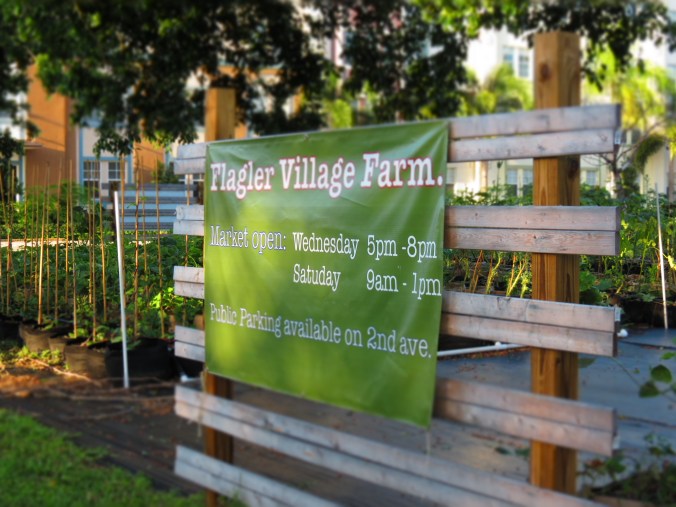
A Farm Grows In Fort Lauderdale
In the previous post, I mentioned that summer in South Florida was like living in a green desert: day after day of heat made hotter by oppressive humidity and afternoon downpours. It’s for these reasons that many gardeners retreat indoors, contenting themselves to look at their green world from behind glass.
Imagine my surprise — and delight — when I came across an oasis in the heart of Fort Lauderdale, a green space that was not only green but was still producing even in the blistering summer heat.
Feeling Hot, Hot, Hot
What’s wrong with me? In a few days, it will be Labor Day, the unofficial end of summer, and my inner New York clock is telling me that I should be able to smell the first hints of an approaching autumn. Here in south Florida, however, summer is still the name of the game.
As I realize how much time has passed since my last post, I am aware of how frustrated and edgy I’m feeling. It has been an incredibly long time since I truly gardened.
Daytime In The Garden Of Mom & Dad
I have to give credit where credit is due.
My parents were the first ones who introduced me to gardening. There were Mom’s rules about deadheading and weeding and Dad’s lessons on mowing and crop rotation — even if the farm was a tucked away corner of the yard.
Recently, I spent several days in my childhood home and lazed away summer afternoons in the backyard, where the slower pace was marked by the filling of bird feeders and the waiting and watching for feathered arrivals.
Field Trip: Lakeside Sand Pine Preserve
There was a time, not too long ago, when this part of South Florida — east of the Everglades and west of the Coast — was nothing but white sand, scrub vegetation, saw palmettos, and sand pines. Development and expansion, with all of its blacktop and gated communities and non-native plants, soon overran the place.
Fortunately, the city of Oakland Park thought to preserve this slice of Florida’s natural history with the Lakeside Sand Pine Preserve, a pristine 5.6-acre site nestled between two lakes. This location, in addition to the abundance of native plants, means the park is home to countless birds, anole lizards, and even gopher tortoises, an endangered species. It’s also a place where the community can come together — volunteers are responsible for the preserve’s upkeep.
I arrived at the preserve after a brief morning shower. As I stepped from my car, I was struck by the silence and solitude in a place that is literally just down the street and over the fence from the trappings of the modern world.
Confessions Of A Binge Gardener
Summertime in South Florida, I’m told, is not the best time to plant or to garden. Locals often cite the high heat and high humidity — which leads to an abundance of pests and mildews.
So while gardens — and gardeners — in this hot area cool off, I’ve spent the time researching plants, dreaming up garden plans, and binge-watching television series. “Breaking Bad.” Done. “Orange Is The New Black.” Check. “Downton Abbey.” Finito.
Everything was moving along nicely until “Downton” introduced a gardener into Violet Crawley’s world, and I found myself hoping for a larger storyline for the young fellow or — even better — a spin-off. “Downton Gardens,” perhaps?
Nevertheless, as I pondered the idea of beginning a gardening program for the inmates on “Orange,” it occurred to me that I had had my fill of fictional gardens. I missed real gardening. There was a burning inside of me — as feverish as those felt by any of Walter White’s meth heads — to dig in the dirt, plant seeds, and root clippings.
So the other day, I caved in to my cravings and embarked on a binge of my very own. A garden binge, if you will.
I had been eyeing this hibiscus in the neighbor’s yard, blooming in the gap between our two houses. Each day, I’d walk by and that flower would wink its stamen at me. And since I’ve been looking for a Florida plant to take the place of hydrangeas, I wondered if I could root hibiscus the same way I was able to root my favorite shrub in my northern garden.
Out came the clippers, some cell packs, a shovel, and the rooting hormone. I did my best to clip non-bud branches, and then removed the lower leaves. The clippings were immediately placed in water to keep the stems moist.
I had also prepared the cell packs with basic garden soil and made holes in the center of each. After dipping the stems in rooting hormone, I slipped them into the pre-made holes, careful to not loosen the powdery rooting hormone. This was followed with a gentle watering, and then the small plants were placed out of direct sunlight.
Once started, though, I couldn’t get enough. I had merely had a sip of gardening and I was still achingly thirsty.
From the corner of my eye, I spotted the neighbor’s croton, a shrub with brightly colored foliage. There are many varieties of the plant, but I’m always drawn to the thin, slightly-curled leaf kind, each branch sharing green and red mottled leaves.
I again used the same rooting technique, planting up four small cuttings.
Not quite sated, I thought to myself, “If only I could dig up an actual plant, an off-shoot from a mother plant.” I crouched and crawled across the ground, lifting branches and looking beneath, sending small anoles scurrying.
Eventually, I found two small Chinese fan palms (Livistona chinensis) that had sprouted from seeds at the base of the mother tree. In time, this palm, with tiny hooks along the stems of the fronds, will reach up to 50’. Because of its slow growing habit, however, it’s often used as an understory planting.
I found the jackpot at the base of a Sunshine palm (Veitchia montgomeryana). There, seven smaller palms — resembling tall blades of grass — had sprouted. I carefully pried each one up and gave them a pot of their own.
By the end of the day, my hands and fingernails caked with dirt, my clothes and forehead soaked with sweat, I took a look at all I had done to satisfy my gardening hunger. I had quite the tally: eight hibiscus, four crotons, two Chinese fan palms, and seven Sunshine palms.
At this point, I’m not sure if any of my treasures will survive — and if they do, I’m not sure if I’ll actually use them in the landscape or give them away. I don’t think I’d sell them, though. I’m not a plant pusher. I’m a binger.
A Box To Build A Dream On
A box arrived in the mail the other day — and this is the story of that box and all that it holds.
On Monday nights, I participate in a Twitter conversation called Garden Chat — a very large, hour-long cyber get-together with gardeners from all over. Usually someone hosts the chat, which means that person organizes a theme and related gardening questions. Those questions are tweeted and answered, and those answers are read and retweeted and favorited by all of the participants.
At the same time, there are smaller side conversations — sharing new flower and harvest photos, tweeting tips and words of encouragement, and, of course, laughing.
It’s not unusual for there to be a giveaway during these chats — simply leave a comment attached to the giveaway tweet and you’re entered. At the end of the chat, a winner is randomly selected and announced.