Saving Elephant Ears & Canna — Part 2


For the sake of saving time, I thought I would combine the final packing practice for Canna and Elephant Ears.  Besides, I don’t think I can actually type the words Canna and Elephant Ears one more time.

The process is pretty much the same for both plants.  You will need peat moss, some kind of storage container (like brown paper bags), a shovel, and a room that stays relatively dry and evenly cool so that the plants can be lulled into a deep sleep without freezing.  If the final storage location is too damp or warm, the plants never get a chance to rest and they are at risk of rotting away — and after so much work getting to this point, that would be a shame.

Step 1: Where Canna are concerned, I double up two brown paper bags and label the outside.  I then put a shovel or two of peat moss in the bottom of the bag so the corms have a nesting area.
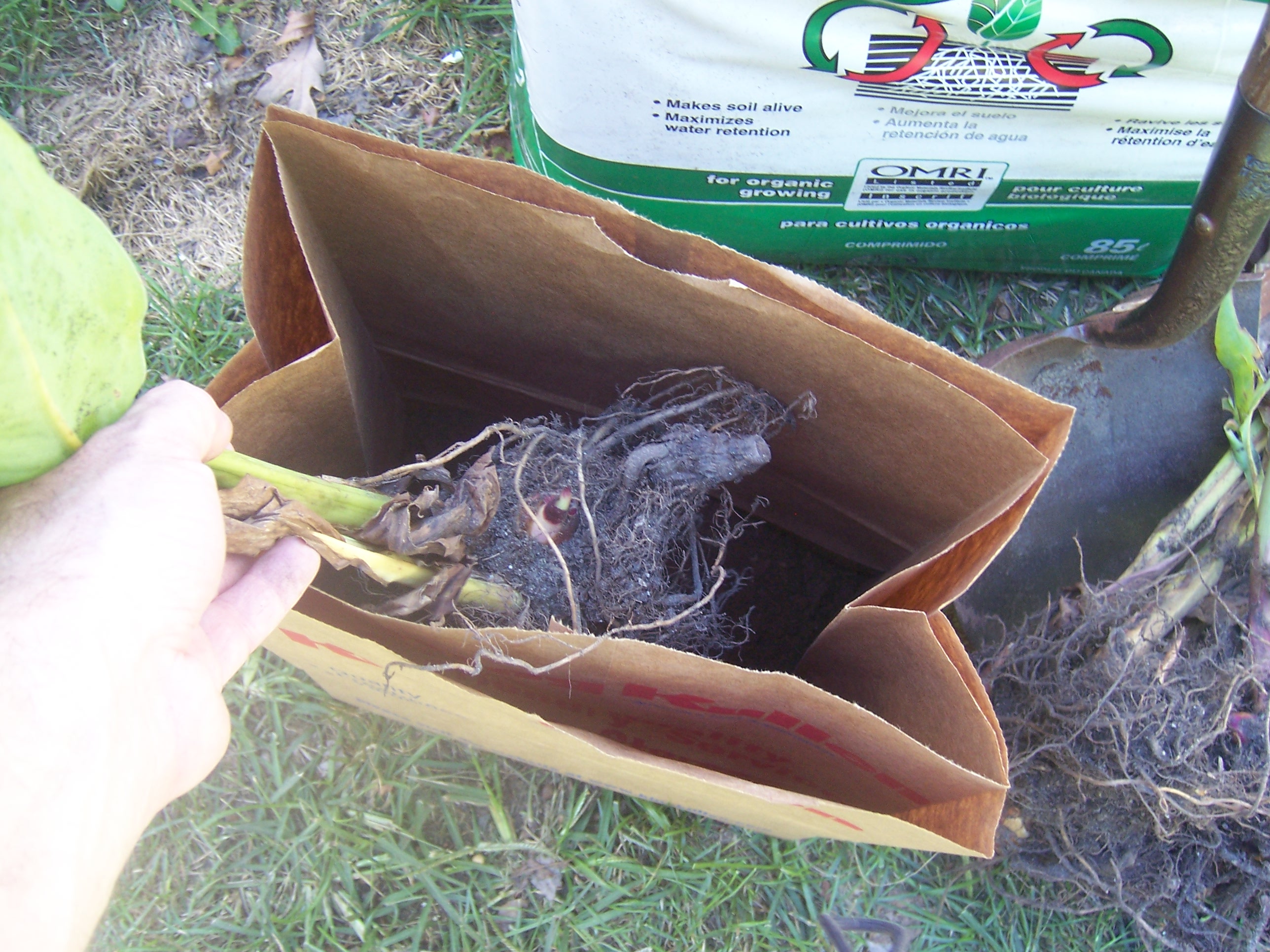
Step 2: I then place the corms (stem and all) into the bag.
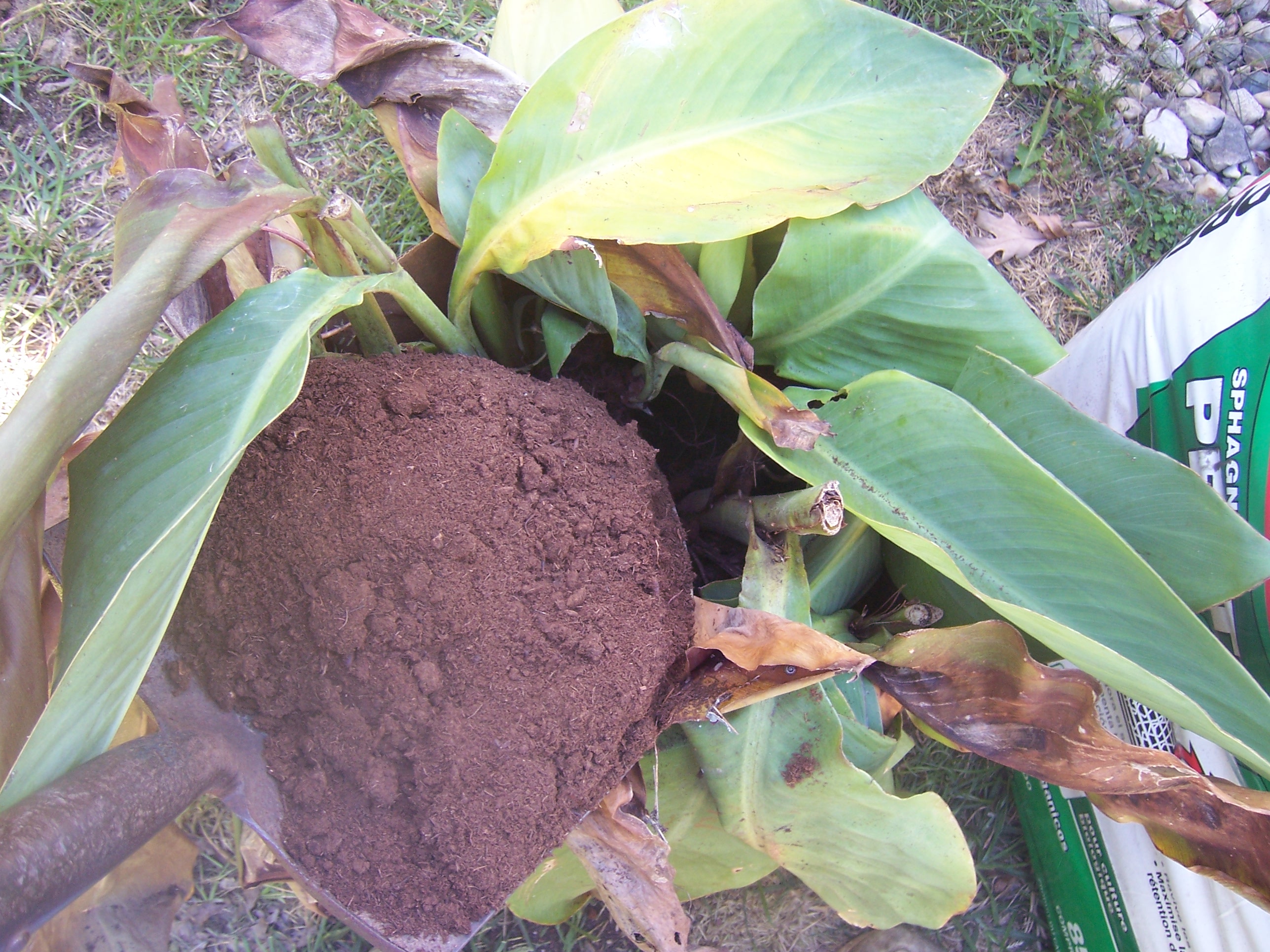
Step 3: I tend to really pack the bags.  I’m not sure if this is correct, but it’s likely that I do this for the sake of space, since I have so many corms to pack away.  Once the bag is full, I then add more peat moss to the bag, shaking the bag so that the peat moss settles and covers the corms.
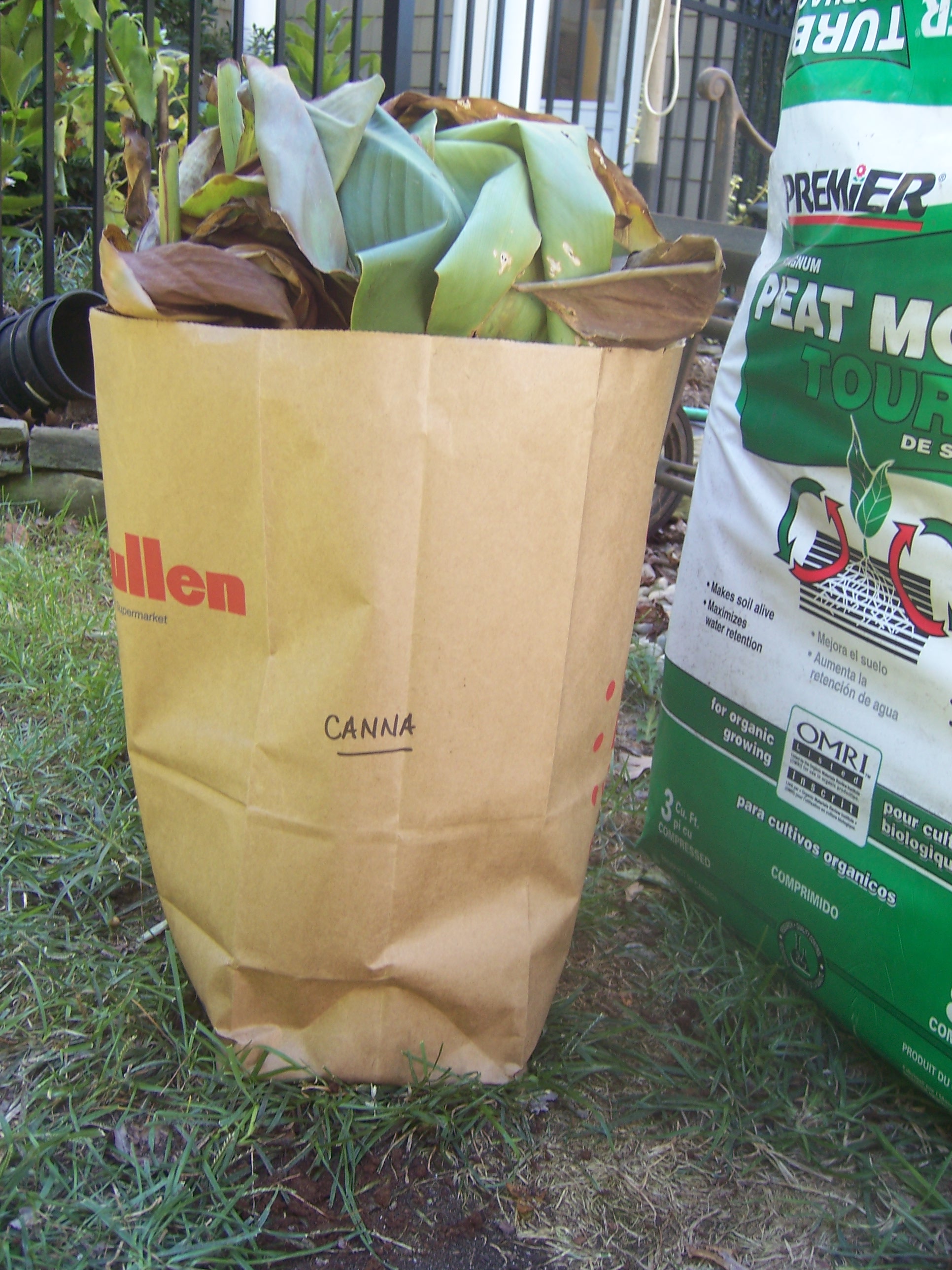
Step 4: Finally, I have something that looks like this.

Now for the Elephant Ears.  Last year, I stored the Elephant Ear bulbs in a plastic crate lined with a plastic bag.  I’m not sure if this had to do with my loss of energy and wanting to finish the task, needing to save space, or just running out of bags.  Either way, it worked.   By the way, don’t be surprised if your Elephant Ears have continued to grow since you dug them up.
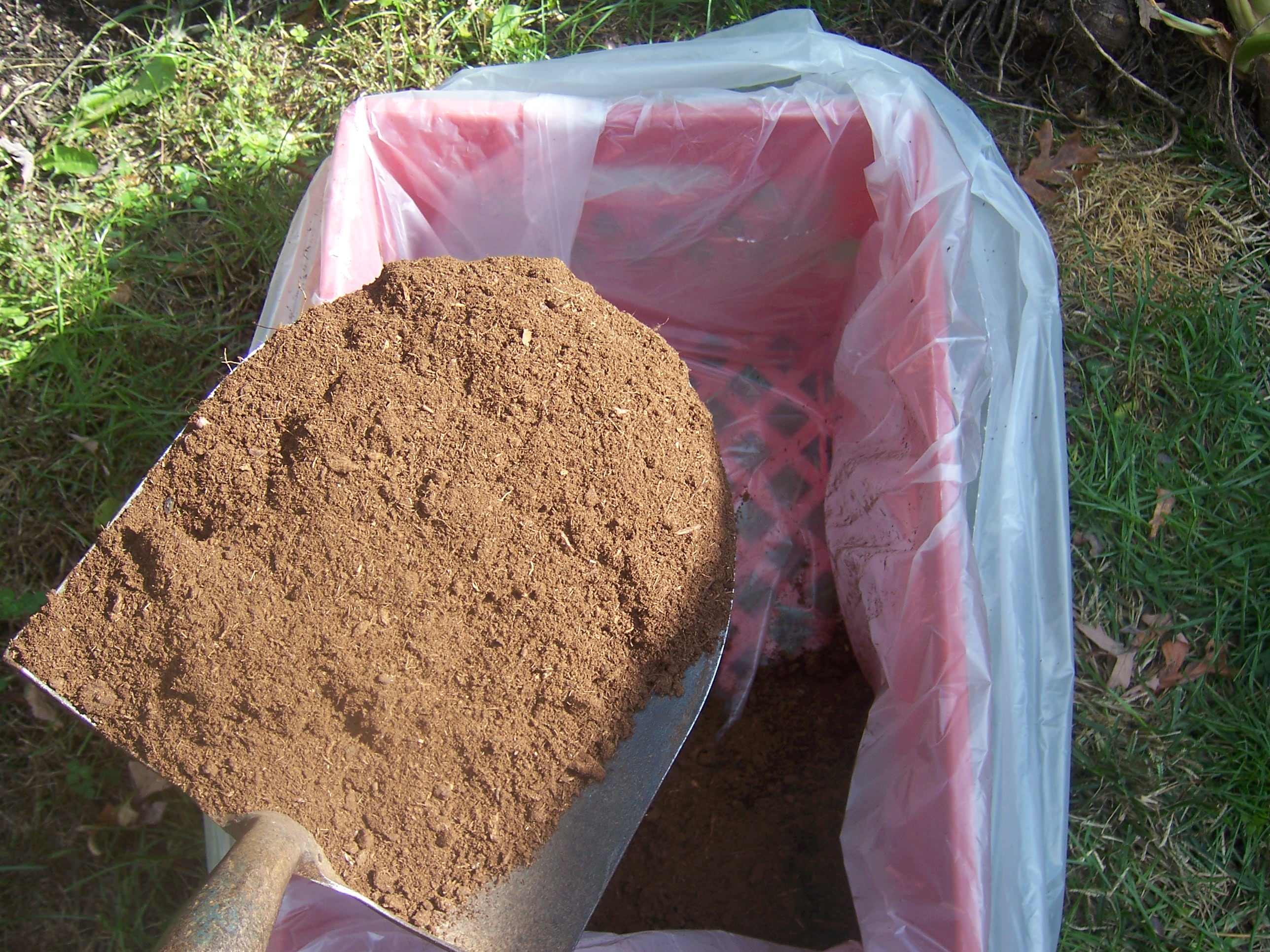
Step 1: Once the crate is lined with a plastic bag, add a few shovels of peat moss into it to give the bulbs a place to rest.
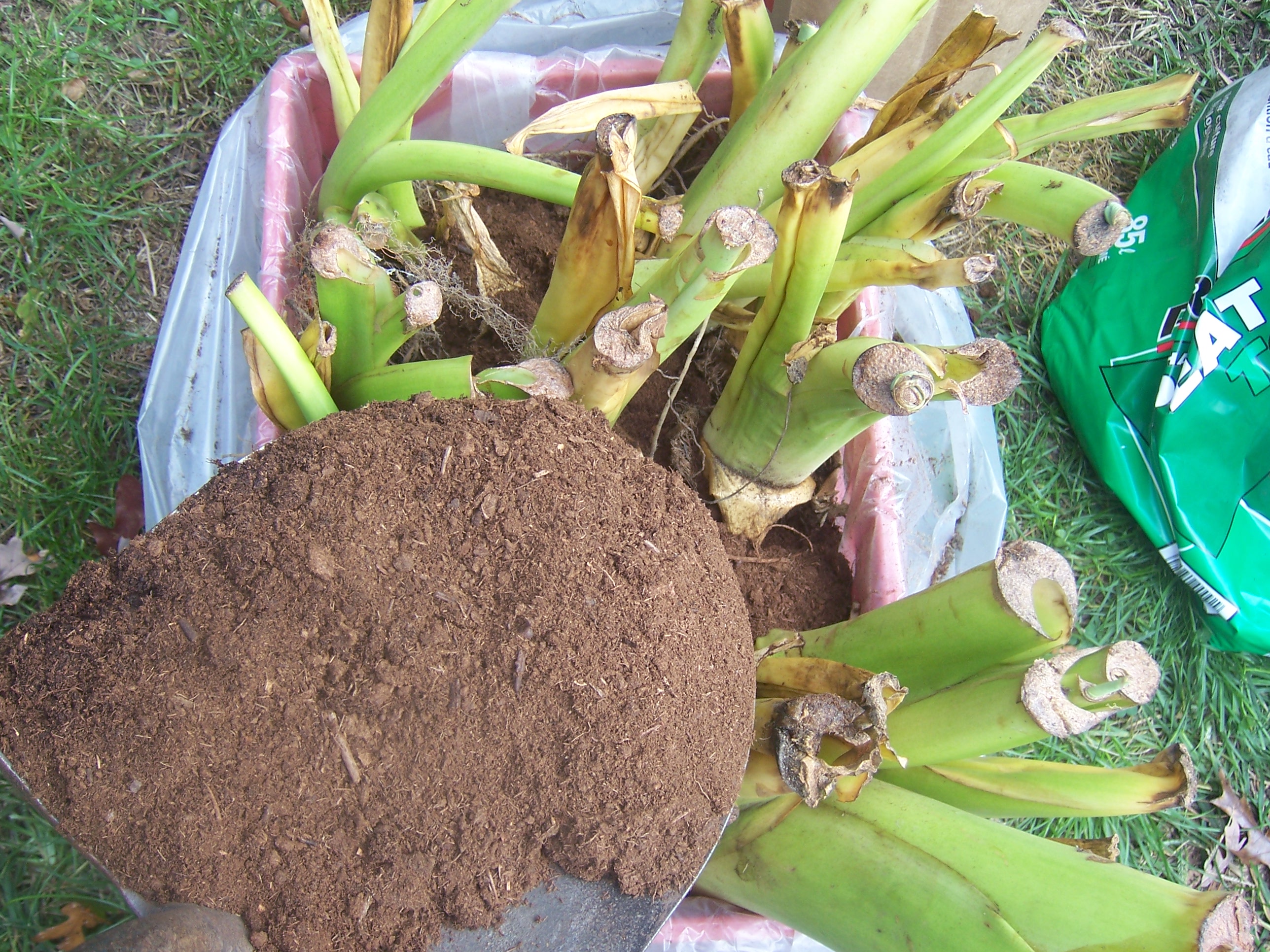
Step 2: Load the Elephant Ear bulbs (stem and all) into the peat moss-filled crate.  Again, I tend to pack a lot in there.  Then add peat moss to cover the bulbs.
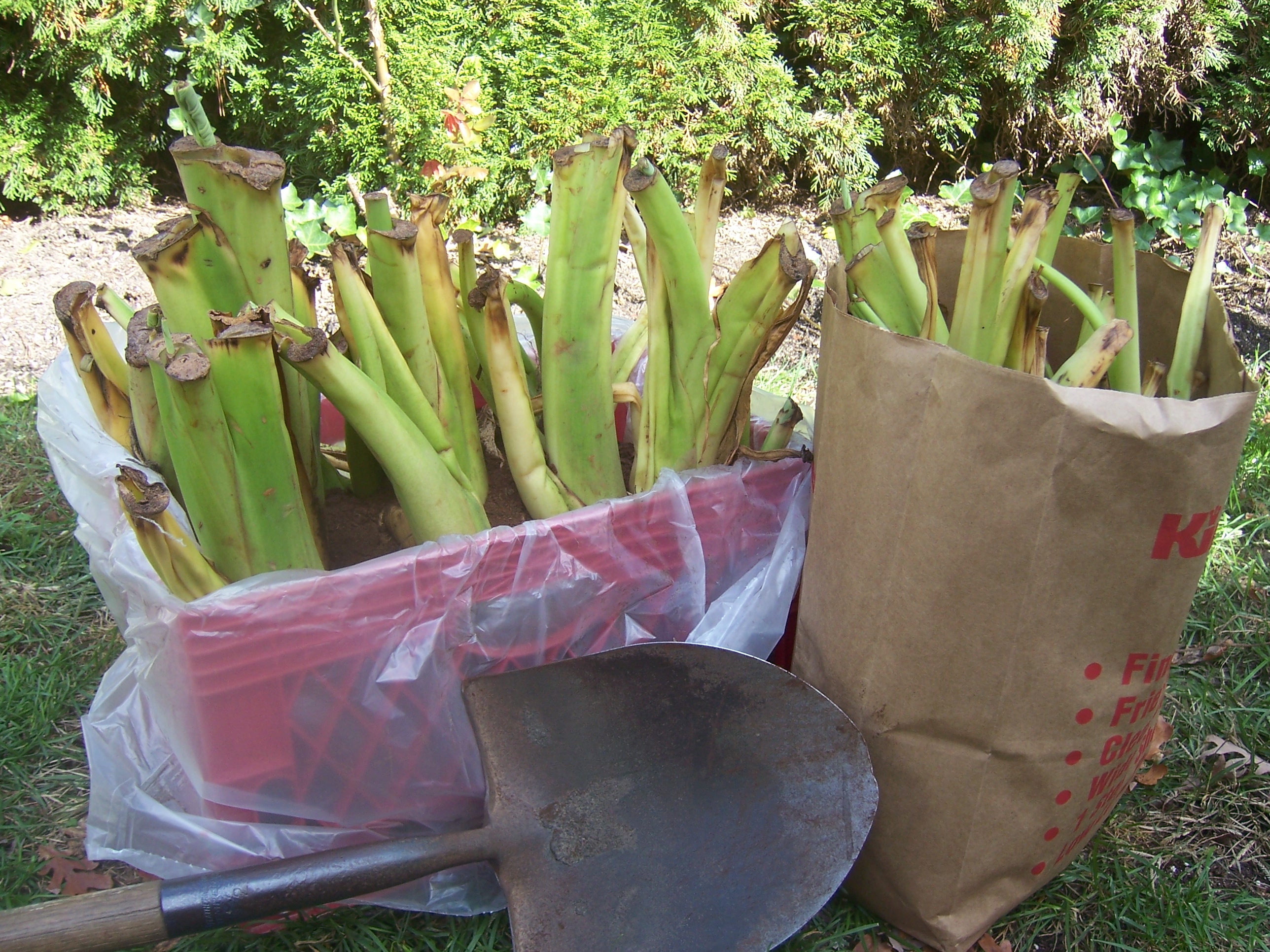
Step 3: Ultimately, this is what I am left with.  All that’s left to do now is carry everything into its Safe Room.

The Final Step: Here is the Safe Room — a cement bunker/bomb shelter hidden behind Joe’s  closet in the bedroom.  Now, anyone who knows me or who has read previous posts understands that I have an active imagination.  As my summer plants continue to live, enclosed behind the closet, my mind races back and forth between Edgar Allen Poe’s Fall of the House of Usher and the classic sci-fi film Invasion of the Body Snatchers.  So far, the Safe Room is protecting Joe and me.  So far. . .

Saving Canna — Part 1


Now that the Elephant Ears are out of the ground, it’s time to turn my attention to the Canna forest that is my yard.  The truth is, I never intended to have a Canna forest — things just got out of hand over the years as corms grew and became easy to divide, or I found new leaf patterns or bloom colors and I thought I needed to have three of each. 

I live in Zone 6 and I have tried to overwinter some Canna in the ground, but I have had no success.  I’ve mulched them and planted them along the south-facing side of the house, but to no avail.  So whether you have a few stalks or a forest, this is what you will need if you live in a northern climate and would like to save your Canna for future summers: garden clippers, shovel or pitchfork, stamina.

Step 1: For the sake of this demonstration, I dug the Canna first.  You could also trim the stalk and then dig out the corm.  Either way, pry up the plant, being careful to not damage the corm with your garden tool.


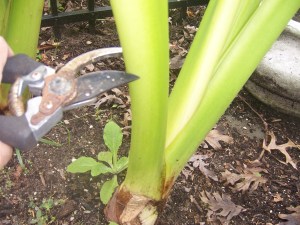
Step 2: Leave about 8″ – 10″ of stalk.  Actually, Canna can grow quite large, so for ease of trimming, it might make more sense to leave the corms in the ground, cut the stalks, and then dig out the plant.


Step 3: As sad as it is to do this job, there is a thrill each time I remove a corm from the ground.  See that white bulbous shape and the group of purple-tinged tips peaking through the roots?  That’s where next year’s growth will occur.  Ah — the promise of next year’s garden!  By the way, this is also a good time to remove any excess dirt.  Don’t divide the corms; that’s a task that’s safer to do in the spring when you unpack them from their hibernation location.     

Step 4: After the corms are out of the ground, I keep them in the potting shed for about a week.  The setting is warm enough for them to dry a bit before packing away, but not so hot that they cook.  Since I have several varieties, I group them in large plastic containers.  I also store them upside down — mostly because my gardening bible, Better Homes and Gardens Complete Guide to Gardening, recommends doing that.  I’m not sure of the reason, but I do as I’m told — and my gardening good book has never failed me. 

Next Post: Saving Elephant Ears and Saving Canna — Part 2.


Saving Elephant Ears — Part 1


With frost rapidly approaching, it’s time to remove my tender Elephant Ears and prepare them for winter storage.  My method is something that I have adapted over the years, and it’s based on what I’ve learned after saving dahlias and caladium.

What you will need: garden clippers, a pitchfork or shovel, old clothes, nerves of steel.

Step 1: The first thing to do is cut back the stems.  I try to leave about 8″ to 10″ of stem.  No matter how many times I have done this, I always feel a little guilty because the leaves have reached their fullest.  But, alas, all good things must come to an end.  Do not be surprised if there is a gush of water that pours from the stalk after you make your cut.
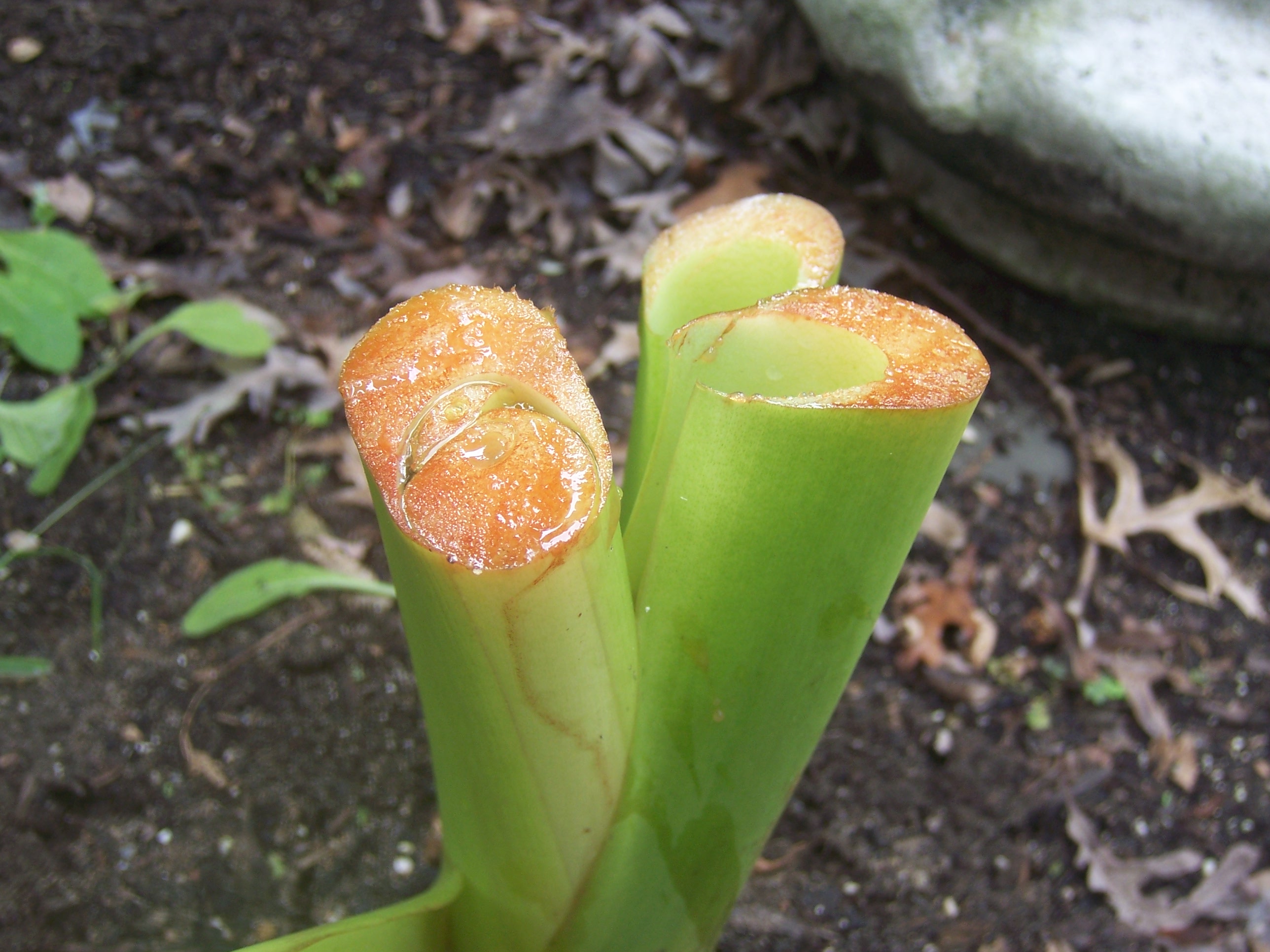
Step 2: After the stalks are cut, within minutes they begin to “bleed.”  If you decide to try this project, be sure to wear old clothes — the brown/red liquid will stain and it does not come out in the wash.  I learned this the hard way, and now I have my Elephant Ear cutting outfit.

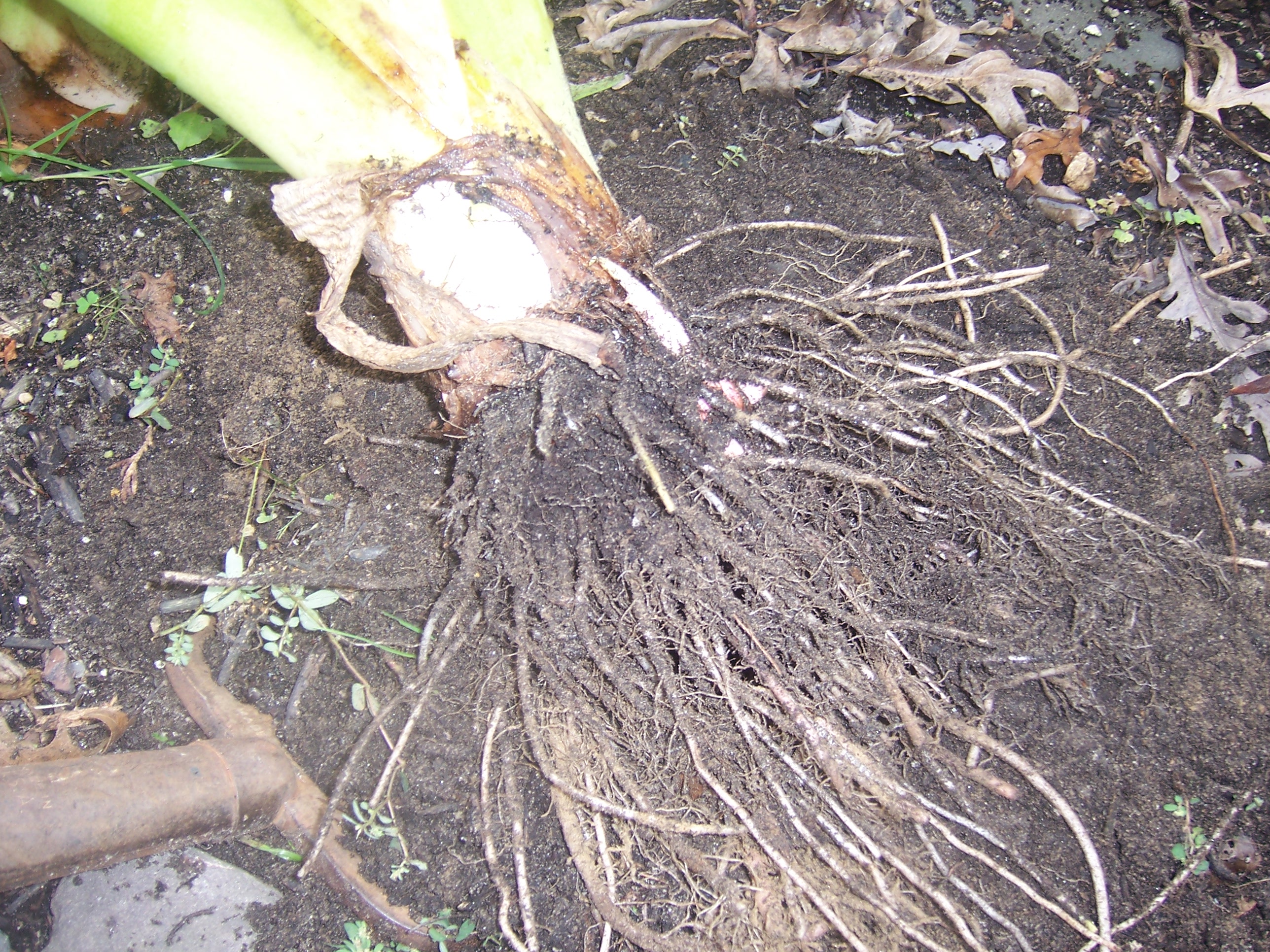
Step 3: Using the pitchfork, I carefully work in a circle, prying up the bulb.  Once it feels loose, I gently pull the base upward, revealing the bulb and the wild mass of roots.  At this point, I will shake off the excess dirt.  You may notice that your main bulb might have smaller bulbs attached.  Do not separate these at this time — that task will be much easier in the spring when you replant your bulb.

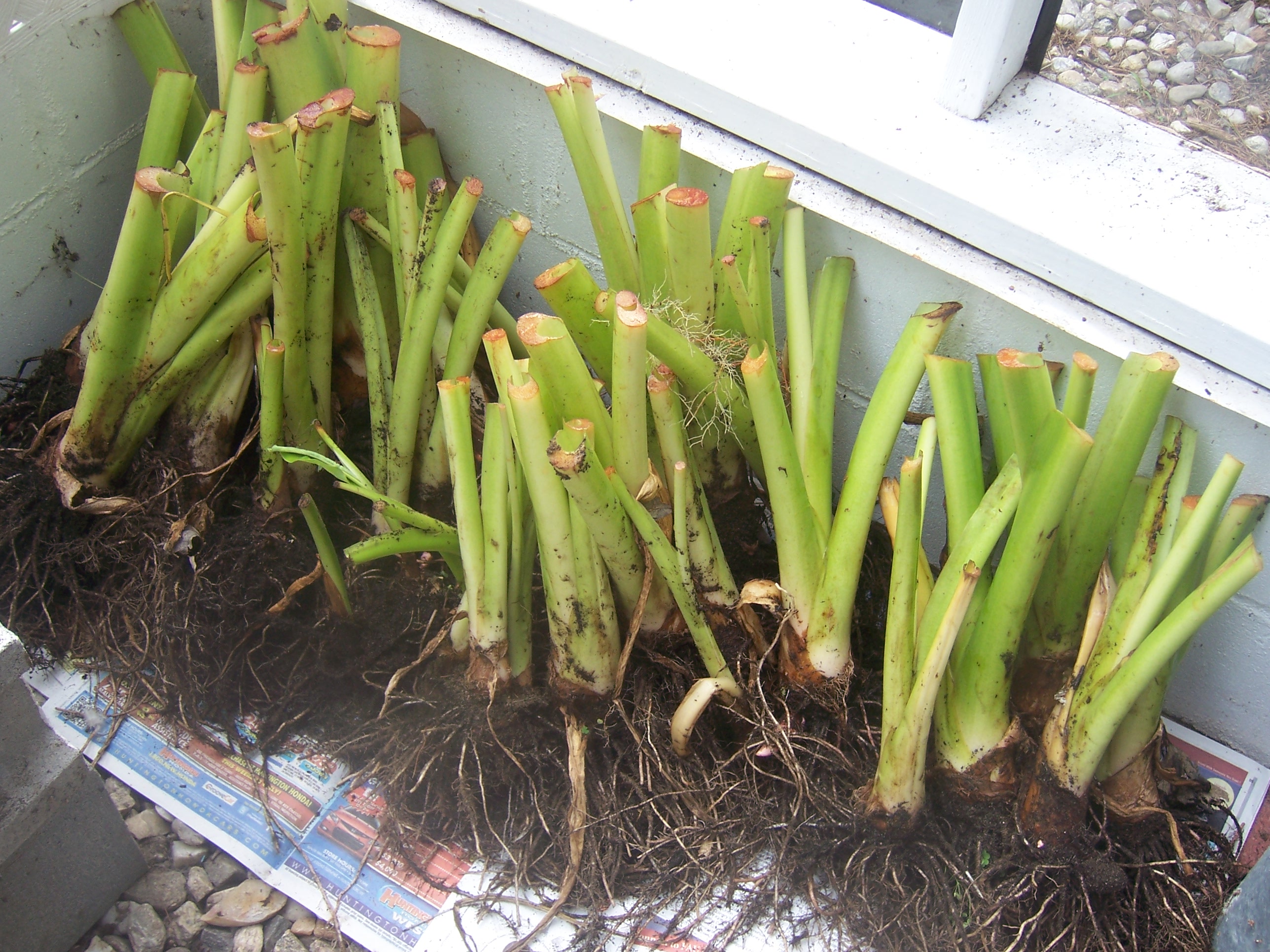
Step 4: Here we have pretty Elephant Ears all lined up in a row.  Once the plants are dug, I store them for a little more than a week in the potting shed.  It’s warm enough and dry enough for the bulbs to set before they are packed away.

Stay tuned for a future post on the final step.

Not-So-Wordless Wednesday: My Roots Are Showing


This is the end result of a day spent digging and removing Elephant Ears and Canna from the garden, and preparing them for their long winter’s nap.

It’s probably my least favorite day in the garden, and each year, I dread its arrival.  The chill in the air is my signal that, “It’s time.”  Armed with a pitchfork, clippers, and nerves of steel, I apologetically approach each plant.  I want to say, “Believe me, this is going to hurt me a lot more than it hurts you.”  I want the plants to understand that my actions are for their own good, so that they may live to see another summer.  But in the end, I fear that they’ll see me as a Viking, pillaging and ransacking their cozy beds.

Gardeners, I think, must have a bit of masochism in their blood.  Who else would try to trick Mother Nature by planting wrong-zone plants, nurturing them into blooms, and then hacking them down, ripping them from the ground, and storing them over the winter — only to start the process all over again in the spring?  Oh, to be content with zone-appropriate material!

Continue reading

Not-So-Wordless Wednesday: The Last Bouquet


For this Not-So-Wordless Wednesday post, I thought I would share the words of others, words that could somehow capture my feelings as I stand in the garden clipping some of the final blooms.

“Sorrow and scarlet leaf,

Sad thoughts and sunny weather.

Ah me, this glory and this grief

Agree not well together.”

Thomas Parson, 1880, A Song for September

The last page in this summer's garden scrapbook.

“For summer there, bear in mind, is a loitering gossip, that only begins to talk of leaving when September rises to go.” – George Washington Cable

There is a definite chatter as I get to work, selecting what’s left among the flowers.  Looking at the leggy stems, some of them browned, and the leaves dusted with powdery mildew, I can definitely hear a chorus of pleasantries and goodbyes as the summer guests make their way to the garden gate.

 “A late summer garden has a tranquility found no other time of year.” – William Longgood

There is a definite somberness and calmness in the garden today.  Perhaps it’s because plants that I have nurtured for so long, some from seed started in February, are leaving after a full season of delivering what was promised — and paying my respects is the right thing to do.  Maybe it has to do with the color of the sunlight, warm and golden, fading from the brightness of July.  The shadows seem longer, and the colors more muted – and yet, it feels warm and glowing, especially as the sunlight hits the faintest change of color in the leaves overhead.  More likely, though, the overwhelming sense stems from a combination of the two — and a little imagination.

“Spring flowers are long since gone.  Summer’s bloom hangs limp on every terrace.  The gardener’s feet drag a bit on the dusty path and the hinge in his back is full of creaks.” – Louise Seymour Jones

Oh, yes, there’s a lot of dragging and creaking happening by this time of year.  I do feel the energy of summer leaving me — or maybe it’s just sympathy pains for the plants.  Gardeners, I think, develop a kind of symbiotic (or co-dependent) relationship with their charges.  When they sprout, I sprout.  When they bloom, I bloom.  And when they wither away, a piece of me goes with them also . . .

Until the process starts all over again.


Bloomin’ Update 10: Autumn Joy


My plan was to have a post featuring the blooms of the waning days of summer.  With camera in hand, I captured bees tending to their chores on a day that felt more like July than September.  If you could see their bee faces, I’m sure they were aglow with autumn joy.

 Then, in a matter of hours, a cold front roared through.  The clouds thickened and darkened, the wind grew stronger, and fat drops of rain splattered everything.  And all the while, the temperature plummeted — so much so, that by sunset, it felt like late October.  When I looked out of a window, I saw the last canna bloom (was that a shiver?) glowing.  I again grabbed the camera, this time to capture the canna’s last stand — and I was blown away by the vividness of color.

 
I wondered what other flowers and plants would look like surrounded by chilled darkness and then the glare of a flash.  I was limited in my selection because of the time of year, but I did (surprisingly) capture a noisy cricket in the ivy that climbs up the maple tree.  He’s resting on the large leaf at the bottom of the photo.
 
   
Now the Zinnias, a little battered and chewed up, but still holding on to their color.


This Blanket Flower is probably wishing that it had a blanket.
 

A few of the old standbys:  a faded Hydrangea (take that Madonna!), Liriope spikes, Coleus “Tartan,” and a Caladium close-up.


The Sunflower Sisters, one streaked with orange, the second like a faded version of the first, and the third looking more like celestial eclipse.

Finally, another glimpse of “Autumn Joy” Sedum.  The bees were probably in a state of suspended animation at this hour and temperature.

My late-night expedition into the garden was a wonderful way to close-out summer.  (Note to self: Next year, don’t wait until the end of summer for a nighttime photo shoot.)  Looking back on this growing season, it was exciting to enter the blogging world and to share my life and garden with you.  I appreciate greatly all of the comments and encouragement.  Now, it’s time for cleaning up, digging and storing tender bulbs, protecting terracotta pots, and the never-ending raking — in other words, the joys of autumn.

Angst In August


“What’s wrong?” 

That was the first question Joe, my partner, asked me the other day.  At first, I didn’t think anything was wrong, other than I felt a little sluggish and unmotivated to do anything.  Then I looked at the calendar.  August. 

I’m quite conflicted when it comes to the 8th month of the year.  I know it’s still summer, which I’m thrilled about, but inside I feel dread and sadness, as if the clock has begun ticking on the garden around me.   And once that thought takes hold, all other melancholic ideas start to sprout.  To put it simply, I’m summer saturated.

For starters, everything in the yard looks overgrown.  The Sunflowers can’t stretch any higher, and they are so crowded and top heavy that they are all falling over at odd slants.  The leaves on the trees are dull green.  Most of the annuals look tired.  The grass is burnt.   The Hydrangea flower heads have started to fade away.  Everything looks sloppy.  My impulse is to go out there and rip everything out of the ground and start all over again with new seedlings.  But that would be ridiculous.  As it is, the days of these plants are already numbered.

Then there is the change in shadow.  As the Earth and Sun have done their celestial dance on the way to the autumnal equinox, I have noticed that where there once was sun, there is now shade.  Just ask the Gazanias.  A week ago, they basked in hours and hours of summer sun.  Now, the shadow of the house lingers a little longer over their bed.

And let’s not forget about the quiet changes in weather.  While the days are still warm, nighttime temperatures have begun their subtle decline.  On some mornings, I can smell the faintest whisp of fall in the air. 

That is, perhaps, where most of my hostility toward August stems from: I know what’s coming.  Leaves will start to change, tropicals will have to be dug and stored for the winter, terracotta pots will need to be cleaned and packed away,  nights will become longer.  I can practically feel Light Deprivation Disorder bubbling up.

Continue reading