
Leading up to the holidays, I had hoped to share a post about my 4x-great grandfather, Ebenezer Loud, because who doesn’t love a good Ebenezer story just before Christmas?
That, at least was the plan.
Leading up to the holidays, I had hoped to share a post about my 4x-great grandfather, Ebenezer Loud, because who doesn’t love a good Ebenezer story just before Christmas?
That, at least was the plan.
I’d like to thank everyone for their encouraging comments and support, here and on my personal FB page, about expanding what I post. Many of you stressed the importance of being true to myself, the need for community during these troubling days, and an appreciation that my words could very well have been their own.
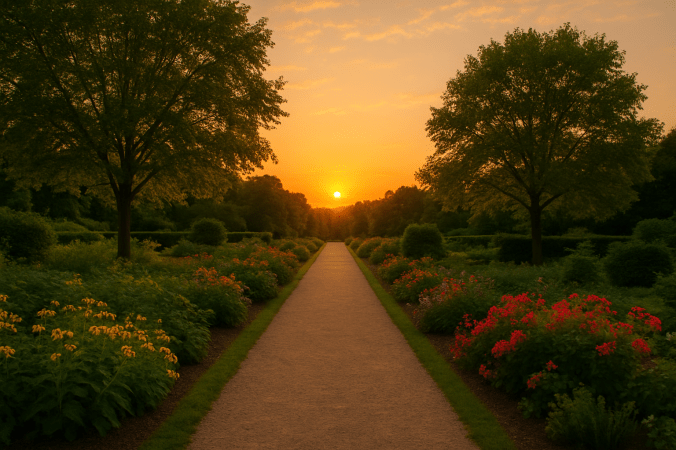
That last item truly means a lot to me, because it’s a reminder that we are not in this alone. So, we will be strong and carry on… and let this post be the first stepping stone on a new garden path.

In the overnight hours before landscape designer Victor Lazzari opened his English-style garden to members of a local garden club, a cold front made its way down the entire length of the Florida peninsula. Wind and light rain arrived in the darkness, but by morning, a cool breeze had pushed away any lingering clouds, unveiling a brilliantly blue sky. The typical South Florida humidity was yesterday’s memory.
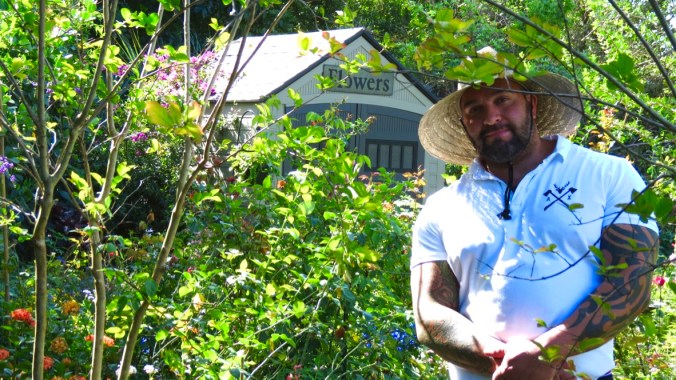
It’s interesting to watch Victor Lazzari in his South Florida garden. At 6’1” and 290 lbs. of muscle and tattoos, he’s certainly a looming presence. It’s also where he happens to be the most comfortable, walking along the garden’s hidden paths, gently cupping roses in hands that are just as capable of lifting 350 lbs. at the gym, and inhaling each bloom’s sweet or subtle scent.
Most strikingly, though, Lazzari’s garden is done in the English style. Yes, an English garden is growing in South Florida.

For decades, Joe and I — first, as tourists; now, as residents — have looked around South Florida and said, “Florida, my Eden.” We’ve said it as we’ve marveled at the lush tree canopy of botanical gardens, as we’ve gazed at tables of flowers and fields of shrubs and trees in local nurseries, as we’ve walked about and worked in our own garden, and as I took photos for this post.
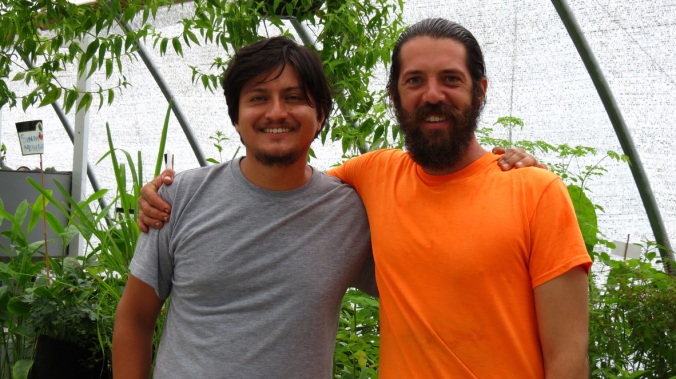
When Santiago Arroyo (left) met Jason Long (right), it was the start of a bountiful friendship. When the two men worked side-by-side in a Florida-farmer apprenticeship program, they not only cultivated a friendship but they shared a common vision of how farming could change the way people live, eat, and think about food.
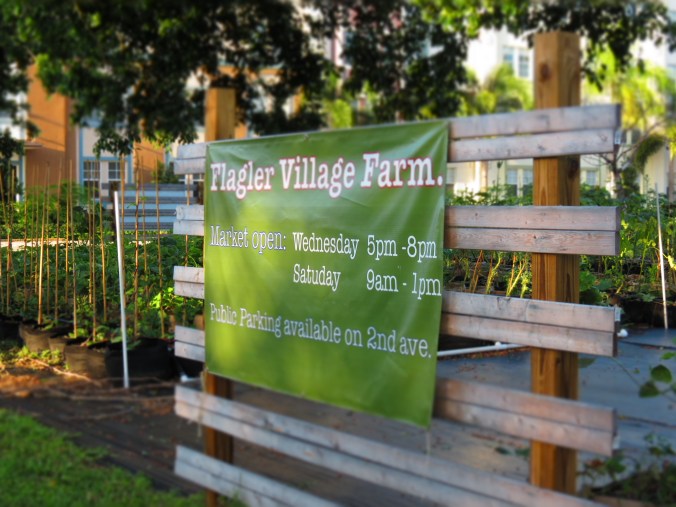
In the previous post, I mentioned that summer in South Florida was like living in a green desert: day after day of heat made hotter by oppressive humidity and afternoon downpours. It’s for these reasons that many gardeners retreat indoors, contenting themselves to look at their green world from behind glass.
Imagine my surprise — and delight — when I came across an oasis in the heart of Fort Lauderdale, a green space that was not only green but was still producing even in the blistering summer heat.
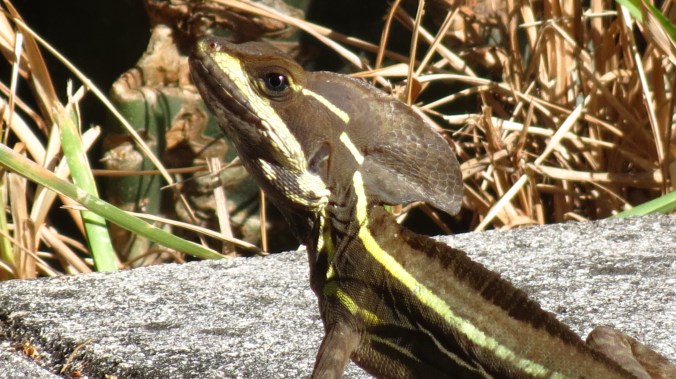
A whole new lizard made an appearance. This one looks like a dinosaur from an old sci-fi film.
A few posts ago, I found myself in a bit of a spring funk. On the one hand, I was excited about spring’s arrival — after all, little darling, in the words of Lennon, Harrison, and McCartney, it’s been a long, cold, lonely winter.
When spring arrived, I was in south Florida — where it’s not so much here comes the sun but rather there is always sun. No one but me seemed to notice that the earth was standing a bit more upright as the northern hemisphere tilted toward the sun. In fact, one deejay wondered aloud on air, “Does South Florida even have a spring?”
Of course, South Florida has a spring. I’m just not sure when it actually happened. I think it was that morning when it was about 70 degrees for a few hours.
Many of you suggested I talk to some locals in order to get a better understanding of spring in these parts. And that’s exactly what I did. Feeling a bit like Ponce de Leon in his search for the Fountain of Youth in Florida, I became an explorer in search of my own newly sprung spring.
Since I don’t have a garden here, I turned to the gardens of my neighbors for some springtime inspiration. On one side, my neighbor has a wildly overgrown bed — for lack of a better word — of banana trees. They’re a bit weed-like — and I’m itching to get in there to clean out the dead leaves and stalks — if only to reach up and grab what is just out of reach from my side of the fence.

This is fresh produce.
The neighbor on the other side has a very lush, attractive landscape — including this hidden heliconia.
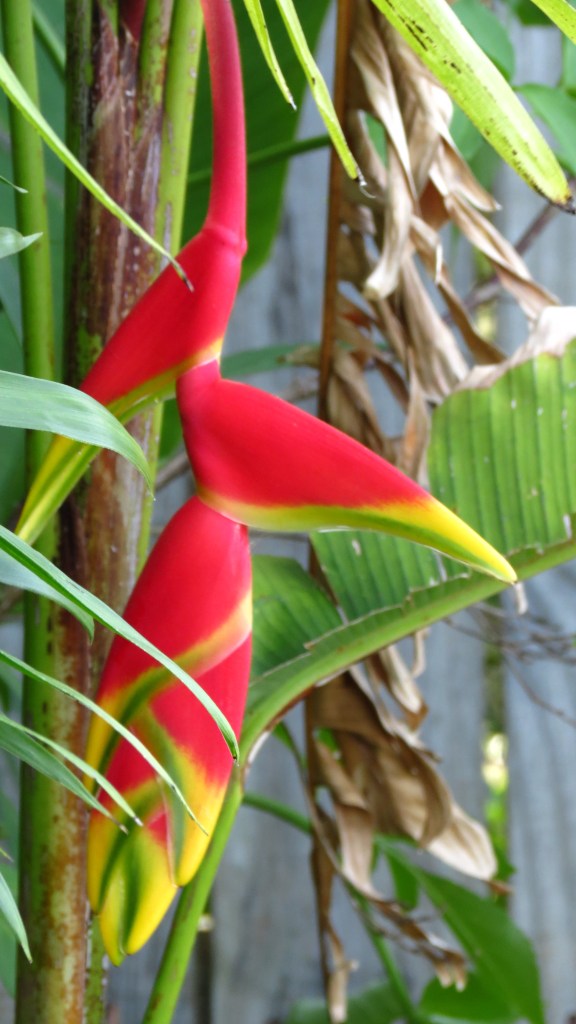
Hello heliconia.
Hanging over our shared fence are the branches and blooms of brugmansia, more commonly known as angel’s trumpets. It’s one thing to stand on my side of the fence and take in all of the pendulous blooms . . .

The bells of brugmansia.
. . . and quite another to lay down in its shade and look upward.

Brugmansia.

Looking upward into brugmansia.
But bananas and brugmansia hardly a spring make. What about bulbs and songbirds, bed cleaning and nurseries stocking up? In fact, nurseries here always seem to be full of potted products — and so the seasons seem to flow seamlessly, perhaps even unnoticeably.
I went in search of experts — and I didn’t have to go far. Charles Livio is the horticulturist for Oakland Park, FL. (Yes, the city has its own horticulturist!) In the summer of 1972, Charles and his family left the New York metropolitan area and arrived in South Florida.
“Yes, our spring is radically different here in our sub-tropical climate,” said Charles via email. “First, let’s throw out that children’s calendar rhyme from up north, ‘April showers bring May flowers.’ First of all, we have flowers blooming all year long, and second, April is not a rainy month here. Our rainy season is normally from late May through early October.”
Echoing this same idea is a regular reader/commenter of this blog, Mary Collins, who is the senior horticulturist at Fairchild Tropical Botanic Gardens in Coral Gables, FL. Like Charles, Mary is a South Florida transplant, having arrived in 1973.

True colors: Heliconia close-up.
“I describe the seasons in South Florida like this,” Mary wrote in a recent email. “Winter: December, January, February is cool and usually dry. Spring: March, April, mid-May is warmer, dry and windy. Summer: late-May, June, July, August, September, mid-October is hot, humid, very rainy, stormy, with June and October often being our rainiest months. Fall: late-October, November is a bit cooler and less humid.”
Now that I have a better understanding of the seasons, I wonder if I’m still missing something. Up north, spring meant excitement. It meant life. It meant green.
But in a land that is perpetually green, where this year’s spring temperatures feel more like a New York summer, where is the excitement? I mean, there are always shoppers in the nurseries but not in the numbers as up north — and much of that might have to do with the limited time gardeners have in colder climates.
Do South Florida gardeners take seasons for granted? Why get excited about any season if the changes are barely perceptible? The answer to my question could not have been more obvious. When searching for garden excitement, talk to a gardener.
At the mention of spring, both Charles and Mary responded with the feeling that I feared was lost — and their excitement for spring is infectious.
“Springtime in South Florida is much more subtle than up north, but there are things to look forward to,” wrote Charles. “In late winter/early spring, the purple trumpet trees are in bloom, followed by the pink trumpets, and then the yellow trumpet trees are masses of gold by April.”

There’s nothing subtle about the color of this trumpet tree.
Similarly, Mary picked up the call of the trees. “There are several beautiful trees which bloom during the spring, including the shaving brush tree (Pseudobombax ellipticum) with pink or white blooms and our native lignum vitae (Guaiacum sanctum) with beautiful violet blue flowers.”
Several trees experience both fall and spring at this time of year. According to Mary,
“This is the time of year when our live oaks (Quercus virginiana) and mahogany (Swietenia mahogany) trees drop their leaves. The oaks produce small, inconspicuous flowers and new leaves shortly after their last year’s flowers have dropped. Mahogany trees also produce new leaves shortly after their old leaves have dropped. Both the oaks and the mahogany are described as being ‘briefly deciduous.’”
Briefly deciduous. Now that’s a term that can get me revved up about spring, that makes me want to go outside and get dirty, to try my hand at some seed sowing in this climate. If I were in New York, I would have already started seeds in advance or patiently waited for the soil to warm up to direct sow. The soil in Florida is already nice and warm, so . . .
Charles offers a word of caution to slow down. “If you were to plant your garden down here the same time in the spring you planted it up north, you would be missing 2/3 of our vegetable growing season. Cool weather crops have already been harvested, and the warm weather crops are being picked. Our very warm and humid summers are not conducive to growing most vegetables. If the insects don’t get you crops, the diseases will. However, there are some tropical crops that will produce during our summers, such as cassava [yuca], pigeon peas, malanga [a root vegetable] and chayote [it’s easier to provide a link for this edible tropical plant]. We may not grow apple, pear, and cherry trees down here, but we have mangoes, avocados, and papayas!”
Mary added: “Spring in this area means orchid shows and spring plant sales. This is an excellent time to purchase plants for your own garden. Don’t forget to plant some of our South Florida native species for our native birds and butterflies! It’s a wonderful time to go for a hike in the Everglades! The water levels are at their lowest; the wildlife is found near the remaining water holes, and the ‘Glades prairies are filled with wildflowers.”
So to answer that South Florida deejay who openly questioned if South Florida even had a spring, the answer is, “Yes, Ponce de Leon, there is a spring.” You just have to know where to look and what to look for. According to both horticulturists, there is one plant in particular that can lead the way. Bougainvillea is at its brightest and boldest at this time of year.

Bougainvillea.
And that’s cause for excitement no matter where spring is springing along.

When I received Gnomes as a gift in 1976, it ignited my imagination. I not only loved the total appearance and creativity of the work, but Wil Huygen’s words and Rien Poortvliet’s illustrations reached out from the pages and carried me into a secret, fantastical world.
Nearly 40 years later, the book has that same hold on me — and more. I revisited the book while cleaning out a bookshelf. Just flipping through the pages brought me back to the wonder I felt as a 13-year-old boy.
 With a name like Dante the Comic, it’s pretty obvious that he’s a funny guy. The name, though, barely scratches the surface of all that he does on screen, behind the scenes, and in his yard.
Dante first came to national attention on season five of NBC’s “Last Comic Standing,” where he received each audience favorite award and a standing ovation in the semi-finals. Ever since, awards and honors have continued to roll in, including the grand prize on ABC’s “America’s Funniest People,” the most comedy awards ever presented by BET, and performing for more US troops than anyone since Bob Hope. And if this isn’t enough, he also writes for E Network’s “Fashion Police,” with Joan Rivers, and hosts a podcast, “Stimulus Package,” which is available through iTunes.
Dante’s newest project is co-starring in the film The InAPPropriate Comedy, slated for a March 22 nationwide release. Directed by Vince Offer, the Sham Wow guy, this sketch-comedy movie follows the mayhem of a tablet computer fully loaded with offensively funny apps. Taking part in the irreverent and raunchy humor is Academy Award-winner Adrien Brody, Lindsay Lohan, Michelle Rodriguez, Rob Schneider, and Dante’s girlfriend, Rebekah Kochan, an actress/comedian with her own loyal following.
For gardeners, though, the most impressive piece of Dante’s resume is the work he does in his yard. Dante the Comic, you see, is also Dante the Gardener.
 Nitty Gritty Dirt Man