
After solving the mystery of how my great-grandparents, Giuseppe and Crocifissa, had met and married in Independence, LA, I was energized to learn more. I already had proof of Giuseppe’s arrival in the United States, but I knew nothing of Crocifissa’s arrival.
So much of her life remained a mystery – and I wondered how far back in time could I travel without ever leaving my house?

At the start of my quest, the only clue I had to work off of was my great-grandmother’s obituary, which dates from 1971. That document stated that Crocifissa had arrived in America as a 6-month-old – and try as a might, I could not find a single 6-month-old Crocifissa on any passenger manifest arriving at Ellis Island or in New Orleans.
Complicating the matter, distant relatives I’ve never met had shared this same information on their trees, with a single supporting document from the Ellis Island website – a passenger manifest that included a Crocifissa, who was 16-years-old and ultimately traveling to Passaic, NJ.
This was not my Crocifissa… and, quite honestly, nor was it theirs.

My mom, Sue, and her grandmother, Susie (Crocifissa).
My mom, though, had a different memory. She believed her grandmother had arrived in America when she was a few years older than 6 months. She also remembered that Crocifissa had a sister, whom my mother knew as Aunt Lucy – and this woman became my time machine ticket.
I added Lucy to my tree to see what clues the Ancestry wizards could deliver. One of the first clues to arrive was a link to Lucy’s Find-A-Grave page. After following the link, the first item I saw attached to her was her obituary, which listed the names of her siblings, Nace (Ignacio), Josephine, and… Crocifissa! Several others were also listed.
Armed with additional names, it was time to once again search the Ellis Island database. “Lucy” returned nothing, as did “Lucille.” Then… Lucia. Of course, Lucia… the names would be in Italian! There were several passengers with the same name, but I eliminated those who were too close to my great-grandparent’s wedding in 1909.

Photo courtesy of MyItalianFamily.com.
In late 1896, I discovered on a manifest, a 44-year-old woman named Maria D (according to Ellis Island’s research team, it was common for married women to be listed with their maiden names), left her small Sicilian village with four of her children. They made their way to Naples, where the five of them boarded the California to make a treacherous winter crossing of the Atlantic to reach America – one small huddled mass, yearning to breathe free. They arrived at Ellis Island on December 7 of that year.
Beneath Maria’s name on the manifest were the Italian names and ages of her children: Giuseppina (20), Ignacio (10), Lucia (7), and Crocifissa (5). Their final destination was New Orleans.
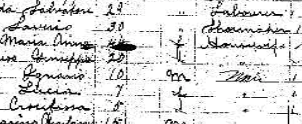
The manifest also provided another piece for the Crocifissa puzzle – the name of her village, Campofelice di Fitalia, which is about 35 miles from Bisacquino, her future husband’s birthplace.
It’s difficult for me not to compare this voyage of hope to the ones so many continue to make to reach this country, to wonder about the courage and dreams, strength and determination it would take for a parent (or anyone, for that matter) to make this sort of journey with their children, whether it’s an immigrant of yesterday or of today. What could be so horrible at home? And what is it about America that attracts so many?
In my case, I found the answer by accident.
At this point on my tree, as I continued to fill in newly discovered names, it was as if the Ancestry wizards were working overtime in delivering clues. Unfortunately, the clues couldn’t agree on the name of Crocifissa’s father – Salvadore? Vincenzo? Charles? My journey through time was sounding more and more like Three Men and a Crocifissa.
One clue, though, caught my eye. It was from another Ancestry member with whom I did not have a DNA connection. Her tree, entitled “Campofelice di Fitalia,” had a person named Crocifissa, along with her siblings and parents.
On Crocifissa’s page in that tree was a link to the Family Search website. After clicking the link, I was brought to an image of a page from an “Atti di Nascita,” a birth record. The document, a combination of printed and handwritten words – all in Italian, listed Crocifissa’s birthdate as June 19, 1891… her birthplace as Fitalia… her mother as Maria D… and her father as… Vincenzo. In this official government record, Vincenzo, who would be my great-great grandfather, is listed as “villico” – a peasant.

Just as I became a little emotional when I saw my great-grandmother’s “X” on her marriage license, I also became a little sad when I saw “peasant” spelled out on a government record. By today’s standards, that seems harsh. He wasn’t listed as a farmer or a laborer, but… a peasant. The word feels final, as if there could be little to no chance for Vincenzo or his children, who were most likely illiterate, to move up to another class. His only hope for himself and his family was the light from a torch that started to illuminate the horizon just five years before Crocifissa’s birth… in that land, all things are possible.
I know I’m a bit sentimental and even Pollyanna-ish when it comes to the idea of America as a melting pot, a mosaic, or even a chunky stew. It’s why I like to think there were kind strangers along the way as both Crocifissa and her family, as well as Giuseppe, made their way to New Orleans – perhaps someone directing them to the ticket counter to purchase train fare once they were processed through Ellis Island… maybe someone who shared some food… maybe someone who spoke their language as they clung to one another, because they were all that was familiar to them in a strange land… maybe someone who was kind to them as they settled in Independence…
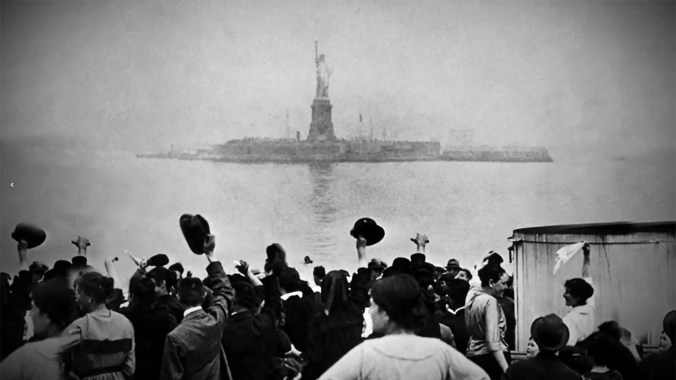
Photo courtesy of CBS News.
These are the things I hoped happened. Sadly, though, I’m also not naïve. While the Statue of Liberty welcomed so many, all too often citizens and the government, with bigotry and violence, pulled the welcome mat out from under the feet of immigrants, including my ancestors and yours.
Today, though… Today, there is a whole other level of government-sanctioned hate, an evil the majority of us have never seen in our lifetimes… the Gestapo-like tactics of ICE agents… the glee in the words and on the faces of MAGA political leaders as they see mounting numbers of people getting arrested and deported… the images of families ripped apart… children zip-tied… ICE raids at churches and schools, immigration hearings and workplaces… deportations to prisons in third-party countries… and 1,200 detainees missing from Alligator Auschwitz, because the state of Florida didn’t think the immigrants were worth the trouble or expense of documentation, so family members have no idea if their loved ones were deported, executed, or fed to the alligators.
Animal shelters keep better records.

Courtesy of the LA Times.
I don’t recognize this America. I don’t love this America. I’m not proud of this America.
As I write this, I can hear the “Yes, but” arguments in my head. “Yes, but my ancestors came her legally.” “Yes, but I heard only criminals are getting deported.” “Yes, but they don’t even try to learn English.” “Yes, but we don’t have enough to take care of our own.”
Yes, but what happened to our humanity?
Maybe, though, none of this is new. Maybe this is what America has always been, but now the hatred was permitted to come out of the shadows. Maybe my belief in what America could be is wrong.
Maybe… but I refuse to think so.
Although Liberty’s torch seems to grow dimmer by the day, I still cling to that light, that illumination called hope… just as Vincenzo and Maria and their children did, just as Giuseppe did, just as the immigrants in your family tree did. We owe that to them. We owe that to this country.
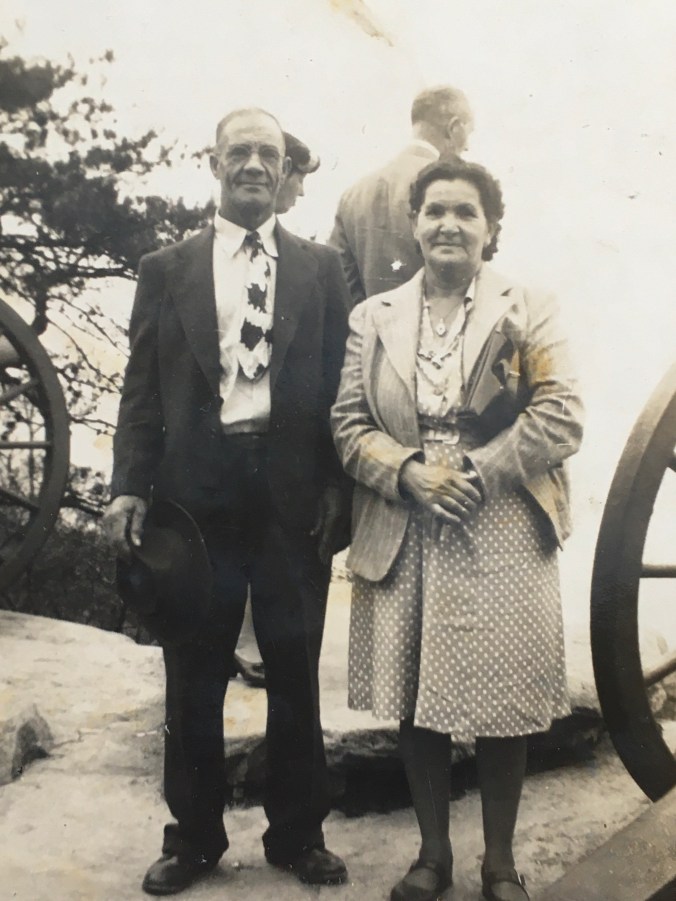
Joe & Susie.
I have yet to find a record of Vincenzo’s arrival in America. My guess is that he arrived after 1891, the year of Crocifissa’s birth, and before 1896, the year his wife and four of his children arrived. I’ll continue searching.
As for Giuseppe and Crocifissa, they Americanized their names, becoming Joe and Susie. In about 1914, five years after they were married, they sold their strawberry farm in Independence and moved to Marrero, LA.
There, my great-grandparents started a family and opened a small grocery. The two of them made the day-long trip from Marrero to New Orleans, in a mule-drawn wagon, to purchase goods and supplies from the French Market. In time, they were instrumental in building the first school in Marrero, purchased land, and started a cattle ranch.
At the time of his death, in 1966, Joe was survived by five children, 35 grandchildren, and 26 great-grandchildren. In 1971, when Susie passed away, their legacy had swelled to 36 grandchildren and 52 great-grandchildren.
I’m the second oldest among the great-grandchildren, but I really have no memory of Joe and Susie. I was born and raised in NY, a long way from Louisiana. This research, though, and the resulting posts about them have given me a tremendous appreciation of what they endured to create a better life for themselves and their descendants… and that, quite honestly, is no different than the dream held by today’s immigrants.
 Nitty Gritty Dirt Man
Thank you, Kevin, for sharing your journey and your thoughts. It often seems like the entirety of human history is the search for a better life for our children. That human impulse transcends nationality or creed.
Hello Linda… beautifully said… and I think that idea gets lost in the politics of it all.