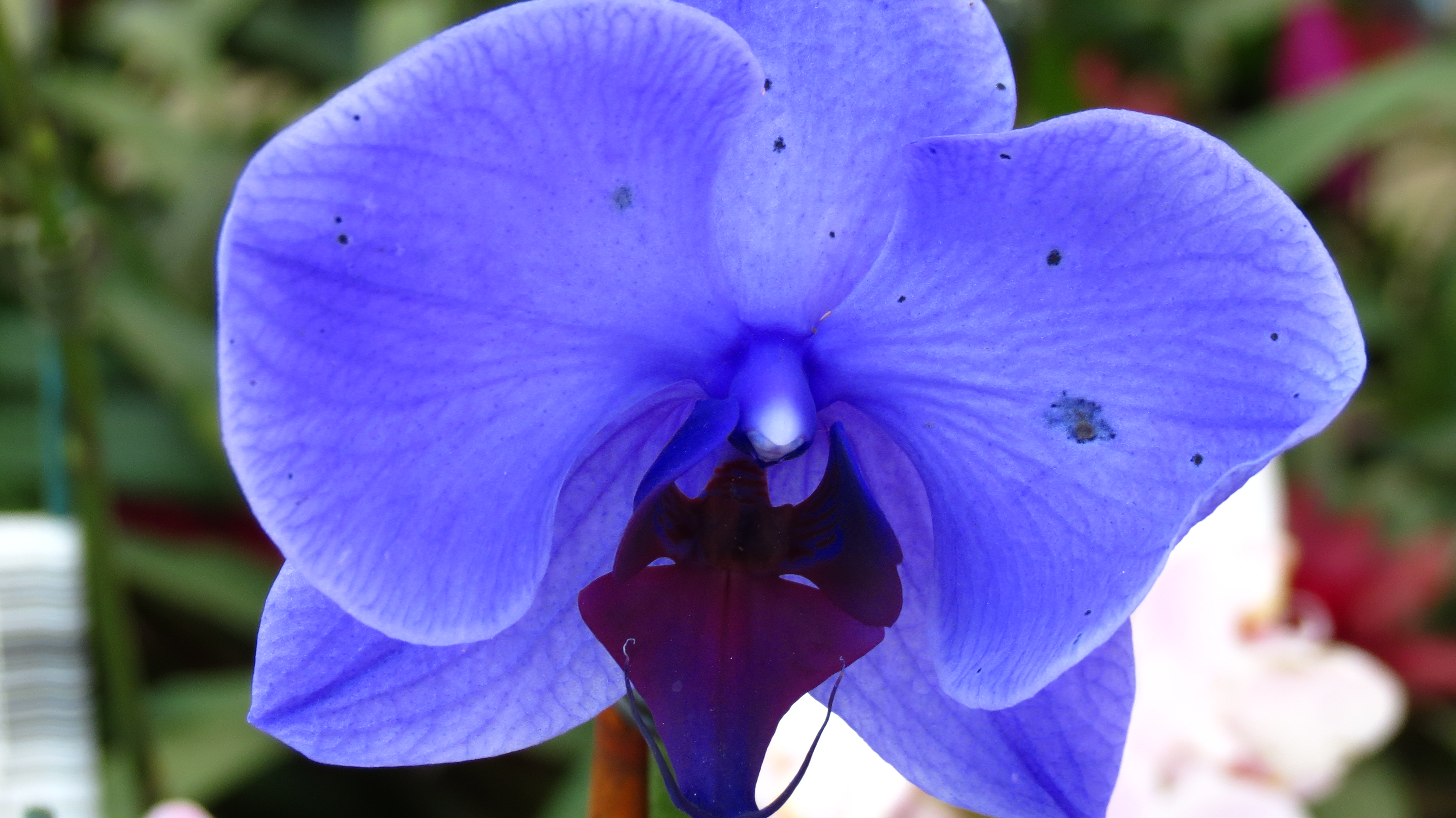
That headline sums up what I felt when I spotted this orchid in a south Florida box store (rhymes with Gnome Repo). I know that an eventual move to Fort Lauderdale would require some adjustments and adaptations and learning, but nothing quite prepared me for orchid fever. From their smiling faces to their vibrant colors, from their graceful bounce to the way their blooms line up along the stem — I find myself completely entranced.
Blooms
Flora Fan Finds Flora Fun In Florida

We should have known that when we signed the papers for the house, that cluster of thunderstorms would have grown into a monster.
For twenty years now, I’ve been making a list. One month before Hurricane Andrew slammed into South Florida, Joe and I purchased our retirement home – and ever since, I have worked on my list, editing it, adding to it, rethinking it.
The list has to do with landscaping our retirement yard, which is pretty much a blank slate. Over the years, we’ve planted palm trees – thereby giving us the basic garden structure. But how do I fill in all of the open areas? How do I adapt my very basic Long Island gardening knowledge to a subtropical zone?
This Bud’s For You
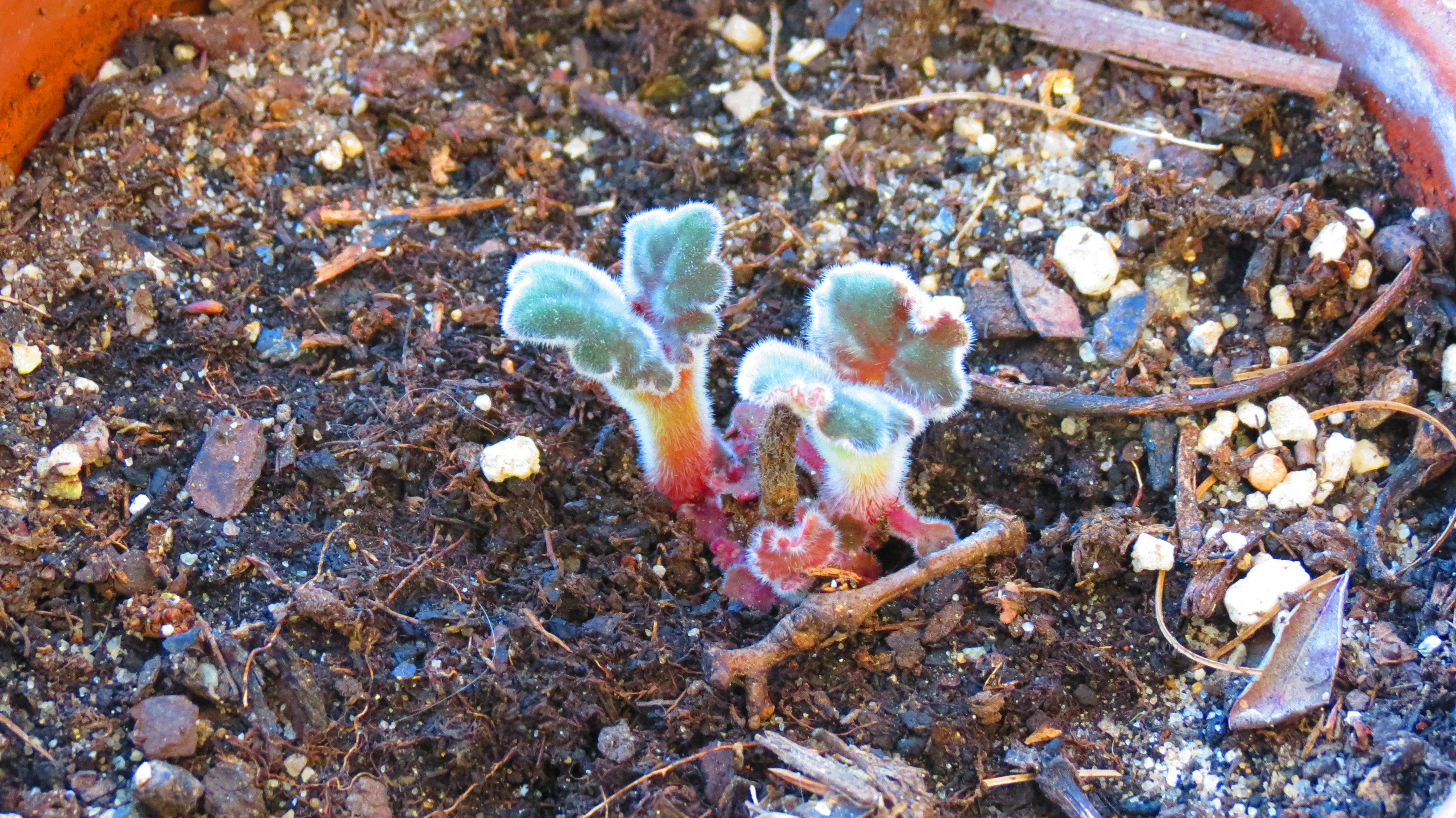
As I sat in my office the other day, I glanced at the terracotta pot, the one that stays outside all summer and that I bring to work each September, and saw the first fuzzy leaves of Gloxinia, a plant that has called this pot home for several years.
It’s a funny thing, this Gloxinia. At the end of the growing season, after all of the leaves and stems have withered away, I put it in an out of the way place. When I remember, I give it some water – and then, thanks to its inner timepiece, it begins to emerge from its winter dormancy – and I am always in awe. While I go about my life and career, this plant is doing its own thing – dormant and alive, right under my nose, and when I least expect it, Gloxinia reminds me that it’s still here.
Meet The Seeds — Part Two
Now that we’ve made the first round of seed introductions, it’s now time to continue down the receiving line. As mentioned in the previous post, I chose many red flowers — but I also included some experiments, seeds that could prove challenging.
First up, an experiment. I always try to include Coleus in the garden. The variety of colors and leaf textures are amazing — and they’re super easy to root if you’d like to save your favorites as houseplants. Simply snip off a stem, place in water, and roots appear. (By the way, that’s also an economical way to keep a favorite Coleus around for the winter months. As the weather warms, take some clippings from that house plant and have roots ready for the outdoor growing season.)
Meet The Seeds — Part One
Simply put, I’m a sucker for seeds. I can’t really say if it’s magical or spiritual, but I am amazed at what is locked inside each oddly shaped, variously sized seed. Just provide the right environment, and it’s as if the Big Bang is put into motion. Roots, stems, leaves, blooms, seed — it’s an ongoing cycle that is so simple (and yet so complicated) that it helps keep me grounded in this hectic world. It’s one thing to stop and smell the roses, but it’s another thing to stop and plant a seed and wait and then smell.
My Park Seed and Select Seeds order has arrived, and very soon, I will begin my own cycle of planting and watering and thinning. I admit, I went a little heavy on red — but I do love red in the garden. It’s hot and vibrant and passionate — and it comes in so many shades, from bright to brick to bold.
And now, without any further delay, I would like to roll out my red carpet.
Bloomin’ Update 17: Anticipation
One of my favorite Christmas carols is “In the Bleak Midwinter,” and my thought was to use it as the basis for a “Bloomin’ Update” post with photos of wintry scenes. But this winter hasn’t been so bleak. In fact, it feels more like mid-March than mid-winter. Perhaps a more appropriate title should be “In the Balmy Midwinter.”
Saving Canna — Part 1
Now that the Elephant Ears are out of the ground, it’s time to turn my attention to the Canna forest that is my yard. The truth is, I never intended to have a Canna forest — things just got out of hand over the years as corms grew and became easy to divide, or I found new leaf patterns or bloom colors and I thought I needed to have three of each.
I live in Zone 6 and I have tried to overwinter some Canna in the ground, but I have had no success. I’ve mulched them and planted them along the south-facing side of the house, but to no avail. So whether you have a few stalks or a forest, this is what you will need if you live in a northern climate and would like to save your Canna for future summers: garden clippers, shovel or pitchfork, stamina.
Step 1: For the sake of this demonstration, I dug the Canna first. You could also trim the stalk and then dig out the corm. Either way, pry up the plant, being careful to not damage the corm with your garden tool.
Step 2: Leave about 8″ – 10″ of stalk. Actually, Canna can grow quite large, so for ease of trimming, it might make more sense to leave the corms in the ground, cut the stalks, and then dig out the plant.
Step 3: As sad as it is to do this job, there is a thrill each time I remove a corm from the ground. See that white bulbous shape and the group of purple-tinged tips peaking through the roots? That’s where next year’s growth will occur. Ah — the promise of next year’s garden! By the way, this is also a good time to remove any excess dirt. Don’t divide the corms; that’s a task that’s safer to do in the spring when you unpack them from their hibernation location.
Step 4: After the corms are out of the ground, I keep them in the potting shed for about a week. The setting is warm enough for them to dry a bit before packing away, but not so hot that they cook. Since I have several varieties, I group them in large plastic containers. I also store them upside down — mostly because my gardening bible, Better Homes and Gardens Complete Guide to Gardening, recommends doing that. I’m not sure of the reason, but I do as I’m told — and my gardening good book has never failed me.
Next Post: Saving Elephant Ears and Saving Canna — Part 2.
Book Review: 1493
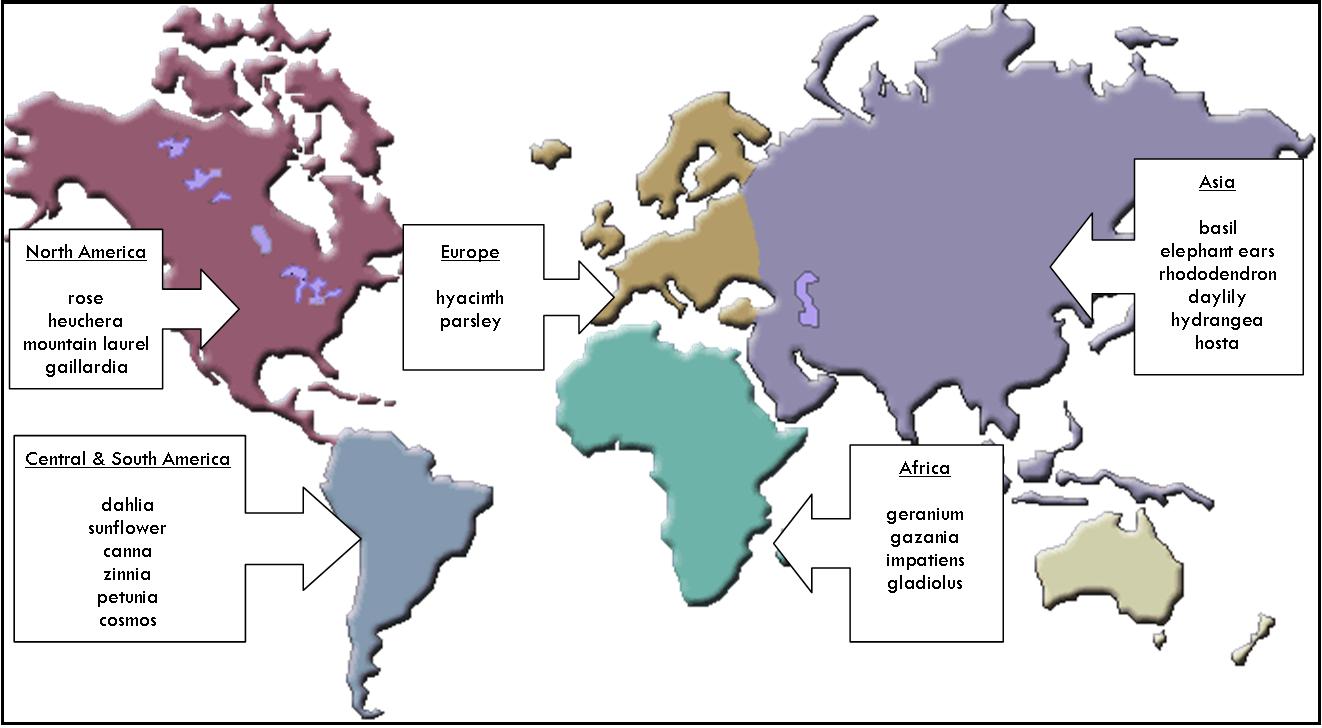
When children recite, “Mary, Mary, quite contrary, how does your garden grow?” perhaps a more appropriate question would be, “From where does your garden grow?” That’s the question I ‘m asking myself this Columbus Day weekend after reading the best-selling new book 1493: Uncovering the New World Columbus Created, by Charles C. Mann. This meticulously researched book examines the world after Columbus set foot in North America.
While Columbus certainly has his critics, there can be no mistaking that his arrival in the New World placed the entire world on the globalization frontier. The author’s position is that much of what we enjoy today can be traced back to what he calls the Columbian Exchange, a means of moving plants and seeds and animals from one part of the world to another part. It is why, for example, that tomatoes arrived in Italy and citrus arrived in Florida. So much of what we take for granted wasn’t always so; and much of it would not be if Columbus had not set the process in motion.
I myself am a bit of a mutt: English, Scottish, German, French, and Italian. My paternal ancestors arrived in North America in 1675; my maternal great-grandfather entered through Ellis Island. While this is my gene pool, I wonder just how diverse and worldly is my garden?
Thanks to the Internet and Google, I learned that what I plant has traveled a long way to be planted. In fact, my garden could be a lesson for world leaders seeking peace. Although it heavily favors Asia and Central and South Americas, there is little conflict in plants from many lands successfully sharing common ground. (Note to self: bring Australia into the mix, but wait until full-out global warming for Antarctica to come into bloom.)
And to think my melting pot only took 518 years — and still counting — to plant.
Happy Columbus Day — and enjoy the weekend in the garden.
Not-So-Wordless Wednesday: My Roots Are Showing
This is the end result of a day spent digging and removing Elephant Ears and Canna from the garden, and preparing them for their long winter’s nap.
It’s probably my least favorite day in the garden, and each year, I dread its arrival. The chill in the air is my signal that, “It’s time.” Armed with a pitchfork, clippers, and nerves of steel, I apologetically approach each plant. I want to say, “Believe me, this is going to hurt me a lot more than it hurts you.” I want the plants to understand that my actions are for their own good, so that they may live to see another summer. But in the end, I fear that they’ll see me as a Viking, pillaging and ransacking their cozy beds.
Gardeners, I think, must have a bit of masochism in their blood. Who else would try to trick Mother Nature by planting wrong-zone plants, nurturing them into blooms, and then hacking them down, ripping them from the ground, and storing them over the winter — only to start the process all over again in the spring? Oh, to be content with zone-appropriate material!
Not-So-Wordless Wednesday: The Last Bouquet
For this Not-So-Wordless Wednesday post, I thought I would share the words of others, words that could somehow capture my feelings as I stand in the garden clipping some of the final blooms.
“Sorrow and scarlet leaf,
Sad thoughts and sunny weather.
Ah me, this glory and this grief
Agree not well together.”
Thomas Parson, 1880, A Song for September
“For summer there, bear in mind, is a loitering gossip, that only begins to talk of leaving when September rises to go.” – George Washington Cable
There is a definite chatter as I get to work, selecting what’s left among the flowers. Looking at the leggy stems, some of them browned, and the leaves dusted with powdery mildew, I can definitely hear a chorus of pleasantries and goodbyes as the summer guests make their way to the garden gate.
“A late summer garden has a tranquility found no other time of year.” – William Longgood
There is a definite somberness and calmness in the garden today. Perhaps it’s because plants that I have nurtured for so long, some from seed started in February, are leaving after a full season of delivering what was promised — and paying my respects is the right thing to do. Maybe it has to do with the color of the sunlight, warm and golden, fading from the brightness of July. The shadows seem longer, and the colors more muted – and yet, it feels warm and glowing, especially as the sunlight hits the faintest change of color in the leaves overhead. More likely, though, the overwhelming sense stems from a combination of the two — and a little imagination.
“Spring flowers are long since gone. Summer’s bloom hangs limp on every terrace. The gardener’s feet drag a bit on the dusty path and the hinge in his back is full of creaks.” – Louise Seymour Jones
Oh, yes, there’s a lot of dragging and creaking happening by this time of year. I do feel the energy of summer leaving me — or maybe it’s just sympathy pains for the plants. Gardeners, I think, develop a kind of symbiotic (or co-dependent) relationship with their charges. When they sprout, I sprout. When they bloom, I bloom. And when they wither away, a piece of me goes with them also . . .
Until the process starts all over again.