Field Trip: International Rose Test Garden


It’s taken five years to write this post.

Five years since Joe and I first started planning a trip to the Pacific Northwest — and learning that the International Rose Test Garden is a short light rail ride away from downtown Portland, OR. Five years since we purchased our plane tickets for a May 2020 trip – and four years since the world canceled it because of COVID.

Continue reading

Field Trip: Ravine Gardens State Park


It’s a millennia-old story… flowing water meets soil, flowing water erodes soil, flowing water cuts through the strata of time, and modern day visitors stare in awe and wonder.

Naturally, many would think this post is about Arizona’s Grand Canyon, but it’s not. It is, though, about Florida’s very own Grand Canyon, which is actually a grand ravine. Located in the small town of Palatka, which sits between Gainesville and St. Augustine, is Ravine Gardens State Park. Joe and I recently visited this park on a road trip to north Florida.

Continue reading

Field Trip, Part 2: Ocoee, FL


Leaving Weeki Wachee, Joe and I drove on a four-lane divided highway that cuts through or comes very close to some of Central Florida’s smaller towns. Our goal was to reach an entrance to Florida’s Turnpike, near Orlando, so we could head southeast and then eventually get onto I-95 southbound.

As we reached the far western fringe of the Orlando area, we saw a sign for Ocoee. I had become obsessed with the town ever since seeing a video a few months earlier (more on that as the story unfolds). We decided to make a detour – which is something I’m going to do right now. Although this blog is devoted to gardening and flower photos, this post is a detour to 1920…

Continue reading

Field Trip: Weeki Wachee Springs


Driving from the southeast corner of Florida northward, there comes a point in the north-central portion of the peninsula where hills appear. For most people, hills probably aren’t that big of a deal – but for a couple of south Floridians, they are.

Continue reading

Hurricane Ian & The Forgotten Field Trip


Before I get into the heart of this post, I’d like to take a few moments to write about Hurricane Ian. Joe and I live in southeast Florida, where we were placed in a tropical storm warning.

Continue reading

Field Trip: Miami Beach Botanical Garden


It’s time to leave the safety of the capsule to once again set foot on the planet. Now that Joe and I are both fully vaccinated and have waited the two-week post-jab period, this is our exact thought as we make arrangements to re-acclimate ourselves to a COVID-weary world.

Continue reading

Field Trip: Tree Tops Park


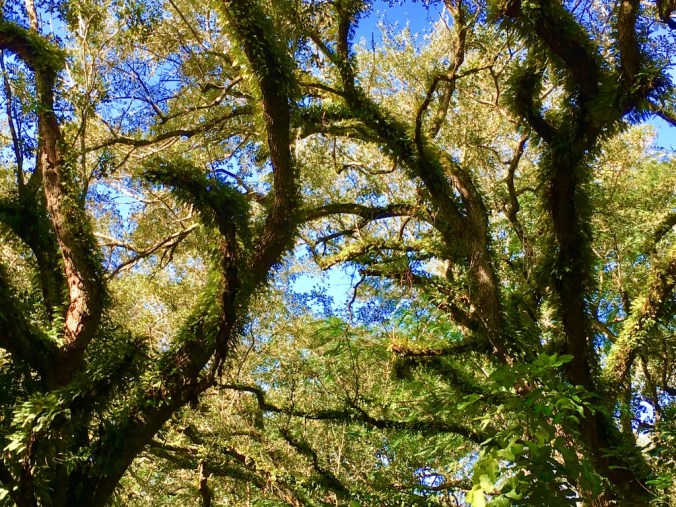
When I first heard of Tree Tops Park, I imagined a public park with treehouses and tree walkways to give visitors a bird’s-eye view among the branches and canopy. In reality, the only thing to climb is an observation tower — otherwise, visitors keep their feet on the ground and look upward. No matter how you look at them, though, the trees at Tree Tops Park are tops.

Continue reading

Field Trip: Fern Forest Nature Center


Hidden beneath the asphalt and manicured communities, the condo towers and man-made canals of southeastern Florida, there is Old Florida — very, very Old Florida.  It’s the Florida that existed long before Henry Flagler built the railroad that opened this region of the state to developers.  It is, perhaps, the Florida that greeted the first settlers.

That idea is what inspired a group of scientists from Florida Atlantic University and Broward Community College.  It was 1979, and their article, “A Tropical Fern Grotto In Broward County,” was published in the American Fern Journal.  That 247-acre grotto was actually a remnant of how Broward County once looked.  More than 30 species of ferns were found living among  200+ species of other plants, all of which inhabited swamp forests, hammocks, pinelands, and prairie ecosystems.

As a result, the land was made a Designated Urban Wilderness Area and named Fern Forest Nature Center.  Walking through the habitat, on both boardwalks and natural paths, allows visitors to take a step back in Florida history.

Much of Florida sits on limestone. Here, large moss-covered chunks make up the floor of the habitat.

The prairie habitat is adjacent to . . .

. . . the swamp habitat, where the leaves of swamp plants resemble leaves on the reflected branches.

Just about ready to bloom.

A convict caterpillar, which will eventually become a Spanish moth.

Cypress trees make up a large number of the plants growing in the swamp forest. They’re easy to identify because of their “knees.”

A close-up of cypress knees.

Air plant colonies are well established along the branches of many of the trees.

More air plants.
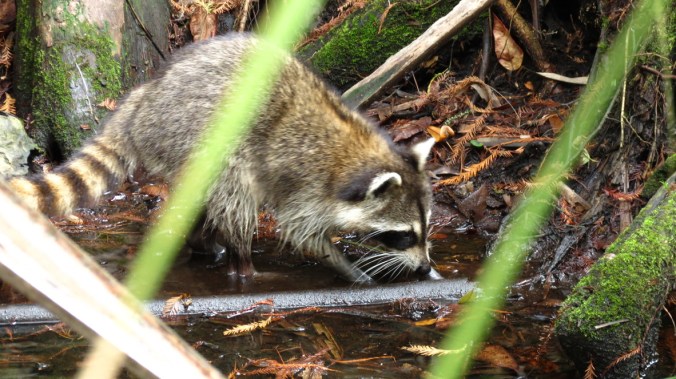
The habitat provides food and shelter for wildlife, either alone . . .

. . . or the whole family.

Fern spores on the underside of a frond.

Marlberry.

Vines are quite happy here.

I’m not sure of this plant’s identity (it could be the invasive Brazilian Pepper Tree) — I just thought it looked like it was ready for the holidays.

Fern Forest Nature Center is located at 201 Lyons Road, Coconut Creek, FL 33063. It’s open from 9 a.m. – 5 p.m., seven days a week, except for some holidays. Check out their calendar for various events.

Field Trip: Bonnet House


I’ve been intrigued with Bonnet House ever since a water taxi guide pointed it out while we were on the Intracoastal Waterway in Fort Lauderdale during one of our first vacations to South Florida. From the water, the 35 acres look like a jungle, a section of property completely undeveloped and straddling the land between the Intracoastal and the Atlantic Ocean.

Somewhere in all that greenery, though, was a house — an historic house, a legendary house. The story, according to the water taxi guide — who tells tales of all the mansions along the Intracoastal — is the house was the home of two artists, Frederic and Evelyn Bartlett.

Continue reading

Field Trip: Florida Southern College


Florida Southern College

On a recent visit to Tampa/St. Pete, as Joe and I ventured away from the metropolitan area, I was reminded of Robert Frost’s famous poem, “The Road Not Taken” — specifically the closing lines:

Two roads diverged in a wood, and I —

I took the one less traveled by,

And that has made all the difference.

Continue reading