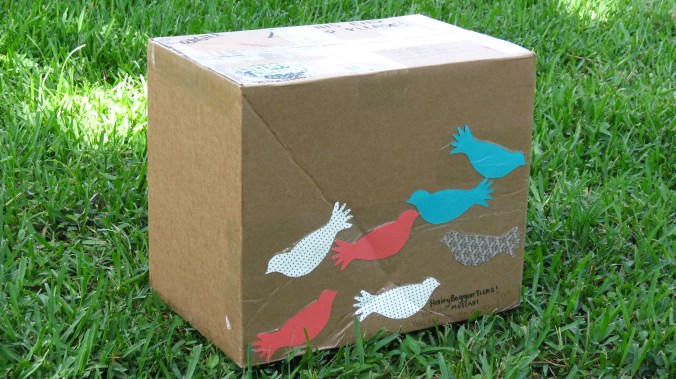
I have a long history with birds — and even though my head has been a target for wings and talons, I still love having them in the yard. Despite the amount of documentation about their intelligence (check out this fascinating documentary on crows), it’s still safe to say that birds can be — well — bird-brained.
Bloomin’ Update 52: Cactus Up Close & Personal
As a general garden rule, I do not like — and so steer away from — plants that can hurt me. Roses are about as close as I get to this thorny issue, which has less to do with the plant and more to do with me. I know me. I know that I can be careless and klutzy — and that combination, along with some blood thinners, means I can easily become a human pin cushion.
A few years ago, Joe and I asked a neighbor if he would like our cactus. It was tall, only one stalk, and never really did anything. It was just there, slightly askew — a leaning tower of needles, so to speak.
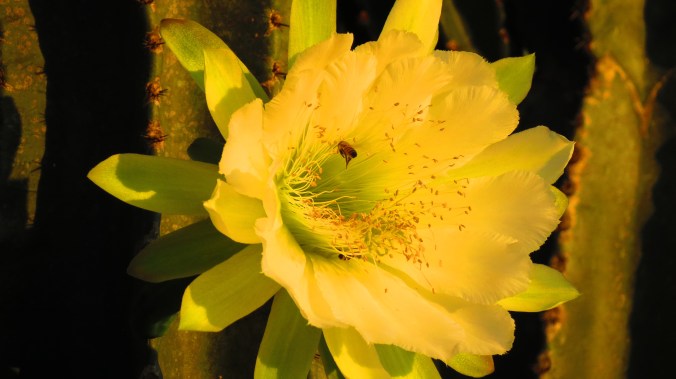
The neighbor gladly accepted the offer, digging up the cactus and replanting it along the property line between him and us — far enough and close enough at the same time. Since then, that single stalk has expanded to about seven towering stems — and it’s now in bloom, giving a whole new definition to vertical gardening.
Look quickly, though, the flowers — which bees love — only last a day.
All These Crabs Are Making Me Itch
I’m about to say something — words that I never thought would come from my mouth. Ever. It’s the stuff of whispered gossip and scribbled comments on bathroom walls.
I . . . have . . . crabs. Or rather, my lawn does.
Joe first told me about our crab infestation months ago, but I didn’t — wouldn’t — couldn’t — believe him. Sure, our lawn might not be the neatest in the neighborhood and sometimes a little overgrown, but land crabs? I’m not one to talk about the neighbors, but there are some pretty nasty lawns out there –and they’re all crab-free!
Wordless Wednesday: Toilet Brush
Bloomin’ Update 51: Gettin’ Schooled In A Nursery

I’m not sure of the name of this plant, but I was charmed by the play of sunlight igniting the leaf’s underside.
Much of my garden time in South Florida is not actually spending time in the garden at all. So far, it’s been about meeting other gardeners, visiting nurseries, reading books, taking notes, and asking questions. I’m a stranger in a strange land here, a zone six-ish gardener in a zone 10 world.
When I learned the local garden club had organized a Saturday field trip to a local nursery, I jumped at the chance to do all of the above — although, I do have to figure out a way to take notes while balancing a camera.
Quinoa Seems To Be The Hardest Word
There are some words and phrases in the English language that completely baffle me. You might even say they are my phonetic foibles.
Awry is one of those words. When my eyes come across it in a sentence, my mind immediately wants to pronounce it as aw-ree. When I do, it’s followed by a momentary beat and I say to myself, “Oh, it’s uh-rye again.”
That’s fine if I’m reading quietly, but not if the word should make an appearance mid-paragraph if I were reading aloud. In that situation, I don’t think there’s such a thing as even a little-bit pregnant pause.
A new word joined the list just a few years ago. Quinoa. Sorry doesn’t seem to be the hardest word, Elton. Quinoa is. If I see it on a menu or in the grocery store, my first impulse is to say, kwin-o-uh — like it’s a summer camp on the shores of a Catskill lake. It never ever occurred to me to pronounce it as keen-wah.
History, Herstory, Our Story — And Giveaway!
Very often, when gardeners walk through the well-tended garden of another gardener, the first impulse is to notice the plants, the textures, the play of color from one bed to the next. Quickly behind that assessment is the acknowledgement — and admiration — for the work and thought that went into creating their garden paradise.
It’s that thought which makes The Victorian Gardener (Shire Publications), by Caroline Ikin, such a fascinating book. Written with Ikin’s keen eye for detail and passion for all things Victorian, the book is a tribute in both words and photos to the men — and eventually the women — who made gardening their life’s work, who tended some of the most famous estate gardens in the world, and who did much of the work with their hands, muscles, and brains.
I recently had the chance to speak with Ms. Ikin, whose previous book, The Victorian Garden, was also featured on this blog.

The garden staff propagated and potted thousands of bedding plants each year.
Photo courtesy of The Garden Museum/London.
NGDM: This is very exciting for me, since you mentioned you were working on this book in our earlier interview promoting The Victorian Garden. In that interview, you mentioned how drawn you were to the Victorian time period — the people, the technology, the role of women. Did anything surprise you in your research for The Victorian Gardener?
CI: It is astounding just how dedicated these young men were in the pursuit of their chosen career. To become a gardener they had to work their way up through the ranks of the profession, moving from garden to garden to gain experience and often living in very basic accommodations. They were expected to study in the evening, keep detailed journals of their progress, learn Latin, bookkeeping and geometry, and never really had any time off as the glasshouse vents had to be opened whether it was a weekday or a weekend.
It was inspiring to research the lives of the pioneering women gardeners who enrolled in training courses and overcame prejudice to gain employment as gardeners alongside men. However, my admiration of this achievement was tempered by the fact that many of these women abandoned their fledgling careers after a year or two to get married, forsaking their hard-won vocation so rapidly.
NGDM: At first glance, The Victorian Gardener appears to be a history book — or a tribute — to Victorian gardeners and their contributions to gardening today. I must tell you, though, that as I read your book I felt I was reading more of a family tree than a history book. I felt a very strong connection to the men — and eventually the women — who toiled in the garden. Was that your goal when you set out to write this book?
CI: There has been a lot written about gardening and garden design, but very little about the history of the gardening profession. I wanted to research the lives of the people who toiled behind the scenes to create such spectacular gardens for their employers and learn how they accomplished so much with the resources available to them at the time. It took a lot of dedication to become a gardener in the Victorian Era and there was opportunity to be grasped by the most ambitious young men. The faces looking poignantly out of the old photographs hint at untold stories and it was this history I wanted to explore.

Female students learn the art of pruning at Studley College, 1910.
Photo courtesy of The Garden Museum/London.
NGDM: In our previous interview, you mentioned that the class structure and social conventions of the Victorian Era would prove too limiting for you. For many Victorian women who gardened, that seemed to be true as well — but as a male reader, I must say I was very impressed with the dedication that these gardeners displayed for their craft. What do you think they could teach us about gardening? What do you think they would think of gardening today?

Apprentices and experienced gardeners are pictured together.
Photo courtesy of The Garden Museum/London.
CI: The Victorians recognised the value of apprenticeship where experienced gardeners would pass on their skills to the next generation. Their methods were based on trial and error, learning from experience and working with nature. Victorian gardeners did not always understand why their techniques worked; they just knew that they did.
When scientific discoveries demystified the nature of botany and processes such as photosynthesis were understood, the gardening profession was elevated to a new level and training courses were established to teach gardeners not only the practical skills necessary to grow plants, but also the science behind the practice.

A multi-bladed shears advertisement from Gardening Illustrated, 1879.
Photo courtesy of The Garden Museum/London.
Just as we do today, Victorian gardeners had to embrace new technology and innovative gadgetry, and experienced gardeners seemed remarkably adept at distinguishing the useful from the worthless. It is no surprise that basic tools such as the trowel and the rake have been in use for centuries with no change to their design.
Although the working conditions of gardeners have improved since Victorian times, it is still a profession where you have to start at the bottom and work your way up, learning all the time from other gardeners, studying books on botany and plant propagation, gaining experience in gardens with different types of soil and climate, working long hours and on weekends.
I think a Victorian gardener time-travelling to a garden in the twenty-first century would recognise a lot of what he saw, and would be disappointed to see that, despite advances in science and technology, there was still no effective way of getting rid of slugs, that weeding was still done by hand, and that water was carried around in a watering-can.
NGDM: As in your previous book, the artwork and collection of photos is astounding! When it comes to putting it all together, how difficult is it for you to narrow down your selection?
CI: I was very fortunate, as I was with my last book, to have access to the extensive collection of archive images at The Garden Museum in London. Although there are many group photographs of Victorian gardeners posing with the tools of their trade, it was quite tricky to find portraits of named gardeners, as few were recorded for posterity in this way, which reflects their status in society. It was also very difficult to find enough colour images to satisfy the publishers – all these remarkable photographs are, of course, in black and white.
NGDM: Two photos in the book jumped out at me — and they’re both of women. One has a woman in full Victorian attire — as if she were going to a garden party — while pushing a lawn mower. The other features a trio of women in men’s clothing. When you’re in your own garden, what’s most comfortable for you to wear?
CI: I love that photograph of the women gardeners at Kew, looking rather defensive in their breeches and boots. The staff at Kew were put in a tricky position when they took on these first women gardeners as there was no precedent for female gardening attire – women would not dare to show their ankles, let alone don a pair of trousers! The voluminous skirts of Victorian fashion were liable to squash the plants, and frills and lace were hardly practical for digging, barrowing and muck-spreading. The decision to allow women to wear the same clothes as men may seem like a radical act of equality, but I suspect it was made out of necessity and a lack of other options.
The idea of wearing a shirt and tie and a three-piece suit for gardening does strike me as uncommonly impractical, not to mention uncomfortable – I prefer jeans and a T-shirt and a sunhat (I’m very much a fair weather gardener, I’m afraid).

Breeches, boots, and aprons on the female students at Glynde School, 1910.
Photo courtesy of The Garden Museum/London.
The Giveaway:
What gardening clothing or garden tool could you not live without?
If you would like to win your own copy of Caroline Ikin’s The Victorian Gardener, please leave a comment about the garden clothing or garden tool you could not live without. For a second chance to win, please visit the Nitty Gritty Dirt Man Facebook page, and answer the same question there.
Entries should be received by Friday, May 16. A winner will be announced on Sunday, May 18.
Thanks for participating — and Happy Mother’s Day!
Repost: How To Read A Palm
I recently participated in a weekly Twitter discussion group called Garden Chat. This particular chat was hosted by Teresa Watkins of Earth Shattering Gardening and the subject was fruit trees. Most of the conversation had to do with apples and pears, best growing practices, advice, and such. That got me thinking about the fruit trees — the only fruit trees — I currently have growing in my Florida yard.
Here’s a look back at a tribute to Cocos nucifera, the coconut palm.
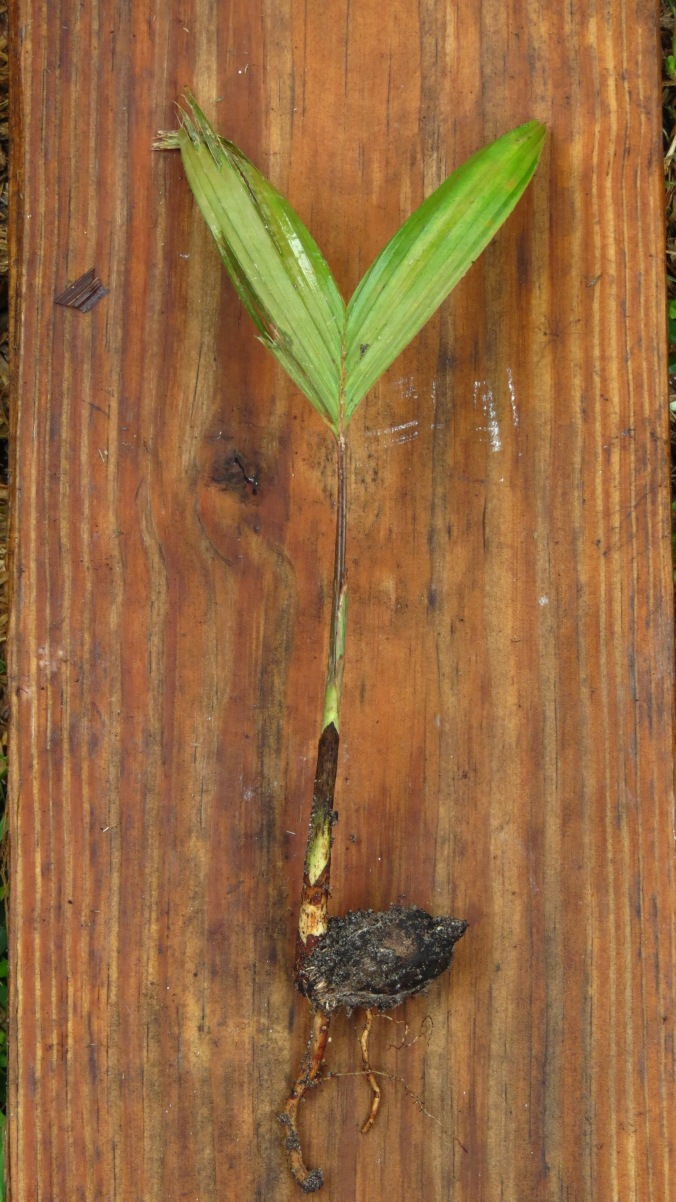
A few days ago, Joe and I found a coconut that had already begun to sprout. Within days of planting it halfway in the dirt, and in a location where it could receive plenty of water and heat, the tightly curled sprout had stretched open (above). It’s amazing to think that this tender green is strong enough to pierce the coconut’s hard shell.
On the other hand, it’s not so surprising when one considers the gift that is a coconut palm.
According to Dr. T. Ombrello, a biology professor at Union County College, the coconut palm is considered to be one of the most useful trees in the world. Parts of the tree can be converted into roofing, fencing, alcohol, shoes, soil amendments, mulch, and so much more. In fact, a recent study indicated 360 uses for the tree, half of which were for food. Even Marco Polo had something to say when he first came across this tree: “One of these nuts is a meal for a man, both meat and drink.”
When a coconut palm is about five years old, it begins to produce both male and female flowers. The pistillate, or female, flowers, are large and spherical. The staminate, or male, flowers are smaller. Initially, the flowers are hidden by a sheath. When the sheath begins to split, it seems to resemble a corn husk.
Within a day, the cream-colored flower branches, or inflorescence, have emerged — and bees are busy at work.
As the inflorescence is exposed to sunlight, it turns a vibrant green.
Don’t be fooled by the frail-looking flower branch. Eventually, it will hold the weight of a whole lot of coconuts. In the course of a year, each coconut palm tree can produce between 25 and 75 coconuts.
That’s 25 to 75 possibilities of coconut water, milk, meat, and, of course, more palms.
Bloomin’ Update 50: Slowly, Softly . . . Spring!
Spring. It’s the word and the season that seems to be on everyone’s lips this year — mine included. Perhaps it’s because this past winter was less wonder and more blunder.
Even the posts of this blog have been overly devoted to thoughts of spring. First there was the lament over the loss of the season as I’ve always known it. Then came the quest to discover spring in my new surroundings.
And now, here is a return — if only for a week — to my Long Island roots, where Joe and I visited family and friends for the Easter holiday. As we spent time at Joe’s sister’s house with her horses, and then at my parents, it was clear that this spring is like no other.
The lingering winter chill seems to have spring pressing the snooze button. The season isn’t too quick to reveal all of the richness and fullness of its colors — but the hints are everywhere. Sunny breezes. Songbirds. Peeks of green that seem to multiply with each new day. And a mid-April snow, winter’s reminder that spring best take its time waking up.
Yes, Ponce de Leon, There Is A Spring
A few posts ago, I found myself in a bit of a spring funk. On the one hand, I was excited about spring’s arrival — after all, little darling, in the words of Lennon, Harrison, and McCartney, it’s been a long, cold, lonely winter.
When spring arrived, I was in south Florida — where it’s not so much here comes the sun but rather there is always sun. No one but me seemed to notice that the earth was standing a bit more upright as the northern hemisphere tilted toward the sun. In fact, one deejay wondered aloud on air, “Does South Florida even have a spring?”
Of course, South Florida has a spring. I’m just not sure when it actually happened. I think it was that morning when it was about 70 degrees for a few hours.
Many of you suggested I talk to some locals in order to get a better understanding of spring in these parts. And that’s exactly what I did. Feeling a bit like Ponce de Leon in his search for the Fountain of Youth in Florida, I became an explorer in search of my own newly sprung spring.
Since I don’t have a garden here, I turned to the gardens of my neighbors for some springtime inspiration. On one side, my neighbor has a wildly overgrown bed — for lack of a better word — of banana trees. They’re a bit weed-like — and I’m itching to get in there to clean out the dead leaves and stalks — if only to reach up and grab what is just out of reach from my side of the fence.
The neighbor on the other side has a very lush, attractive landscape — including this hidden heliconia.
Hanging over our shared fence are the branches and blooms of brugmansia, more commonly known as angel’s trumpets. It’s one thing to stand on my side of the fence and take in all of the pendulous blooms . . .
. . . and quite another to lay down in its shade and look upward.
But bananas and brugmansia hardly a spring make. What about bulbs and songbirds, bed cleaning and nurseries stocking up? In fact, nurseries here always seem to be full of potted products — and so the seasons seem to flow seamlessly, perhaps even unnoticeably.
I went in search of experts — and I didn’t have to go far. Charles Livio is the horticulturist for Oakland Park, FL. (Yes, the city has its own horticulturist!) In the summer of 1972, Charles and his family left the New York metropolitan area and arrived in South Florida.
“Yes, our spring is radically different here in our sub-tropical climate,” said Charles via email. “First, let’s throw out that children’s calendar rhyme from up north, ‘April showers bring May flowers.’ First of all, we have flowers blooming all year long, and second, April is not a rainy month here. Our rainy season is normally from late May through early October.”
Echoing this same idea is a regular reader/commenter of this blog, Mary Collins, who is the senior horticulturist at Fairchild Tropical Botanic Gardens in Coral Gables, FL. Like Charles, Mary is a South Florida transplant, having arrived in 1973.
“I describe the seasons in South Florida like this,” Mary wrote in a recent email. “Winter: December, January, February is cool and usually dry. Spring: March, April, mid-May is warmer, dry and windy. Summer: late-May, June, July, August, September, mid-October is hot, humid, very rainy, stormy, with June and October often being our rainiest months. Fall: late-October, November is a bit cooler and less humid.”
Now that I have a better understanding of the seasons, I wonder if I’m still missing something. Up north, spring meant excitement. It meant life. It meant green.
But in a land that is perpetually green, where this year’s spring temperatures feel more like a New York summer, where is the excitement? I mean, there are always shoppers in the nurseries but not in the numbers as up north — and much of that might have to do with the limited time gardeners have in colder climates.
Do South Florida gardeners take seasons for granted? Why get excited about any season if the changes are barely perceptible? The answer to my question could not have been more obvious. When searching for garden excitement, talk to a gardener.
At the mention of spring, both Charles and Mary responded with the feeling that I feared was lost — and their excitement for spring is infectious.
“Springtime in South Florida is much more subtle than up north, but there are things to look forward to,” wrote Charles. “In late winter/early spring, the purple trumpet trees are in bloom, followed by the pink trumpets, and then the yellow trumpet trees are masses of gold by April.”
Similarly, Mary picked up the call of the trees. “There are several beautiful trees which bloom during the spring, including the shaving brush tree (Pseudobombax ellipticum) with pink or white blooms and our native lignum vitae (Guaiacum sanctum) with beautiful violet blue flowers.”
Several trees experience both fall and spring at this time of year. According to Mary,
“This is the time of year when our live oaks (Quercus virginiana) and mahogany (Swietenia mahogany) trees drop their leaves. The oaks produce small, inconspicuous flowers and new leaves shortly after their last year’s flowers have dropped. Mahogany trees also produce new leaves shortly after their old leaves have dropped. Both the oaks and the mahogany are described as being ‘briefly deciduous.’”
Briefly deciduous. Now that’s a term that can get me revved up about spring, that makes me want to go outside and get dirty, to try my hand at some seed sowing in this climate. If I were in New York, I would have already started seeds in advance or patiently waited for the soil to warm up to direct sow. The soil in Florida is already nice and warm, so . . .
Charles offers a word of caution to slow down. “If you were to plant your garden down here the same time in the spring you planted it up north, you would be missing 2/3 of our vegetable growing season. Cool weather crops have already been harvested, and the warm weather crops are being picked. Our very warm and humid summers are not conducive to growing most vegetables. If the insects don’t get you crops, the diseases will. However, there are some tropical crops that will produce during our summers, such as cassava [yuca], pigeon peas, malanga [a root vegetable] and chayote [it’s easier to provide a link for this edible tropical plant]. We may not grow apple, pear, and cherry trees down here, but we have mangoes, avocados, and papayas!”
Mary added: “Spring in this area means orchid shows and spring plant sales. This is an excellent time to purchase plants for your own garden. Don’t forget to plant some of our South Florida native species for our native birds and butterflies! It’s a wonderful time to go for a hike in the Everglades! The water levels are at their lowest; the wildlife is found near the remaining water holes, and the ‘Glades prairies are filled with wildflowers.”
So to answer that South Florida deejay who openly questioned if South Florida even had a spring, the answer is, “Yes, Ponce de Leon, there is a spring.” You just have to know where to look and what to look for. According to both horticulturists, there is one plant in particular that can lead the way. Bougainvillea is at its brightest and boldest at this time of year.
And that’s cause for excitement no matter where spring is springing along.