Bloomin’ Update 66: The Discontent Of Our Winter


Nothing burns like the cold.

George RR Martin wrote those words as part of the prologue in one of his Game of Thrones books – and all I could think about were my plants wailing these same words, as a record-breaking cold front moved down the Florida peninsula and into the Caribbean.

Overnight temperatures hovered just above the freezing mark and wind chills dipped into the mid-20s, making South Florida feel colder than an air-conditioned Publix on a summer’s day.

Many of my northern friends scoffed at me each time I mentioned how cold it was in South Florida. I get it, I really do. I remember, not so fondly, those frigid January and February days. It’s one of the reasons February was always my least favorite month. The icy cold made the shortest month feel like the longest.

By Florida standards, though, this was cold – especially for plants. In northern gardens, plants have three seasons to prep for winter’s icy return. In southern portions of Florida, however, there’s a 12-month growing cycle – and there’s no season for bracing. It’s always warm until it’s not.

Prior to the front’s arrival, I moved all of the delicate and tender potted plants –orchids, succulents…
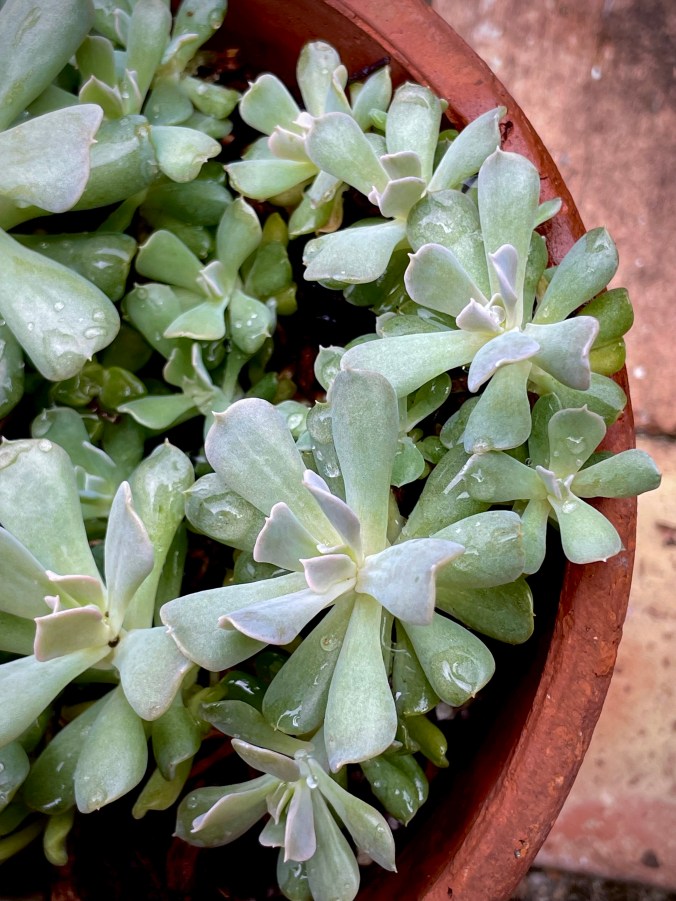
and newly rooted propagations, like dwarf jatropha trees and angel wing begonias —
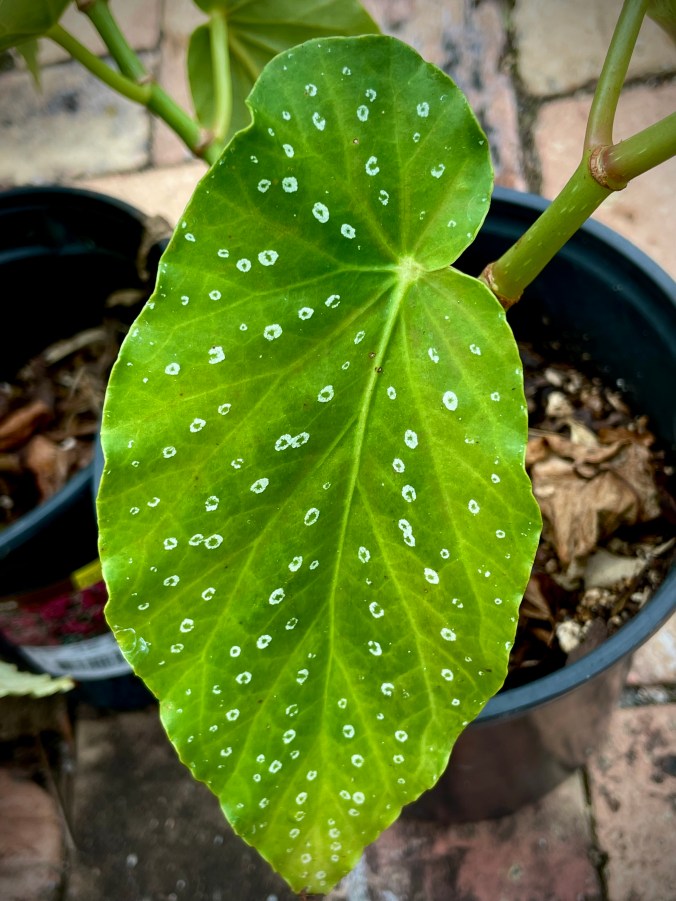
into the garage.
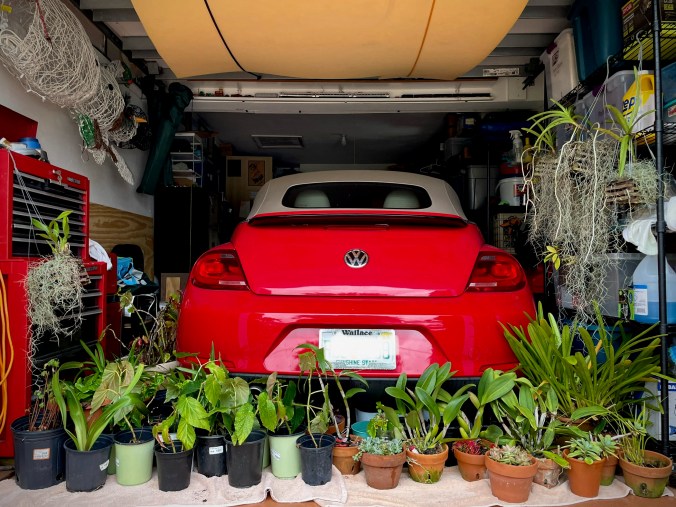
Orchids tied to trees or anything planted in the ground were on their own. Yes, I could have covered them, as I did a few years ago, but this was then…
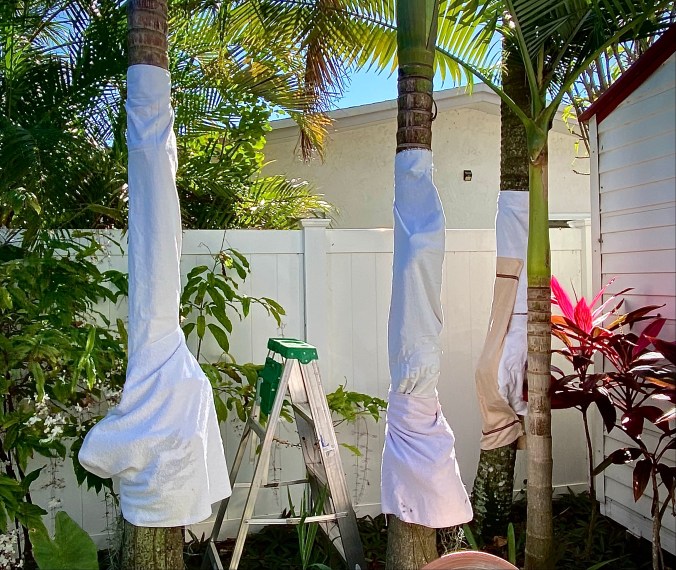
Prepping for a cold front two years ago.

… and this is now. The gardener that I am today is tired and still cares, but not as strongly as I used to. As far as I was concerned, it was time for the plants to put on their big girl leaves and to shiver their timbers. If they didn’t make it, it was a sign to redo some landscaping and to shop for replacements.

After several days and nights – yes, iguanas fell from the trees, some killed by the cold – temperatures warmed enough for me to bring everything outside again. As I walked around the yard, I noticed that the leaves on some of the plants showed signs of cold burn.
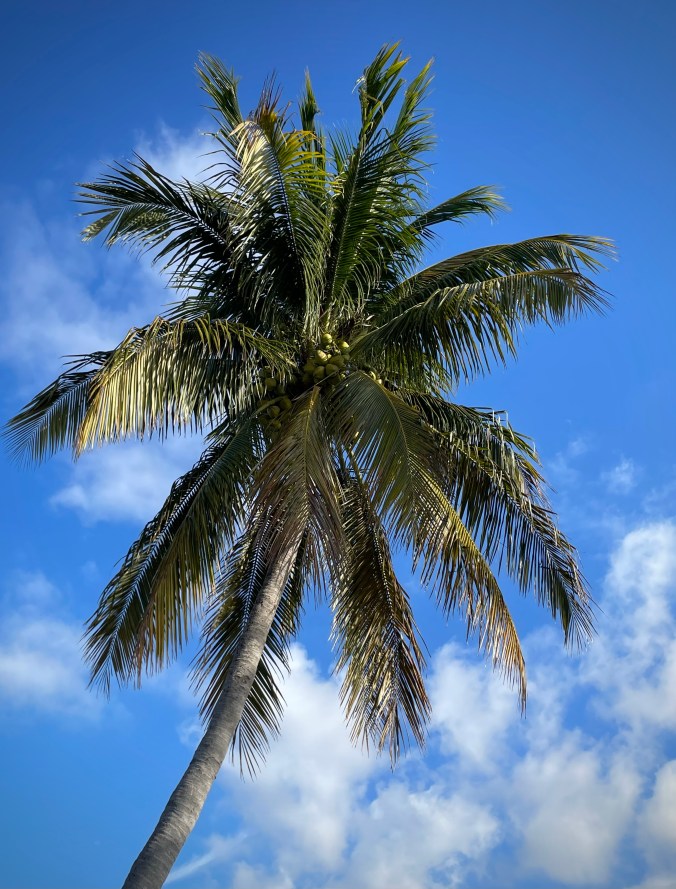
The tips of several palm fronds were tinged with brown. In time, these fronds will fade from green to yellow to crispy brown, and then fall. It’s all a bit sacrificial… they did their job in keeping the heart of the palm warm and alive.

The green and white variegated patterns of Java White copperleaf had dulled and browned.
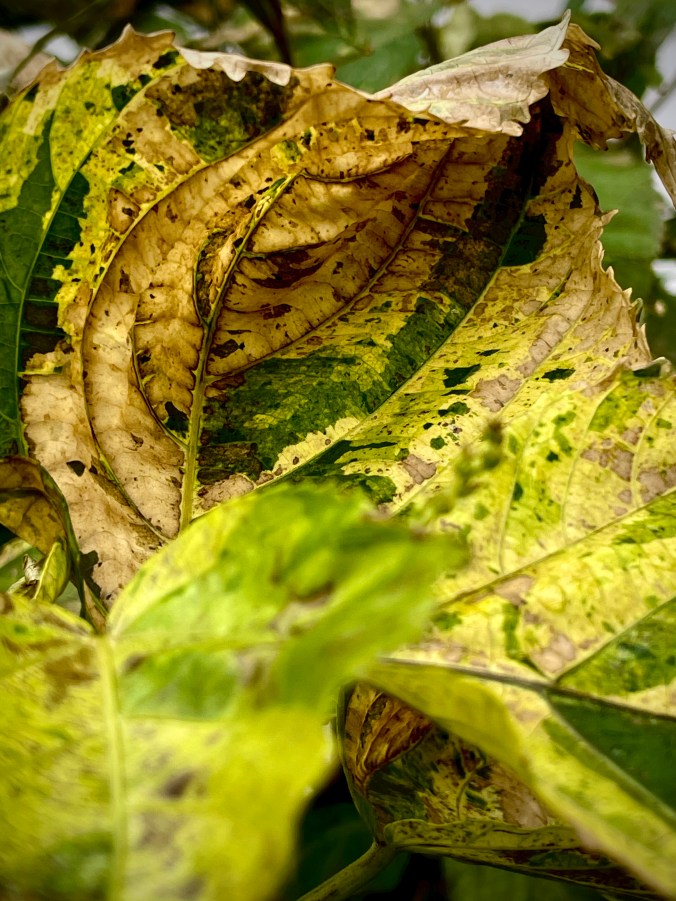
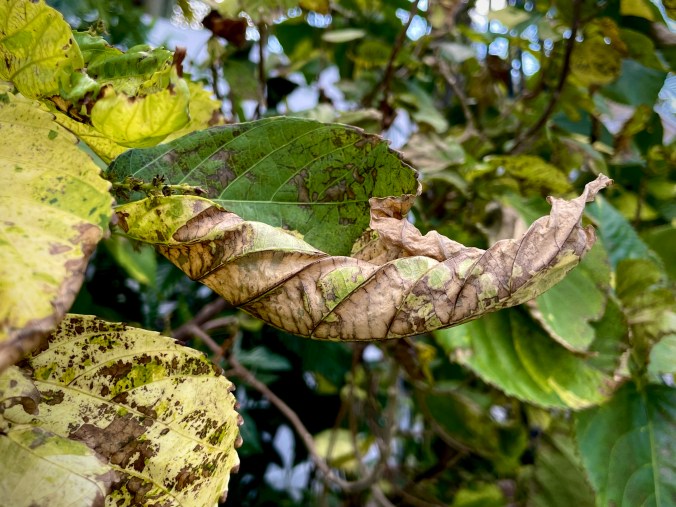
By far, the plant that took the hardest hit was the chenille shrub. Leaves that had once been lush and green just days before had withered and curled.
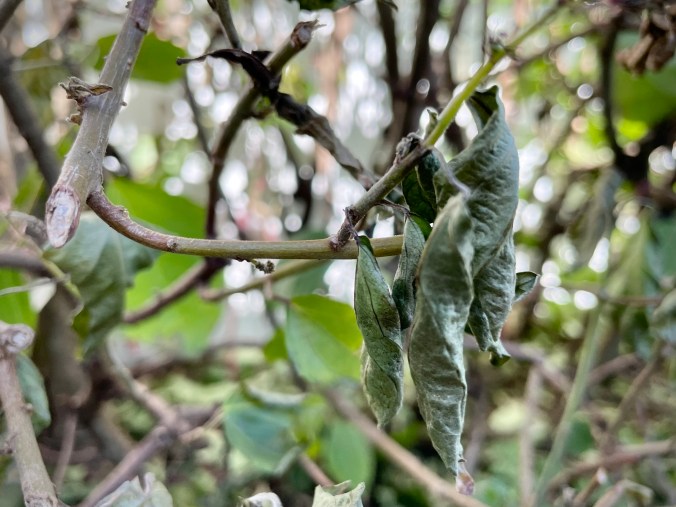
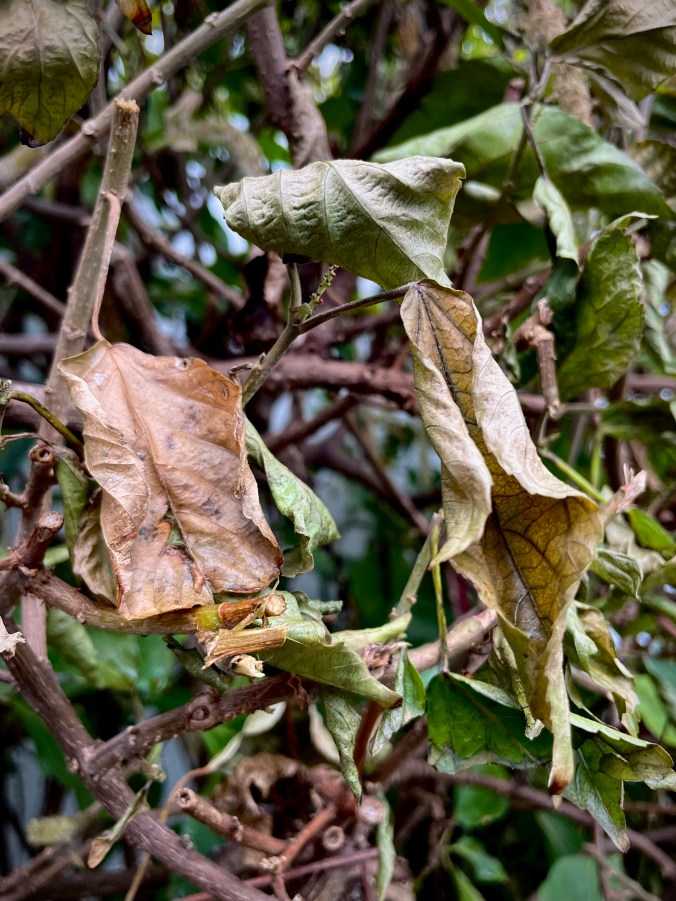
Then, they browned.
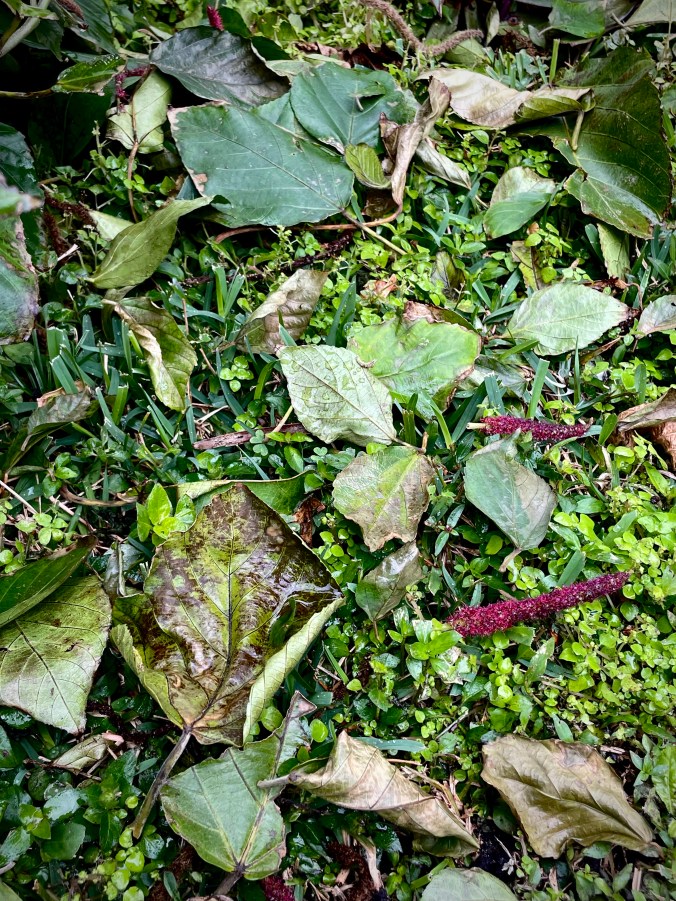
Ultimately, the leaves littered the ground, like trampled confetti.
I shouldn’t be able to see the white fence through the chenille shrub.
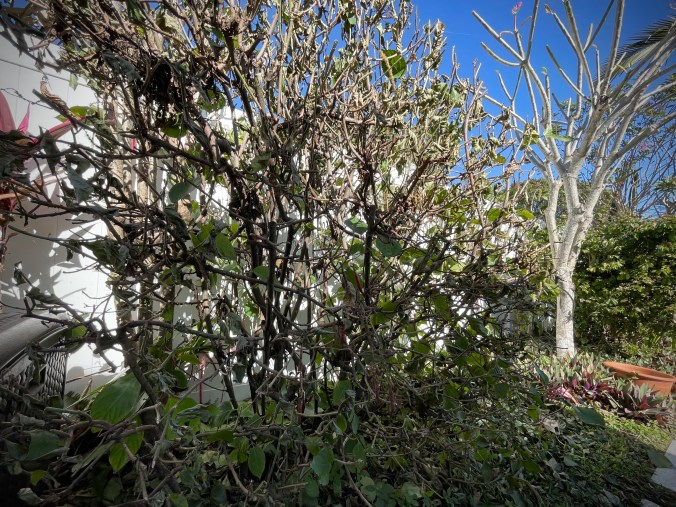
I wrestled with what I should do. Should I prune the plant back to stimulate new growth… or should I just hope that new leaves will appear along the branches? Ultimately, I decided to keep it well-watered and to take a wait-and-see approach.

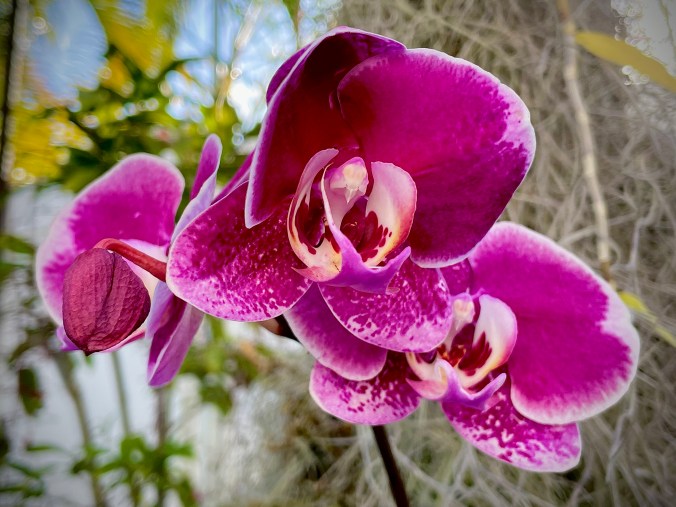
While waiting to see, though, I was struck by the plants that seemed to weather the weather. While I can’t tell if unopened orchid buds on the plants tied to palm trees aren’t damaged, this one managed to hold onto its flowers.
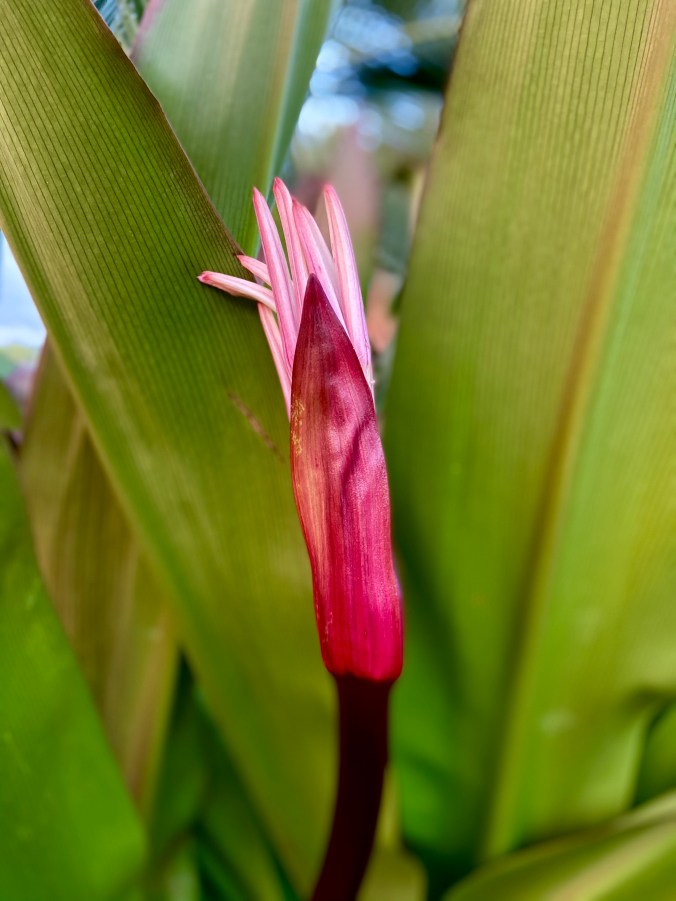
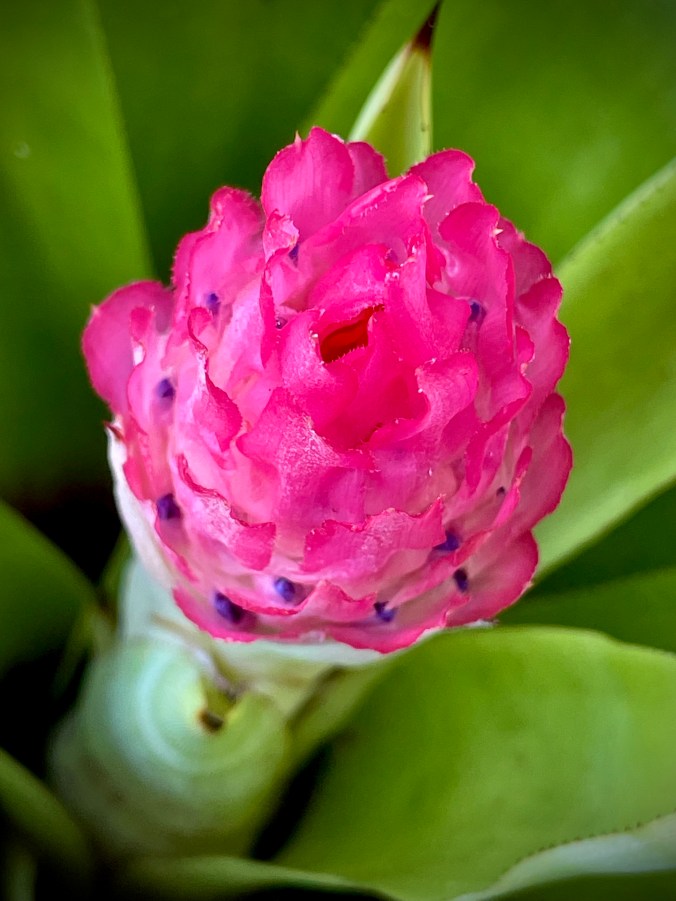
Meanwhile, this newly emerging bromeliad appeared to have laughed at the cold.
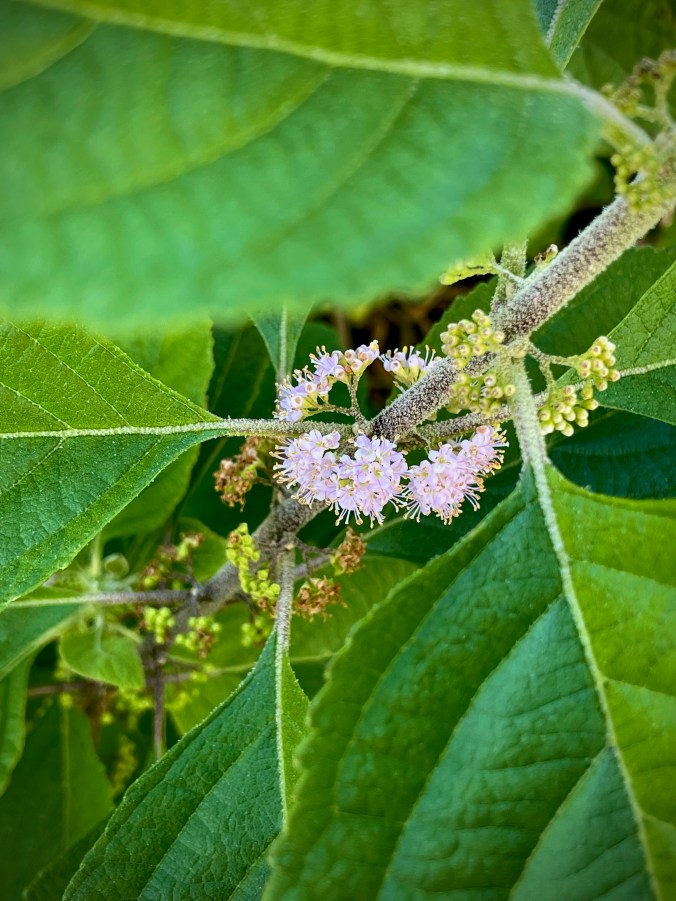
Florida natives, like blue porterweed (foreground) and American beautyberry (just behind the porterweed), did remarkably well.
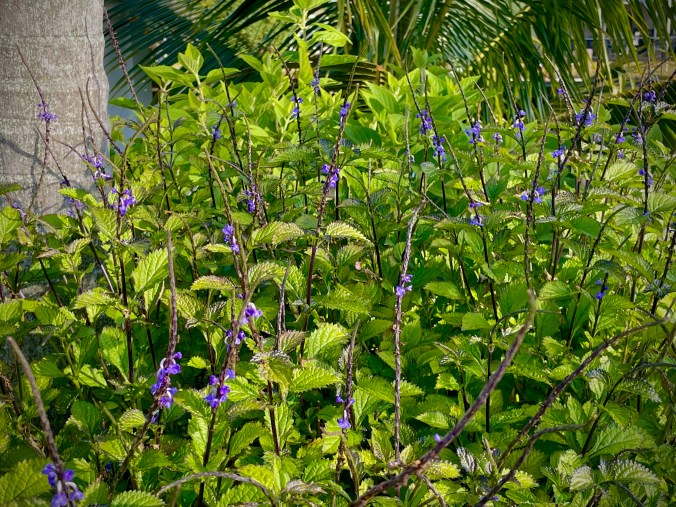
The delicate American beautyberry flowers didn’t even flinch — and will eventually transform into clusters of purple berries.
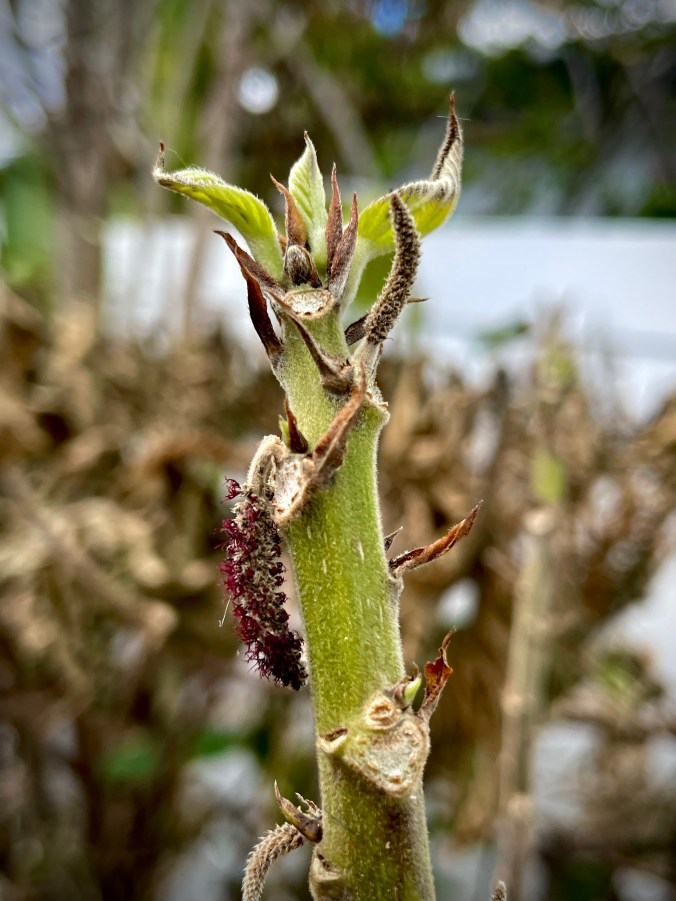
Nevertheless, I was worried about the chenille plant. Each day, I’d walk by it, examining it for new growth and dumping buckets of water around its base. Then, this appeared at the tip of one of the upward growing stems.
Just before posting this, I did another inspection of the chenille plant and spotted this speck of green on one of the lower branches.
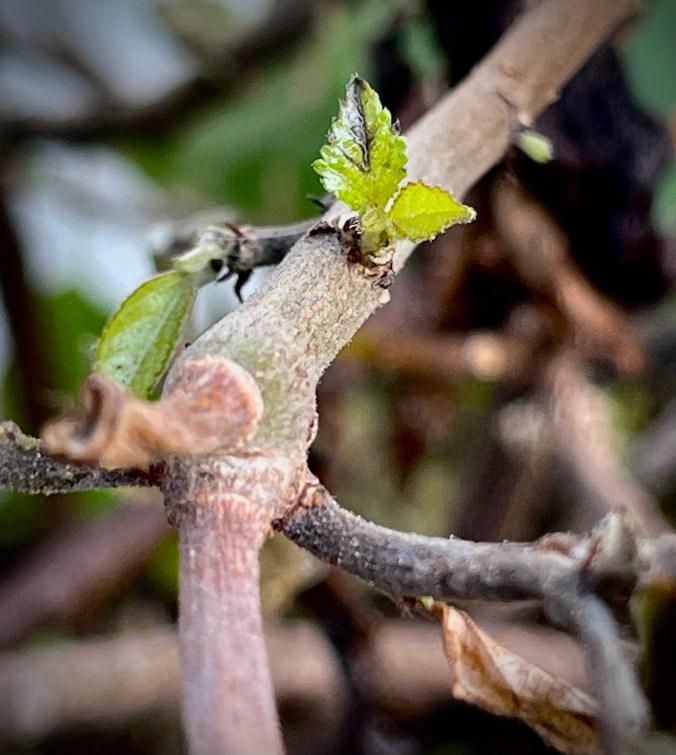
As I stepped away and adjusted my eyes, I couldn’t help but notice small specks of green on many of the lower branches — leaves that would eventually fill in and prevent me from seeing the white fence behind it.

It’s a wonder what a little bit of green can do to a gardener’s soul.

It was hope.

My intention was to keep this post strictly about plants, but as I wrote about the cold weather in Florida, I couldn’t help but think of winter… really think about this winter.

While meteorologically this winter has been one of the coldest, it has also been just as cold politically. Not a day has gone by when ice or ICE hasn’t controlled the daily headlines.

When that thought ran through my mind, I reflected on the events in Minnesota, specifically the murders/executions of Renee Good and Alex Pretti at the hands of ICE agents, who were just following the orders of this regime, which then turned to lies and smears to coverup the crimes. Like many of you, I was horrified and sickened and angry. God, was I angry.

And then I thought of the Minnesotans… tens of thousands, hundreds of thousands… bundled up in winter gear, taking a stand in bitter temperatures… their message of resistance filtered through a frosty fog of breath and spreading across the country.

It occurred to me that hope isn’t always green, as I wrote in this post. This winter — the winter of our discontent — hope was wrapped in layers of wool and down coats, scarves and hats and ear muffs, gloves and mittens and boots.

I just want to thank you for giving me that hope… and may that hope continue to grow throughout our seasons, no matter where we live.

Bloomin’ Update 65: An Orchid’s Life


Just as summer was flowing into autumn — which in south Florida means summer heat becomes autumn heat — I couldn’t believe what I saw on one of my orchids. It was a large bud, swollen and green with a collection of tiny ruffles at the tip. The timing of this blossom may have been a coincidence, but I jumped on it as one of the hints that fall was actually happening in my part of the world. Continue reading

Bloomin’ Update 64: Harvest Days, SoFlo Style


Sometimes, it’s easy to forget it’s autumn. That has become my annual thought the longer I live and garden in South Florida. I know many plants, even down here, have a season, but it’s not until I see the national weather forecast for the Dakotas, my friend’s pictures of her New England view of painted leaves, and other garden blogs filled with photos of gardens in seasonal transition that I truly realize that the times, they are a-changin’.

It’s at this moment, in a land where most feel there are only two seasons — hot and hotter — that I become more aware of the later sunrises and earlier sunsets, and of the shimmering, golden hue of the sunlight in the late, late afternoon. We were even given a small tease as a weak “cold” front made its down the Florida peninsula for a day, delivering — at the very least — a drop in humidity. Other than that, though, autumn here is pretty much summer.

On the other hand, the combination of these subtle changes and a pandemic that’s kept me firmly planted at home has given me a reason to not only harvest bananas (above), but to also collect seeds and start new plants.

Pride of Barbados

This small flowering tree or tall flowering shrub began as a gift from friends. As hard as I prune it to keep it short, it seems happiest when it’s allowed to fully grow upward. Then, at the top of its stems, clusters of orchid-like flowers bloom. In turn, these are followed by dangling seed pods, which I quickly collect before they pop open so I don’t have a forest of Pride.

One pod I let dry on my potting bench. When I cut it open, I was surprised to find the seeds in an alternating pattern. I’m not sure if this is typical or a quirk of this particular pod. Either way, I was still impressed that nature could produce something so perfect and symmetrical.

I planted some of the seeds. Within days, they sprouted and now I have a pot of seedlings that need to be potted up. I’m still not sure if I’ll plant these when they’re a little older or if I’ll give them away.

Mexican Cotton Plant

One of my favorite plants that I’ve grown is Mexican Cotton Plant. I have mine in a pot, and I’ve always been able to keep it pruned to encourage branching and stronger growth. This year, though, something happened. After flowering, it produced the buds that would eventually open to reveal cotton. That’s when I noticed the leaves dying. My hope was for the plant to live long enough for these buds to mature, but that wasn’t the case.

I harvested the buds and let them dry. In a matter of days, they popped open, revealing the cotton balls. I pulled out the cotton, each piece of fluff covering a seed. These are now planted and I’m waiting for them to sprout.

White African Iris

Last year, a friend gave me some seed pods from his White African Iris. I dried the pod, removed the seeds, and planted them. They are now flowering for the first time.

Crinum Lily

One of my favorite plants is the Crinum Lily. Large and tropical, the plant is related to amaryllis rather than lilies — and it can easily fill a bed with its sword-like leaves. The treat is when they send up a flower spike (above). Within a day, the flower cluster opens even more (below).

They also spread. One way is for the mother bulb to produce pups. These can be separated and then planted. I tend to do this on a regular basis to keep the mother plants looking clean and neat.

The other method is fascinating. When a flower is pollinated, a bulblet forms on the flower spike. As it matures, its weight will either help bend the flower stalk to the ground or it will simply fall off. Recently, while cleaning the Crinums, separating pups, and weeding, I found a bulblet that had fallen to the ground, where it had germinated. At first glance, I thought the withered bulblet was a stone.

King Palm

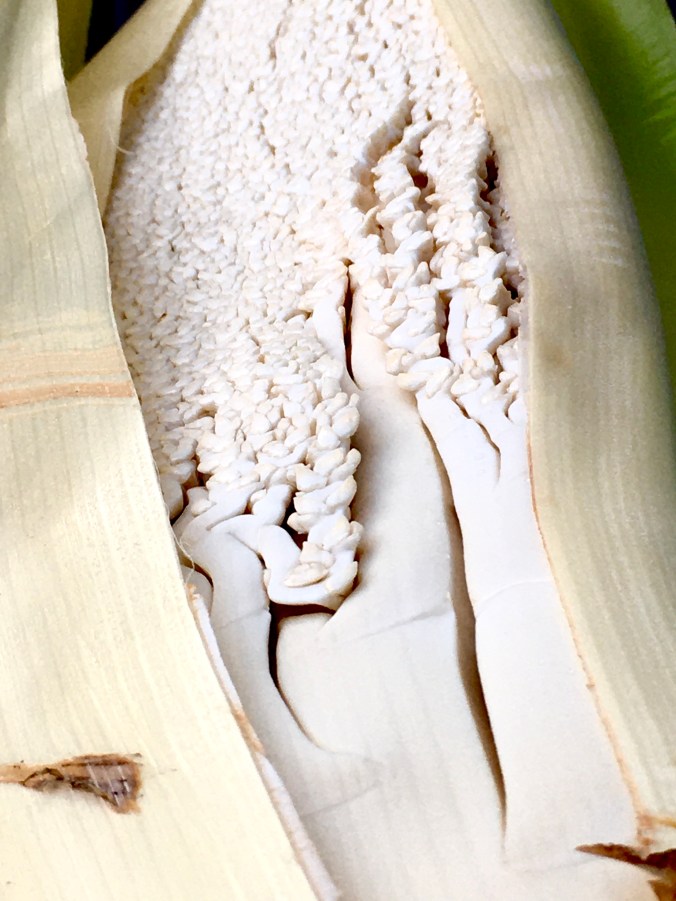
Normally, when  palm trees produce their inflorescence, Joe cuts them off to prevent becoming overrun with sprouting palm trees everywhere — except this time. I was interested in harvesting seeds from the King Palm, so we let the hull-like structure (peduncular bract) that contains the small flowers remain attached to the tree. The photo above is of another peduncular bract that we cut in half to see how tightly packed the inflorescence is.

After a few weeks, the bract popped open, revealing its multi-branched inflorescence.

In time, the inflorescence branches spread and bees are drawn to the hundreds of small beige flowers.

Back To The Bananas

I realize bananas may not be everyone’s idea of a fall fruit. That title usually belongs to apples and pears and pumpkins. This year, though, the banana plant happened to produce just in time for a fall harvest — and there were lots of bananas. I added them to cereal, shared them with neighbors, froze some for future use, and tried my hand at banana bread for the first time.

My neighbor’s recipe called for loaf pans, but all I had was a Bundt pan — so that’s what it had to be. Not as tasty as my neighbor’s — but all in all, a delicious way to celebrate the season in a SoFlo way.

Garden Secrets of Bunny Mellon Giveaway

I wanted to take a few moments to thank everyone who participated in the recent giveaway of Garden Secrets of Bunny Mellon, by Linda Jane Holden, and to congratulate Carol H. for being the lucky winner!

Bloomin’ Update 63: Fancy Plants


Recently, I took a long overdue stroll through a local South Florida nursery. I wasn’t expecting to take photos — this was supposed to be a quick trip to pick up some vinca for some of the pots in the backyard.

Continue reading

Bloomin’ Update 62: The Glorious Gloriosa Lily


I’ve become a little bit obsessed with the Gloriosa Lily ever since I spotted it casually rambling over my friend Neil’s shrubs. The vining plant was so intertwined with the neighboring plants that it looked as if its exotic flowers were part of the shrubs. On top of that, the flowers last a very long time when cut and placed in a vase. Even the cut buds eventually open!

Continue reading

Bloomin’ Update 61: Seeing Red, White, Purple, & “Green”


I can’t think of a better way to celebrate the arrival of spring than with a display of vibrant colors, a site for eyes sore from the dreary grays of winter. Even South Florida, often accused of not actually having a change of seasons, wants to get in on the spring act.

Continue reading

Bloomin’ Update 60: An Autumnal Interlude


If the transition from winter to spring in South Florida is subtle, the one between summer and fall is practically invisible. While autumn is already a few weeks old — according to the calendar and posts from northern gardeners — the weather forecasters in Zone 10 say that anything resembling fall (temperatures below 70) will not arrive until sometime in November — and that will most likely happen while I’m fast asleep.

Continue reading

Bloomin’ Update 59: Twenty Years To Life


It’s difficult to believe that it’s the first day of winter, WordPress has added snow, the holidays are upon us, and 2017 is coming to an end. For many, this time of year is an opportunity to look back and reflect.

My day of reflection, though, happened on December 12, the 20th anniversary of my car accident.

Continue reading

Bloomin’ Update 58: My Garden Doesn’t Need Me


My garden doesn’t need me.

Oh, it uses me — for watering and weeding and such — but it really doesn’t need me.

Continue reading

Bloomin’ Update 57: Iguana Be Sedated


Croton

There are cold-blooded stalkers among us, watching everything we do, knowing when we’re not around, taunting us with their teeth and tails. “They” are iguanas, and as many of you know, they and they’re insatiable appetites are a constant battle for my garden and me.

Continue reading