Bloomin’ Update 51: Gettin’ Schooled In A Nursery


I'm not sure of the name of this plant, but I was charmed by the play of sunlight igniting the leaf's underside.

I’m not sure of the name of this plant, but I was charmed by the play of sunlight igniting the leaf’s underside.

Much of my garden time in South Florida is not actually spending time in the garden at all. So far, it’s been about meeting other gardeners, visiting nurseries, reading books, taking notes, and asking questions. I’m a stranger in a strange land here, a zone six-ish gardener in a zone 10 world.

When I learned the local garden club had organized a Saturday field trip to a local nursery, I jumped at the chance to do all of the above — although, I do have to figure out a way to take notes while balancing a camera.

Continue reading

Quinoa Seems To Be The Hardest Word


March 24, 2014

March 24, 2014

There are some words and phrases in the English language that completely baffle me. You might even say they are my phonetic foibles.

Awry is one of those words. When my eyes come across it in a sentence, my mind immediately wants to pronounce it as aw-ree. When I do, it’s followed by a momentary beat and I say to myself, “Oh, it’s uh-rye again.”

That’s fine if I’m reading quietly, but not if the word should make an appearance mid-paragraph if I were reading aloud. In that situation, I don’t think there’s such a thing as even a little-bit pregnant pause.

A new word joined the list just a few years ago. Quinoa. Sorry doesn’t seem to be the hardest word, Elton.  Quinoa is.  If I see it on a menu or in the grocery store, my first impulse is to say, kwin-o-uh — like it’s a summer camp on the shores of a Catskill lake. It never ever occurred to me to pronounce it as keen-wah.

Continue reading

Repost: How To Read A Palm


Coconut Sprout

I recently participated in a weekly Twitter discussion group called Garden Chat.  This particular chat was hosted by Teresa Watkins of Earth Shattering Gardening and the subject was fruit trees.  Most of the conversation had to do with apples and pears, best growing practices, advice, and such.  That got me thinking about the fruit trees — the only fruit trees — I currently have growing in my Florida yard.

Here’s a look back at a tribute to Cocos nucifera, the coconut palm.

Coconut Palm Sprout

A few days ago, Joe and I found a coconut that had already begun to sprout. Within days of planting it halfway in the dirt, and in a location where it could receive plenty of water and heat, the tightly curled sprout had stretched open (above). It’s amazing to think that this tender green is strong enough to pierce the coconut’s hard shell.

On the other hand, it’s not so surprising when one considers the gift that is a coconut palm.

According to Dr. T. Ombrello, a biology professor at Union County College, the coconut palm is considered to be one of the most useful trees in the world. Parts of the tree can be converted into roofing, fencing, alcohol, shoes, soil amendments, mulch, and so much more. In fact, a recent study indicated 360 uses for the tree, half of which were for food. Even Marco Polo had something to say when he first came across this tree: “One of these nuts is a meal for a man, both meat and drink.”

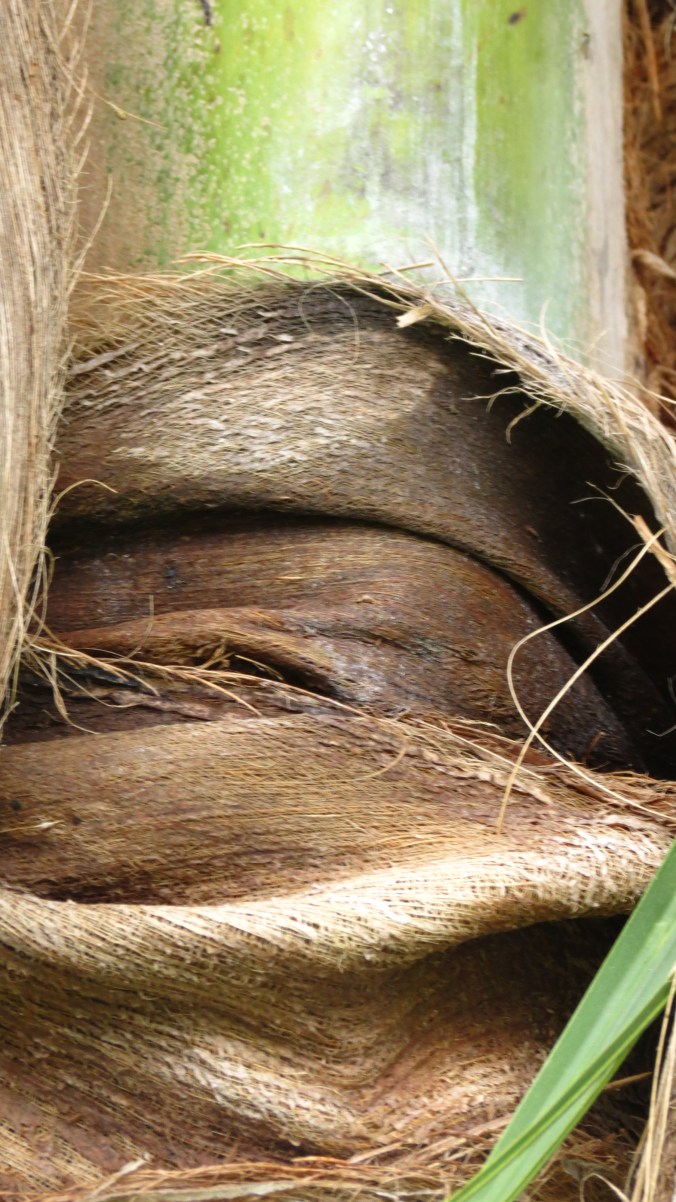
A close-up of the coconut palm "burlap," a kind of fibrous cloth.

A close-up of the coconut palm “burlap,” a kind of fibrous cloth.

When a coconut palm is about five years old, it begins to produce both male and female flowers. The pistillate, or female, flowers, are large and spherical. The staminate, or male, flowers are smaller. Initially, the flowers are hidden by a sheath. When the sheath begins to split, it seems to resemble a corn husk.

Coconut Palm Sheath

Coconut Palm Sheath 2

Within a day, the cream-colored flower branches, or inflorescence, have emerged — and bees are busy at work.

Inflorescence Yellow

As the inflorescence is exposed to sunlight, it turns a vibrant green.

Inflorescence Green

Don’t be fooled by the frail-looking flower branch. Eventually, it will hold the weight of a whole lot of coconuts. In the course of a year, each coconut palm tree can produce between 25 and 75 coconuts.

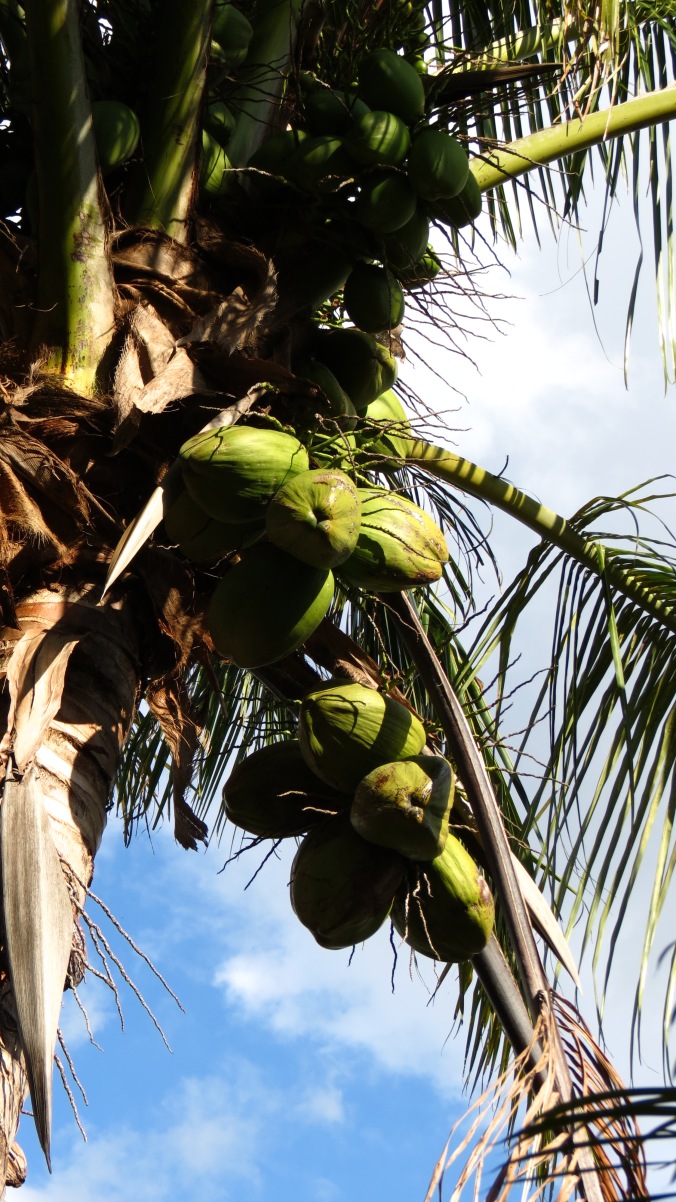
What a lovely bunch of coconuts, courtesy of Cocos nucifera.

What a lovely bunch of coconuts, courtesy of Cocos nucifera.

That’s 25 to 75 possibilities of coconut water, milk, meat, and, of course, more palms.

Coconut Sprout 2

Yes, Ponce de Leon, There Is A Spring


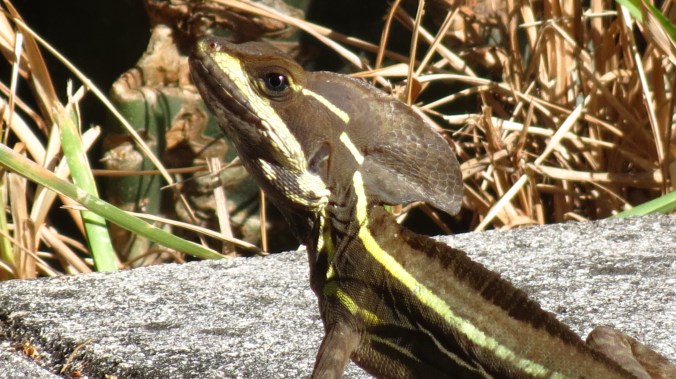
A whole new lizard made an appearance.  This one looks like a dinosaur from an old sci-fi film.

A whole new lizard made an appearance. This one looks like a dinosaur from an old sci-fi film.

A few posts ago, I found myself in a bit of a spring funk. On the one hand, I was excited about spring’s arrival — after all, little darling, in the words of Lennon, Harrison, and McCartney, it’s been a long, cold, lonely winter.

When spring arrived, I was in south Florida — where it’s not so much here comes the sun but rather there is always sun. No one but me seemed to notice that the earth was standing a bit more upright as the northern hemisphere tilted toward the sun. In fact, one deejay wondered aloud on air, “Does South Florida even have a spring?”

Of course, South Florida has a spring. I’m just not sure when it actually happened. I think it was that morning when it was about 70 degrees for a few hours.

Many of you suggested I talk to some locals in order to get a better understanding of spring in these parts. And that’s exactly what I did. Feeling a bit like Ponce de Leon in his search for the Fountain of Youth in Florida, I became an explorer in search of my own newly sprung spring.

Since I don’t have a garden here, I turned to the gardens of my neighbors for some springtime inspiration. On one side, my neighbor has a wildly overgrown bed — for lack of a better word — of banana trees. They’re a bit weed-like — and I’m itching to get in there to clean out the dead leaves and stalks — if only to reach up and grab what is just out of reach from my side of the fence.

This is fresh produce.

This is fresh produce.

The neighbor on the other side has a very lush, attractive landscape — including this hidden heliconia.
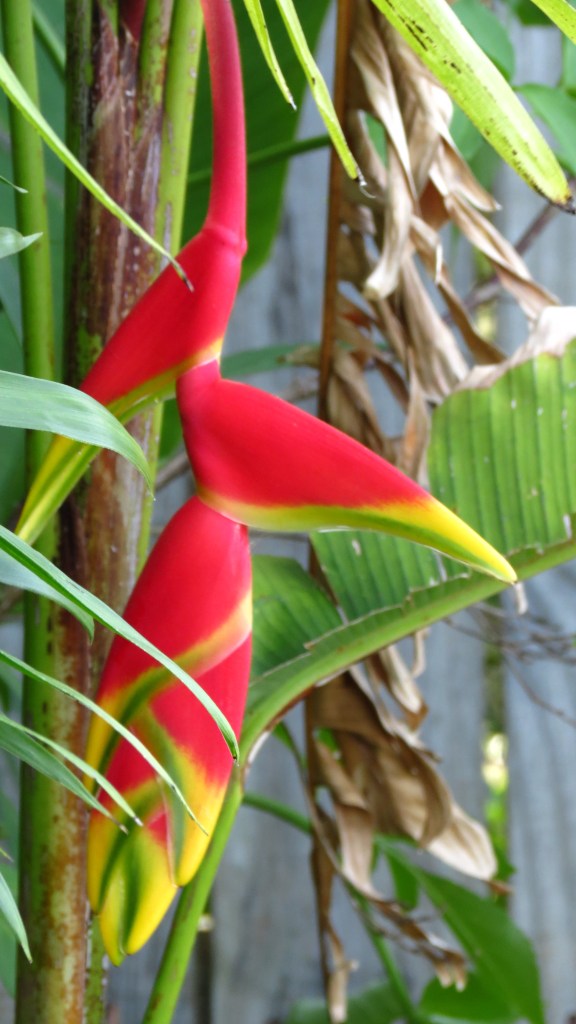
Hello Heliconia.

Hello heliconia.

Hanging over our shared fence are the branches and blooms of brugmansia, more commonly known as angel’s trumpets. It’s one thing to stand on my side of the fence and take in all of the pendulous blooms . . .

The bells of Brugmansia.

The bells of brugmansia.

. . . and quite another to lay down in its shade and look upward.

Brugmansia.

Brugmansia.

Looking upward into Brugmansia.

Looking upward into brugmansia.

But bananas and brugmansia hardly a spring make. What about bulbs and songbirds, bed cleaning and nurseries stocking up? In fact, nurseries here always seem to be full of potted products — and so the seasons seem to flow seamlessly, perhaps even unnoticeably.

I went in search of experts — and I didn’t have to go far. Charles Livio is the horticulturist for Oakland Park, FL. (Yes, the city has its own horticulturist!) In the summer of 1972, Charles and his family left the New York metropolitan area and arrived in South Florida.

“Yes, our spring is radically different here in our sub-tropical climate,” said Charles via email. “First, let’s throw out that children’s calendar rhyme from up north, ‘April showers bring May flowers.’ First of all, we have flowers blooming all year long, and second, April is not a rainy month here. Our rainy season is normally from late May through early October.”

Echoing this same idea is a regular reader/commenter of this blog, Mary Collins, who is the senior horticulturist at Fairchild Tropical Botanic Gardens in Coral Gables, FL. Like Charles, Mary is a South Florida transplant, having arrived in 1973.

True colors: Heliconia close-up.

True colors: Heliconia close-up.

“I describe the seasons in South Florida like this,” Mary wrote in a recent email. “Winter: December, January, February is cool and usually dry. Spring: March, April, mid-May is warmer, dry and windy.   Summer: late-May, June, July, August, September, mid-October is hot, humid, very rainy, stormy, with June and October often being our rainiest months. Fall: late-October, November is a bit cooler and less humid.”

Now that I have a better understanding of the seasons, I wonder if I’m still missing something. Up north, spring meant excitement. It meant life. It meant green.

But in a land that is perpetually green, where this year’s spring temperatures feel more like a New York summer, where is the excitement?   I mean, there are always shoppers in the nurseries but not in the numbers as up north — and much of that might have to do with the limited time gardeners have in colder climates.

Do South Florida gardeners take seasons for granted?  Why get excited about any season if the changes are barely perceptible? The answer to my question could not have been more obvious. When searching for garden excitement, talk to a gardener.

At the mention of spring, both Charles and Mary responded with the feeling that I feared was lost — and their excitement for spring is infectious.

“Springtime in South Florida is much more subtle than up north, but there are things to look forward to,” wrote Charles. “In late winter/early spring, the purple trumpet trees are in bloom, followed by the pink trumpets, and then the yellow trumpet trees are masses of gold by April.”

There's nothing subtle about the color of this Trumpet Tree.

There’s nothing subtle about the color of this trumpet tree.

Similarly, Mary picked up the call of the trees. “There are several beautiful trees which bloom during the spring, including the shaving brush tree (Pseudobombax ellipticum) with pink or white blooms and our native lignum vitae (Guaiacum sanctum) with beautiful violet blue flowers.”

Several trees experience both fall and spring at this time of year. According to Mary,

“This is the time of year when our live oaks (Quercus virginiana) and mahogany (Swietenia mahogany) trees drop their leaves. The oaks produce small, inconspicuous flowers and new leaves shortly after their last year’s flowers have dropped.  Mahogany trees also produce new leaves shortly after their old leaves have dropped. Both the oaks and the mahogany are described as being ‘briefly deciduous.’”

Briefly deciduous. Now that’s a term that can get me revved up about spring, that makes me want to go outside and get dirty, to try my hand at some seed sowing in this climate. If I were in New York, I would have already started seeds in advance or patiently waited for the soil to warm up to direct sow. The soil in Florida is already nice and warm, so . . .

Charles offers a word of caution to slow down. “If you were to plant your garden down here the same time in the spring you planted it up north, you would be missing 2/3 of our vegetable growing season. Cool weather crops have already been harvested, and the warm weather crops are being picked. Our very warm and humid summers are not conducive to growing most vegetables. If the insects don’t get you crops, the diseases will. However, there are some tropical crops that will produce during our summers, such as cassava [yuca], pigeon peas, malanga [a root vegetable] and chayote [it’s easier to provide a link for this edible tropical plant]. We may not grow apple, pear, and cherry trees down here, but we have mangoes, avocados, and papayas!”

Mary added: “Spring in this area means orchid shows and spring plant sales. This is an excellent time to purchase plants for your own garden. Don’t forget to plant some of our South Florida native species for our native birds and butterflies! It’s a wonderful time to go for a hike in the Everglades! The water levels are at their lowest; the wildlife is found near the remaining water holes, and the ‘Glades prairies are filled with wildflowers.”

So to answer that South Florida deejay who openly questioned if South Florida even had a spring, the answer is, “Yes, Ponce de Leon, there is a spring.” You just have to know where to look and what to look for.  According to both horticulturists, there is one plant in particular that can lead the way.  Bougainvillea is at its brightest and boldest at this time of year.

Bougainvillea

Bougainvillea.

And that’s cause for excitement no matter where spring is springing along.


Say Hello To My Little Friends


Palm Tree Night

Don’t be deceived by the romance of a warm tropical night, gentle breezes, and swaying palms — there are countless eyes in the shadows watching us, studying us.  I know this because I’ve met them, face-to-face — or rather face-to-web.  Just recently, I managed to entertain a whole new set of neighbors with my spider web dance, the kind where I flail my arms all around me, overdramatically brushing webs from my face and hair.

The difference, though, between these South Florida webs and my Long Island webs was that these seemed a bit thicker and gooier — but there was no sign of the spider that spun this mess.

Generally speaking, I like spiders. They provide a valuable garden service. I  just want them to keep their webs out of my space and I’ll gladly stay out of theirs.

Then came the morning when I — in what can only be described as a Little Miss Muffet moment — had the feeling I was being watched.  It wasn’t the sort of staring that comes from the countless lizards scurrying and sunning about.  I’ve grown accustomed to  them.

Continue reading

Weekly Photo Challenge: Reflections


Reflections

Spring arrived the other day — and as a northern gardener, it means so much.  Despite the winter-like temperatures that continue to hold on, this spring is a milestone.  Not only does it mark time in the calendar, it’s the light at the end of winter’s dark tunnel.  It’s the promise of new, green growth and branches filled with buds, of garden clean-up and future plans.  It’s hopes and wishes and dreams in the blink of a season.

Those were my thoughts — and feelings — as I sat in my South Florida backyard, staring at a tree that looked more summery than spring-like.   In fact, according to my skin, spring arrived here months ago — even before I arrived in February — and this vernal equinox felt more like a summer solstice.

That’s when it struck me.  Do gardeners experience something akin to phantom limb syndrome?  Inside I’m cheering spring’s arrival.  I imagine myself examining each inch of soil in a search for bulbs pushing through the last remnants of snow.  After that, I’m clipping some of my neighbor’s forsythia branches to bring them inside for forced blooming.  And then I’m removing fallen leaves from the hydrangea’s comb-like branches, giddy with the appearance of green shoots.  Each of my senses is experiencing its own spring awakening.

Getting giddy over green.

Getting giddy over green.

Here in the subtropics, though, I’m searching for signs of the spring that I know, that I feel.  Maybe it’s because this is my first actual change of season here or that I’m still green — so to speak — in a land that never seems to lose its green, but I can’t seem to find spring.  Even a local radio deejay sounded overjoyed at the first day of spring, but before the notes of the next song could play, she took a step back and wondered aloud, “Does South Florida even have a spring?”

Of course, it has a spring — a different kind of spring — and I so badly wanted to do something to recognize the season that I knew, but nothing seemed to fit right.  So I sat and stared at a tree and allowed my senses to enjoy the sensations of previous springs.  Besides, this warm, moist Florida air seemed better suited for lounging — and reflecting.

The Biggest Seed I Ever Planted


 Seed Memories

It’s seed starting time — and by now, I should have flats of impatiens and petunias and geraniums planted in my Long Island potting shed, with dahlias, cosmos, and gazanias scheduled for the weeks ahead.  But as I’ve said in previous posts, this is a season of a different kind — in so many ways.

For starters, I’m away from the potting shed.  Instead, I have south Florida — and as my northern garden and gardening friends have shivered and shoveled during this winter’s harshness, south Florida has enjoyed exceptional warmth.  By northern standards, it feels like summer.

Continue reading

A Weed By Any Other Name . . .


Weed all about it! Florida Pusley; Richardia scabra.  The multitude of small flowers close up at night and then reopen with the sun.

Weed all about it! Florida Pusley; Richardia scabra.
The multitude of small flowers close up at night and then reopen with the sun.

When it comes to my lawn, I’m pretty basic, following one important rule.  Be green.  I’m not too fussy about what’s actually growing — but as long as it’s green, it has a place in the lawn.

When I see that in writing, it sounds as if I’m a bit of a colorist, embracing one color over all others.  In actuality, though, the green weeds are welcome to bloom in any color they like.  I just find that my color requirement for admittance into the lawn is one way to keep me from having to resort to herbicides and liquid fertilizers.  I have no intention of having my little piece of suburbia become one of the stops on a national golf tournament.

Continue reading

Field Trip: Local Color At The Farmers Market


Farmers Market

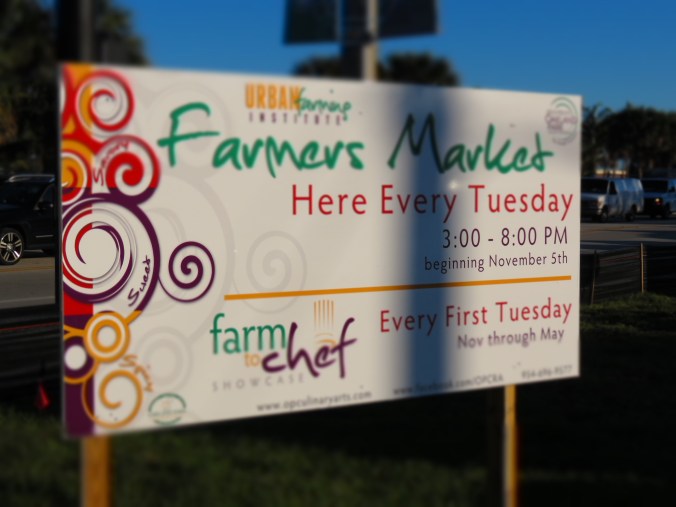
A few posts ago, I lamented the fact that I was to be a garden blogger without a garden.  Imagine my delight, though, when I read in the local paper that Oakland Park, FL, has a weekly Farmers Market.  In fact, it’s just one of the many towns in south Florida with a Farmers Market.  Suddenly, I’m a garden blogger among gardeners.

Join me for a sunset stroll among the stalls, when the warm light and aromas helped turn what’s usually a vacant field into a painter’s palette of home-grown, home-made, organic food.

Continue reading

When The Fog Rolls In — And Out


Foggy Night

There’s no other way to describe my brain during these frigid January days than this photo of a foggy, foggy night.  I admit when I first saw the lights beaming through the misty mid-winter air, I thought of a scene from “The X-Files” — you know, an alien spacecraft had landed just on the other side of the trees behind my house.

But the more I stared at the photo, the more I thought about the tangled thoughts and clouded emotions and glimmers of light in my head.  There’s a lot happening up there, and very often it’s difficult to make sense or to accept what it all is.

Continue reading