
Part of what I truly enjoy about genealogy is the detective work, finding clues and fitting the puzzle pieces together to create a more complete picture of my ancestors. Such was the case as I worked on my great-grandfather Giuseppe’s history. As the picture of his life came into focus, there was one, very large, missing detail:
Who was his wife, my great-grandmother, Crocifissa M.? Where did she come from in Sicily? How and where did my great-grandparents meet? Did they know each other in Sicily? Did they meet on the same boat traveling from Naples? Did they bump into each other while getting processed through Ellis Island?
Or am I completely romanticizing them into a Hollywood movie?
Beyond her Sicilian ancestry, I knew next to nothing of Crocifissa. Whatever bits and pieces I’ve been able to discover from my mother have had their edges softened by time… or I’ve found suspect information on other Ancestry trees compiled by distant relations, in which the research just doesn’t add up.
It’s a frustrating thing to spend hours staring at the computer, examining every collected artifact for clues, flipping and flopping between screens… and to never see an answer staring at you in black and white. That’s exactly what happened to me as I read and re-read and re-read again clippings of Giuseppe’s and Crocifissa’s obituaries.
At last, I saw a clue . Both of them, the obituary writers said, had spent time in Independence, LA.

Photo courtesy of the Independence Italian Cultural Museum.
Independence, once known as Uncle Sam, was meant to be an industrial town. That was the plan, at least, when the Southern Car Company, a manufacturer of railroad rolling stock, opened its doors in 1837.
That didn’t happen, though. Within a couple of decades, the plant shut down and moved its operations to Mississippi, the town changed its name, and the soil, just acidic enough to grow strawberries, was the calling card that drew Sicilian immigrants to the area. Work plus land plus opportunity equaled the promise of the longed-for American Dream.
My great-grandfather, Giuseppe, newly arrived in Alabama via Ellis Island in 1907 and now switching back and forth between his given Italian name and Joe, must have heard talk of the agricultural opportunities in Independence, as well as of the history of bigotry and violence directed toward blacks and Sicilian immigrants in the area. That’s the reason Tangipahoa Parish, where Independence is located, was also known at the time as “Bloody Tangipahoa.”
Nevertheless, lured by farming, he felt the risk was worth it and seized the opportunity to pack up whatever he had and traveled to the small town about 70 miles north of New Orleans.
Although I had placed Giuseppe in Independence, I had no way of knowing how or when Crocifissa, also using the name Susie, had arrived. I also wasn’t sure if they even met there. I was taking a gamble on this lead. Could I find a marriage license?
I dove into Independence and learned two things. There’s a small stone building in the town that now houses the Independence Italian Cultural Museum, which is full of displays and exhibits (and recipes) celebrating the region’s Sicilian roots. I also learned that the city hall did not have marriage records. For those, I’d have to contact the Tangipahoa Parish offices, which I did via email.

One week later, I received an email from a clerk at Tangipahoa Parish offices. It was an apology and an explanation that she had been on vacation. There was also a promise that she would look into my request.
Several days later, this email arrived: “I’ve located a copy of your great-grandparents marriage certificate.” Naturally, I ordered a copy. When it arrived, there it was… my great-grandparents, Giuseppe and Crocifissa were married on January 31, 1909, which, I have learned, was a very mild day at the end of a colder-than-normal month.
I couldn’t stop reading their marriage license, reviewing each line of it over and over again. I felt a rush of relief and excitement… I had found an answer, one that brought my great-grandparents together, in the same place, on a piece of paper that had been lost to time.

My eyes kept falling on Crocifissa’s signature… it was an “X” next to a shortened version of her name, written in a more elegant handwriting. That “X” – so simple – said so much. When I think of my 17-year-old great-grandmother – of whom I knew so little — surrounded by friends on her happy day, not able to sign her name and carefully making an “X” instead, I get a little misty-eyed.
As I stared at the document, I noticed the handwriting of the witnesses, friends of the couple. It was all shaky and rough, except for someone named D. Placido Gabrielli. His name was written in the same elegant script as Crocifissa’s. Who was he? Was he the one who wrote her name? How did he fit in with this group of Sicilian farm workers?
I Googled his name and soon ended up on a webpage for Mater Dolorosa Catholic Church, the large brick church in Independence, LA. Once there, I clicked on the page labeled “History.”
When Independence was in its infancy, a small wood-framed church served the community. While that church had been enlarged on several occasions, it was partially destroyed in a storm in 1907 – and this was about the time when Giuseppe had arrived in Independence.

The former Mater Dolorosa Catholic Church now houses the Independence Italian Cultural Museum. Photo courtesy of Tangipahoa Tourism.
With the influx of Sicilian immigrants, a larger and more substantial church was needed. In 1908, the first resident pastor, Father Placido Gabrielli, arrived. Soon after his arrival, he – with the help of Sicilian immigrants and farm workers — built a stone and concrete church, which now serves as the Independence Italian Cultural Museum.
Fireworks exploded in my brain with this full-circle chain of events.
All of this means that there is an incredibly good chance that Giuseppe’s hands and muscle helped to build that church… and maybe Crocifissa, with the other women in the parish, helped prepare food and served the workers… and by January 1909, Father Gabrielle would have married them in the church they helped build.
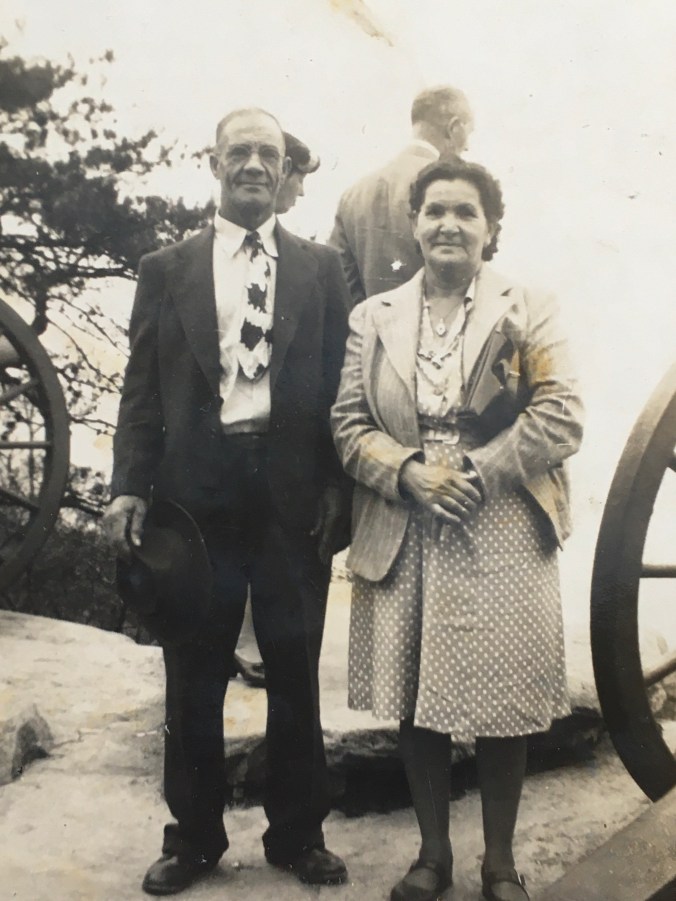
Giuseppe/Joe & Crocifissa/Susie.
In my heart of hearts, I believe this is how – or very close to how — they met. I may not have total proof, but I have the next best thing — a very good feeling.
Or am I romanticizing them into a Hollywood movie?
 Nitty Gritty Dirt Man
It must have been so fascination and shall I say emotional for you to discover their marriage certificate. My grandmother used to tell me she saw many people sign with an X – even though she could sign her name, she only went to Grade 3. Educational opportunities and family constrains for many girls kept them virtually illiterate. Sad to think. Great detective work, Kevin!
Hello Flavia… it was emotional. It was like a mystery solved, but then it lead to so many other questions. I think that’s an excellent point about educational opportunities. While many boys in those days also left school in order to work, they still had employment value because of their gender. For girls, it meant they would have to depend on others, usually a man, for financial security.
STOP! Kevin, this story is incredible! Thanks so much for posting it. I couldn’t stop reading it — in fact, I read it twice. As always, your command of the written word is superb. I can picture your ancestors, reading over your shoulder, with a smile on each face, and enormous pride in each heart. Thanks so much for a “peek” into your curious mind. Curiosity is a sign of intelligence — no surprise. 💚
Hi Kathy — thank you so much for your kind words. I guess you could say it’s your fault that I even started a blog… so thank you for that! You sowed the seeds of inspiration.
Pingback: Adventures In Ancestry: The Mystery of Crocifissa, Parte Seconda | Nitty Gritty Dirt Man
Amazing story!
Thank you, Beth.