
Hibiscus.
Summertime in South Florida, I’m told, is not the best time to plant or to garden. Locals often cite the high heat and high humidity — which leads to an abundance of pests and mildews.
So while gardens — and gardeners — in this hot area cool off, I’ve spent the time researching plants, dreaming up garden plans, and binge-watching television series. “Breaking Bad.” Done. “Orange Is The New Black.” Check. “Downton Abbey.” Finito.
Everything was moving along nicely until “Downton” introduced a gardener into Violet Crawley’s world, and I found myself hoping for a larger storyline for the young fellow or — even better — a spin-off. “Downton Gardens,” perhaps?
Nevertheless, as I pondered the idea of beginning a gardening program for the inmates on “Orange,” it occurred to me that I had had my fill of fictional gardens. I missed real gardening. There was a burning inside of me — as feverish as those felt by any of Walter White’s meth heads — to dig in the dirt, plant seeds, and root clippings.
So the other day, I caved in to my cravings and embarked on a binge of my very own. A garden binge, if you will.

Hibiscus.
I had been eyeing this hibiscus in the neighbor’s yard, blooming in the gap between our two houses. Each day, I’d walk by and that flower would wink its stamen at me. And since I’ve been looking for a Florida plant to take the place of hydrangeas, I wondered if I could root hibiscus the same way I was able to root my favorite shrub in my northern garden.
Out came the clippers, some cell packs, a shovel, and the rooting hormone. I did my best to clip non-bud branches, and then removed the lower leaves. The clippings were immediately placed in water to keep the stems moist.

I had also prepared the cell packs with basic garden soil and made holes in the center of each. After dipping the stems in rooting hormone, I slipped them into the pre-made holes, careful to not loosen the powdery rooting hormone. This was followed with a gentle watering, and then the small plants were placed out of direct sunlight.
Once started, though, I couldn’t get enough. I had merely had a sip of gardening and I was still achingly thirsty.

Croton
From the corner of my eye, I spotted the neighbor’s croton, a shrub with brightly colored foliage. There are many varieties of the plant, but I’m always drawn to the thin, slightly-curled leaf kind, each branch sharing green and red mottled leaves.
I again used the same rooting technique, planting up four small cuttings.
Not quite sated, I thought to myself, “If only I could dig up an actual plant, an off-shoot from a mother plant.” I crouched and crawled across the ground, lifting branches and looking beneath, sending small anoles scurrying.

Eventually, I found two small Chinese fan palms (Livistona chinensis) that had sprouted from seeds at the base of the mother tree. In time, this palm, with tiny hooks along the stems of the fronds, will reach up to 50’. Because of its slow growing habit, however, it’s often used as an understory planting.
I found the jackpot at the base of a Sunshine palm (Veitchia montgomeryana). There, seven smaller palms — resembling tall blades of grass — had sprouted. I carefully pried each one up and gave them a pot of their own.
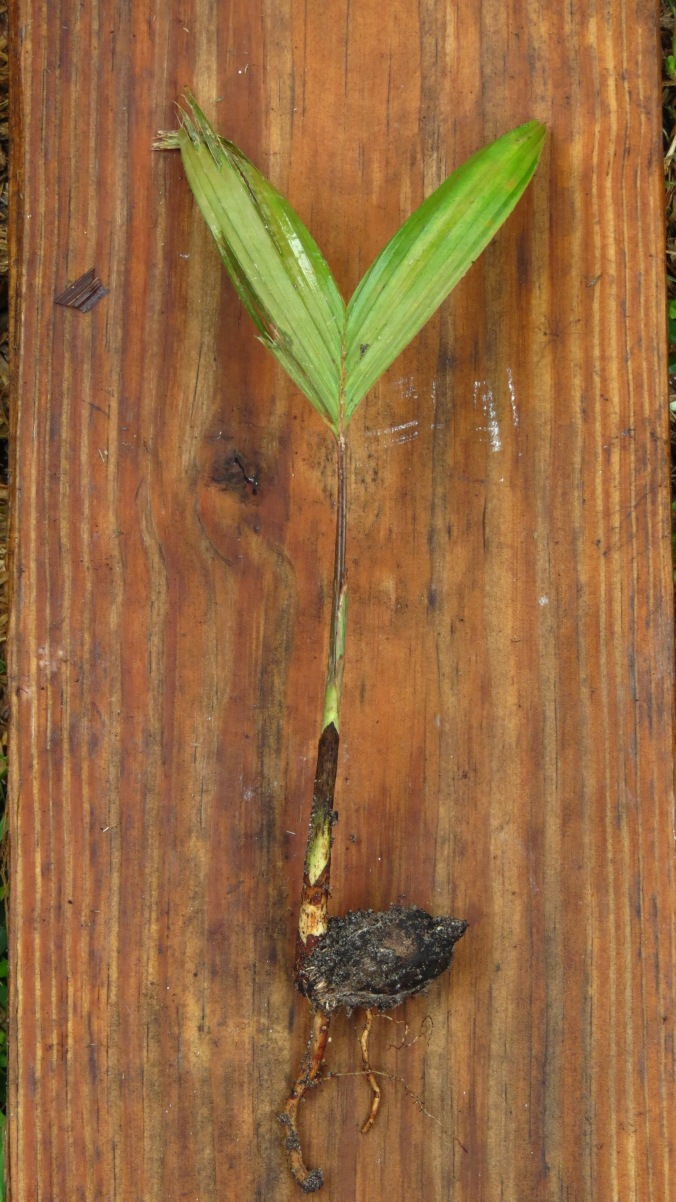
Sunshine Palm.
By the end of the day, my hands and fingernails caked with dirt, my clothes and forehead soaked with sweat, I took a look at all I had done to satisfy my gardening hunger. I had quite the tally: eight hibiscus, four crotons, two Chinese fan palms, and seven Sunshine palms.
At this point, I’m not sure if any of my treasures will survive — and if they do, I’m not sure if I’ll actually use them in the landscape or give them away. I don’t think I’d sell them, though. I’m not a plant pusher. I’m a binger.




 Nitty Gritty Dirt Man