
It was the best of times. It was the worst of times.
Charles Dickens, in one of literature’s most well-known openings, was referring to life in London and Paris. I like to think, however, he was writing about my tomatoes.
It was the best of times. It was the worst of times.
Charles Dickens, in one of literature’s most well-known openings, was referring to life in London and Paris. I like to think, however, he was writing about my tomatoes.

I was as surprised by the emailed notice as I was by the mysterious moth resting on the edge of a terra cotta strawberry pot. My blog was nominated for The One Lovely Blog Award.
I know blog awards receive mixed reactions. Some people love ‘em; some people don’t. Some see them as an honor; others see them as a chore.
Personally, this particular nomination could not have come at a better time.
The other day, as I was passing a local playground, I spotted a group of men who were able to throw together a random basketball, football, handball, any-kind-of-ball game without speaking any words to one another. There were some hand gestures and a few noises, and then the game began.
I’m not a fan of zombies. They’re creepy, unstoppable and incoherent. Yet, millions of people flock to their movies, read their novels, and watch their television shows. While some battle zombies in video games, others are preparing for an actual zombie apocalypse.
But they’re wasting their time. The real cause of our undoing is a creature far colder than zombies.
Iguanas.

Hydrangea, OPALS 3-6, depending on variety.
When Joe and I first moved into our Long Island home, I had my all-time worst allergy season. All at once, it seemed, the oaks unleashed gobs and gobs of pollen in clumps that rivaled tumbleweeds. Pale yellow dust coated everything with its evilness.
As a new homeowner, I wondered and worried how I would be able to garden in a world that was inhospitable, where merely stepping outside caused relentless sneezing, itchy and swollen and watery eyes, and a sore throat.
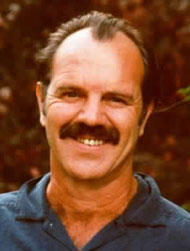
Thomas Ogren.
Fast forward some twenty-odd years and we have Thomas Ogren, a gardener/educator who has compiled more than thirty years of research into The Allergy-Fighting Garden, a wonderful new book that combines horticultural science with logical garden choices so that homeowners and communities can work toward limiting the amount of allergens in the environment.
The book combines the best of his two previous works, Allergy-Free Gardening and Safe Sex in the Garden, with new information, so the end result is something that is informative and user-friendly.
My favorite portion of the book is the section entitled “The Allergy-Fighting Plants,” a very thorough A-to-Z listing of garden plants and their OPALS rating. OPALS is the Ogren Plant Allergy Scale, which Ogren created when he wasn’t researching, lecturing, writing, or gardening. It’s the first allergy-ranking system for plants and is now used by the United States Department of Agriculture. On the scale, plants are ranked from from 1 (least allergenic) to 10 (most allergenic). I’ve illustrated this post with photos of some of my gardening choices, and I’ve added their OPALS ranking.

NGDM: The strangest thing happened to me while reading your book. I had a series of aha moments because so much of what you’re writing makes complete sense — that gardeners can garden allergy-free — and it’s something I’ve never even considered. I always thought that will gardening comes pollen, and with pollen comes sneezing. We just have to deal with it. When you began your research, what was the moment that you had your Aha Moment, that you were on to something?
Tom Ogren: That total Aha Moment….or, actually two of them: I had been very skeptical about both allergies and asthma, but my wife had both. I’d read a book by some MD called Psychosomatic Illnesses and in it the author, a man, wrote that allergies and asthma mostly affected women because they were more emotional, more given to hysteria . . . and I sucked that all up. After all, I didn’t have allergies or asthma, so obviously I had my act together much more than did my wife, Yvonne.
Yvonne would have an attack of asthma (fairly frequently back then) and I would show no sympathy at all, and (I sure do hate to admit this) often I’d even lecture her on how she ought to get her act together. This went on for years, but one day I was doing a landscape job in Berkeley, California, and people everywhere were sneezing and generally acting like they felt miserable. It was early spring and everywhere the big acacia trees were in bloom.
When the landscape job was done (a week or so), I drove back home to San Luis Obispo and as I drove I thought about all of this allergy I’d been seeing, and I came up with an idea. The next day, back at work (I teach landscape gardening and horticulture in a prison), I got with my students (big, tough, muscular gangbangers, every last one of them) and I proposed that we sniff flowers and record what, if anything, happened.
First we sniffed some pansies and nothing happened at all, then we did some double dianthus and again nothing at all. The third plant we tried was bottlebrush flowers. I sniffed them, nothing; my foreman sniffed them, nothing — but then the next guy took a sniff of the bottlebrush flowers and wow! Did he ever sneeze! Really loud and really hard.

Daylily, OPALS 6.
Suddenly I was suspicious of that idea that allergy was “all in your head.” By the time we’d gone through the whole class, one third of them were sneezing, over and over again. It was perfectly amazing and it was an Aha Moment if there ever was one. Not only had I discovered that some flowers triggered this response, but also that some flowers did not — a learning lesson. I also suddenly felt very guilty for the hogwash that I’d been putting my wife through. This was the first Aha Moment.
The second Aha Moment: I’d been studying plants and allergies for 6-7 years or so and one night my wife and I were in bed and she was reading a novel and I was reading a thick serious book about monoecious and dioecious flowering systems in trees. I read something and then said to Yvonne, “I just had an idea. These dioecious plants, they are often the very worst allergy plants of all, but think about this. Since they are 100% separate-sexed, that would mean that the males produce all the pollen and the females catch it and turn it into seed.”
“Okay,” said Yvonne.
“Yeah,” I said, “but look at it this way. The big lists of plants they say not to use, all those maples, poplars, willows, yews, junipers and so on, the female plants aren’t producing any pollen, just the males. And think about this, if a female plant produces no pollen and it traps pollen, it means that female plants are actually allergy-free plants! See what I mean?”
She looked at me for a moment and then said, “You know, Tom, you just might be on to something with that.”
Now, really, what I’d reasoned out there, it wasn’t rocket ship science, just the opposite. But still, up to that point no one had ever written anything ever saying this. It was an Aha Moment. For sure.

Canna, OPALS 3.
NGDM: I imagine you must often find yourself fighting an uphill battle trying to get your message out there, especially when dealing with cities and municipalities. What has been the greatest challenge?
TO: Well, indeed this has been nothing but an uphill battle, and it still is. Considering that pollen is the most common allergy/asthma trigger in the world, I am amazed that allergists do not take any courses at all in horticulture, and very few of them have had any courses in botany either.
Likewise, I am amazed that all these asthma educators and the many health groups that are associated with them, that they dwell on 2nd hand smoke, on mold, on dampness, on infestations of rodents and or roaches but they never even consider doing anything to limit exposure to pollen. I heard two speeches in the last few days on “asthma triggers” and the word pollen wasn’t mentioned even one time. I find this disturbing at best.
Most cities and counties don’t seem to want to do anything about allergies at all, and not all that much about asthma. Allergies are seen by many as not so important (especially if those in charge don’t have allergies) . . . and yet more than 80% of those with asthma already have allergies, and also that getting allergies greatly increases your chances of getting asthma. Cities are very reluctant to ever cut down a tree “just” because it is highly allergenic. Even worse, they are generally quite reluctant to even stop planting the very most allergenic trees. Most of the time they appear to want to keep on doing things just as they have always done them. But then, cities and municipalities are not the only ones that make this an uphill battle. Commercial horticulture has so far not done their part either, mostly just the opposite.
All said, it sounds terrible, but nonetheless, I am very dogged in my pursuit of this, and in the end I feel that common sense will yet win the day.

Hosta, OPALS 1.
NGDM: Your book is very user friendly and very well-researched — but I was most impressed with your OPALS rankings, a means of providing the allergy quotient of so many plants. It seems like it would be a no-brainer for wholesalers and retailers to include that information on the plant tag. Why do you think there’s so much reluctance to provide this information?
TO: Nursery people don’t like to say anything negative about any plants, and especially not ones that they sell. The big growers already make good money on many very allergenic male clones, and they will keep on growing them until suddenly no one wants them anymore.
NGDM: If you could offer the average home gardener three top tips to address allergy-free gardening in their own yards/communities, what would it be?
TO: One, make a big effort to get rid of the very worst plants in their own yards, and at the schools where their kids attend. Two, join with some other people and try and get a local pollen-control ordinance enacted, an ordinance that stops the sale and planting of the very worst landscape plants. Lastly, plant and encourage others to plant many more female plants — there’s no balance of the sexes in cities, and everywhere more female plants are needed.

Zinnia, OPALS 3.
NGDM: When did a passion for gardening first take hold in you? Who inspired you to get in the garden?
TO: When I was a kid we had a lovely old black lady who lived with us to help out with all of us kids (there were six of us). Her name was Katherine Scott and she loved to garden and she’s the one who first showed me how to plant the squash and bean seeds, how to weed and water; she’s the one who really got me hooked….and I was totally hooked by age four.
My grandfather, Tom Myers, he was a doctor and he loved to garden, especially to grow roses. I was named for him and I can still see him wearing his old clothes, working contentedly in his big rose garden. When I was seven, he asked me what I wanted for my birthday and I told him I wanted my own guava tree — and that’s what I got. I loved that tree and I was the only kid I knew who had his own fruit tree.
Lastly, both my mother and father appreciated good gardens, even if they weren’t especially good gardeners themselves. My mom loved the idea of lots of fruit trees in the yard, and my dad planted them, and as I was the oldest boy, he often had me help him.
I guess you could say I was raised right!

For the record: Oak, OPALS 8. No surprise that I was sneezing.

I know gardeners can be an excitable bunch when it comes to flowers and vegetables, soil and pests. Seed catalogs on a snowy day, bulbs poking up with the first warm breath of spring, an enormous sunflower, and fifty shades of green — all these things and more can get a gardener’s pulse racing.
Still, I thought my neighbor’s excitement over a small bloom was a bit overdone.

Petunias and I go back. Way back.
Long before I started my own plants in the potting shed in February, petunias were a staple in my parents’ garden. They were often planted in old tires that my father would cut, flip inside out, and paint white — instant, recycled planters.
Petunias were also in the lyric of a song my mother used to sing around the house: “I’m a lonely, little petunia in an onion patch.” I’m not sure if she ever sang the entire song, but the melody was way too chipper for a teary-eyed, solitary petunia in a planting of pungent bulbs.
Nevertheless, when it came time for a Florida garden, I had to decide if I wanted to continue with plants that I used in Zone 7a — or did I want to jump into the Zone 10b pool with both feet.
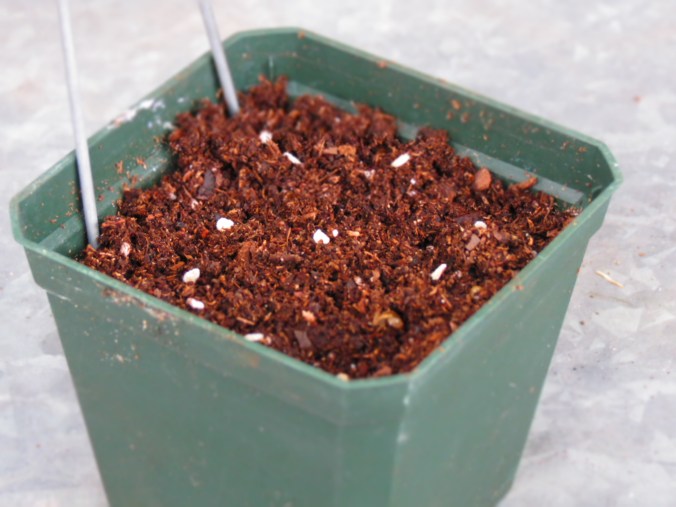
If seeds could talk, I wonder what tales they would tell.
I’m sure they would recite their perfect equation of soil, light, and water for their optimum germination. They wouldn’t even wait for us to ask. They would just offer that info up at the start of the conversation. Seeds are funny that way.
I wonder, though, if they would be willing to share with us their story? That perhaps their great-great-great-great grandfather hitched a ride on Paul Revere’s coat on his famous midnight ride? Or that they, in fact, escaped from a research lab looking to build a better seed?
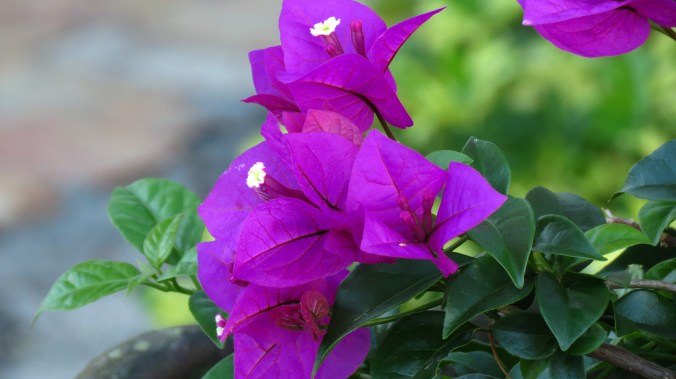
Bougainvillea.
It’s been some time since I posted a “Bloomin’ Update,” because — well — I had nothing bloomin’ in my garden because I didn’t have a garden in zone 10.
But as 2014 changed into 2015, so too did the garden change. Where there was once only lawn, there are now beds. Where there are beds, there are now plants and pots and paths. (Speaking of paths, I’ll describe the path I took to create this garden in a future post.)
With all of the changes happening around me, I decided to make some changes to this blog. For a while, I’ve considered purchasing my own domain — which I have now done. It’s official, I am now Nitty Gritty Dirt Man dot com.

 Nitty Gritty Dirt Man