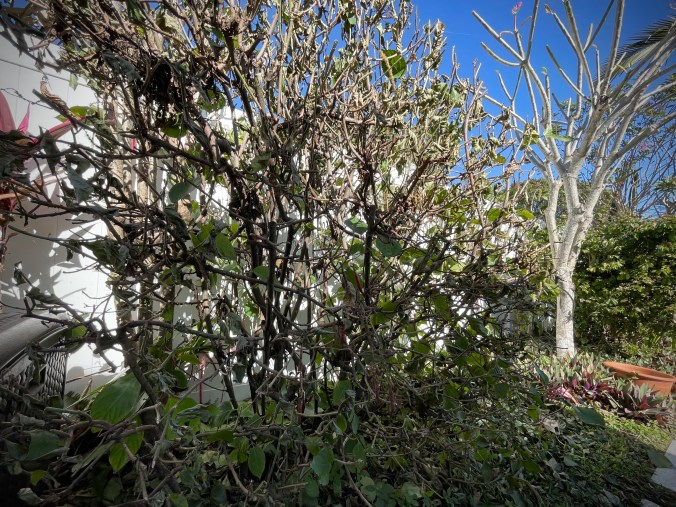
There’s a lot to be said for doing nothing. The older I get, the more I try to embrace that ethic in the garden. There seems to be so much else to worry about these days, do I really need to add garden worries onto the heap?
There’s a lot to be said for doing nothing. The older I get, the more I try to embrace that ethic in the garden. There seems to be so much else to worry about these days, do I really need to add garden worries onto the heap?

Just as summer was flowing into autumn — which in south Florida means summer heat becomes autumn heat — I couldn’t believe what I saw on one of my orchids. It was a large bud, swollen and green with a collection of tiny ruffles at the tip. The timing of this blossom may have been a coincidence, but I jumped on it as one of the hints that fall was actually happening in my part of the world. Continue reading

The cold snap from the previous post lasted that entire weekend. Out of an abundance of caution, I kept the outdoor orchids wrapped under towels and shirts, while the potted orchids were kept inside. On Monday, winds died down and temperatures became more seasonal.
This is what a cold front – a real cold front – looks like in South Florida. This may not be a Buffalo, NY-worthy cold front and it certainly can’t compare to the wickedness of the weather in California or Alabama, but by South Florida standards, this weekend’s weather was cold. This sort of cold – the kind that comes with wind chills and falling iguana warnings – isn’t very fun.

This is a baby staghorn fern. I came across it recently while doing some therapeutic weeding — therapeutic for me, not so much for the weeds. I was actually surprised to see it because the closest mature staghorn is in the across-the-street neighbor’s backyard.
Plus, it was clinging to stone. In the wild, these tropical epiphyte ferns use their roots to grab tightly onto the bark of a tree while its fronds take in the needed moisture and nutrients. This little guy, though, was holding onto the rough, hard surface of a paver used as a retaining wall for a raised bed.
The more I considered its journey from a spore drifting on wind currents to its determination to hold onto something — anything — solid, the more I realized that this was the best way to illustrate my absence for the past few months.
Without going into detail, the bulk of 2020 saw Joe, myself, and his family protecting ourselves from COVID while also caring for the health of his father. Dad was diagnosed in May with malignant melanoma.
In a normal world, life is a rollercoaster. COVID, though, seemed to stifle and slow many of the ups while adding speed and dangerous curves to the downs. By the end of 2020 and into 2021, Dad needed round-the-clock care. On February 3, he passed away as a result of his weakened state, which itself was the result of two surgeries and general anesthesia that seemed to exacerbate his Alzheimer’s.

Since then, Joe and I have worked at catching up on chores long neglected: AC maintenance, plumbing issues, tree removal and shrub pruning, and that therapeutic weeding.
Through it all, though, we’ve reflected on Dad. He was many things to so many people. He was a father, grandfather, and great-grandfather, uncle and friend, and coach, referee, umpire, and mentor. To me, he was my father-in-law, a kind, decent, honest, and gentle man who lived life to its fullest. He’s also the man who instilled these same values in Joe, my husband and partner.
I admit that while some days have felt almost normal, other days have been, well, a daze. It was on one such day that I looked up and spotted an orchid blooming way up high on the trunk of a sabal palm, one that I had tied to the tree before I knew anything about how to do that.
At the time, I was told to wait for the flower spike to finish and to just tie it. Climbing a ladder, I slapped the clump of roots — no additional sphagnum moss, no coco-fiber lining to keep things together, no nothing — and sloppily wrapped green floral tape around the orchid and palm trunk, hoping for the best.
It has never bloomed, not once, since I tied it up there. Some years, it looked as if it was barely alive.
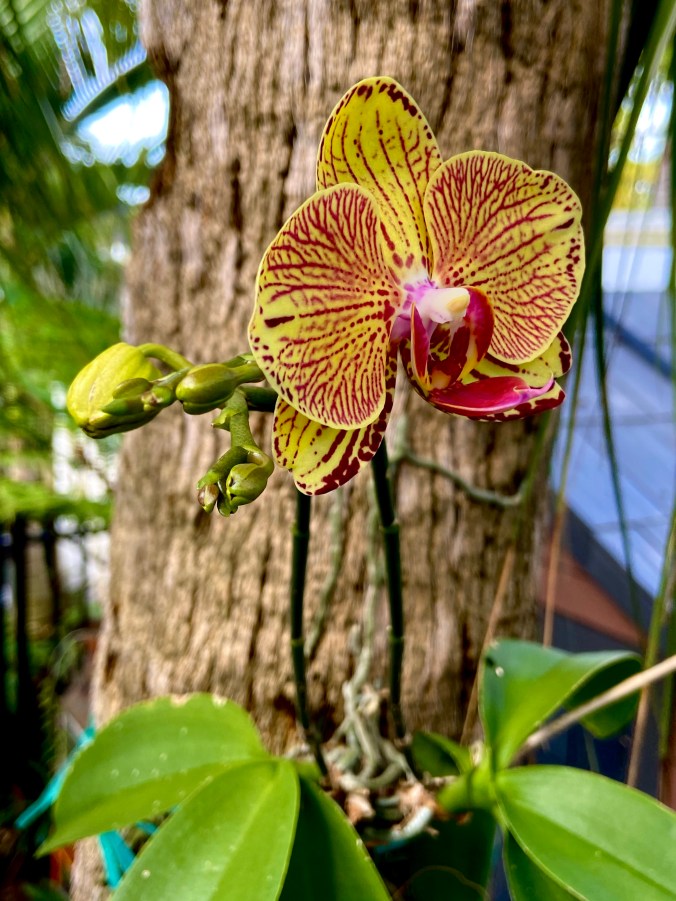
This year, though . . . this year it’s flowering, its roots firmly attached to the trunk. It gave me a reason to get the ladder and climb up to get a closer photo of this miracle on a tree trunk, a reminder that we’re all holding on and we’re all going to be okay.

This is the dilemma that’s been staring at me for some time, now. I have two orchids — one in a terra cotta pot and one in a plastic pot — and they have each made themselves very comfortable in their respective homes. In fact, they’re almost too comfortable, with their roots bursting out and over the pots.

Recently, I took a long overdue stroll through a local South Florida nursery. I wasn’t expecting to take photos — this was supposed to be a quick trip to pick up some vinca for some of the pots in the backyard.

Spring in South Florida is plant sale season. Cities and garden clubs throughout the region are hosting sales of flowering shrubs, palms, exotics, and native plants — and very often, gardeners drive a long way to find their perfect plant, a great deal, or both.

I can’t think of a better way to celebrate the arrival of spring than with a display of vibrant colors, a site for eyes sore from the dreary grays of winter. Even South Florida, often accused of not actually having a change of seasons, wants to get in on the spring act.

