When I was in third grade, I arrived home from school very, very angry. We had learned about slavery that day and since I knew my mother was born and raised in Louisiana, a southern state, she was, I believed, responsible for it.
In hindsight, I admit this was a bit melodramatic – even for a 9-year-old – but it also doesn’t erase that my 9-year-old mind and heart both understood that there was something and everything wrong, painful, and immoral about slavery.
So, as someone with Union and Confederate heritage, I decided to do some digging – and the deeper I went, the dirtier things became.
Before I get into the heart of this post, I’d like to offer a bit of context, which I know I’ve said in earlier posts. The basis of my ancestry research is a genealogy resource, 300 Years of Louds in America, compiled and written by C. Everett Loud. Each of the 13 chapters is devoted to a child of Francis Loud, my 7x-great-grandfather, who was born in Ipswich, MA, in 1700. His own father, my 8x-great-grandfather, arrived in colonial America in about 1675.
The North
I met Rienzi Loud on page 92 of 300 Years. A descendant of Jacob Loud, the oldest child of Francis and the subject of Chapter 1, Rienzi was born in Massachusetts and moved to Michigan in 1859. Several years later, the United States was ripped apart by the Civil War and Rienzi enlisted as a quartermaster sergeant with the 1st Michigan Cavalry Unit.
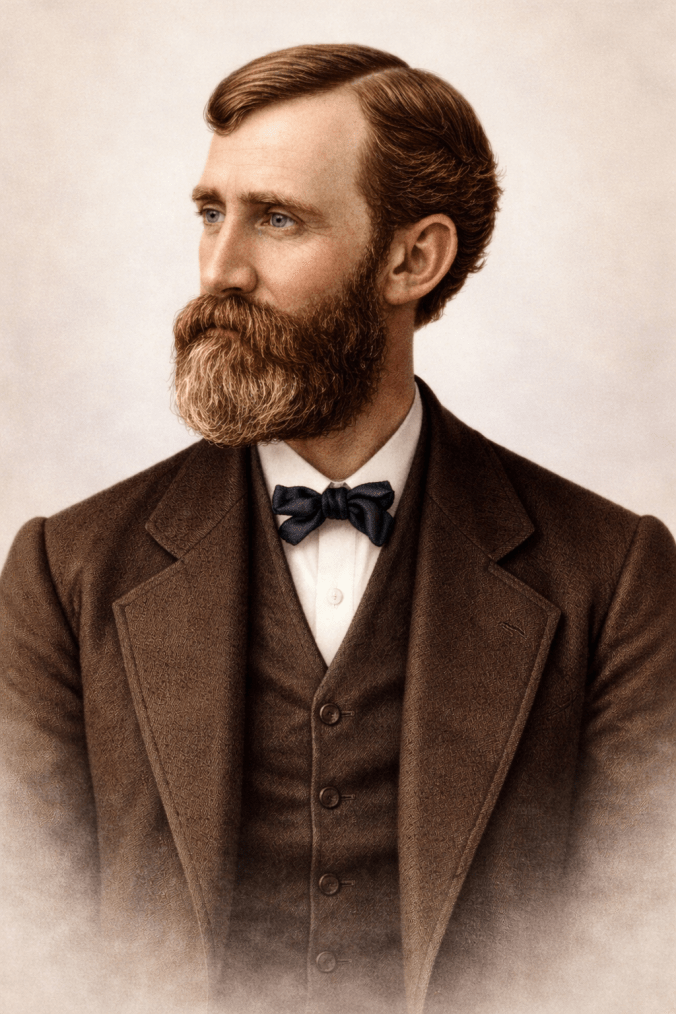
Rienzi Loud
Meanwhile, Massachusetts had elected a vocal abolitionist, John Andrew, as governor. A strong proponent of enlisting black men as uniformed soldiers in the Union Army, Governor Andrew received the green light in January 1863 to raise a black army.
His request to have the army led by black officers, however, was denied. To circumvent this ruling, Governor Andrew handpicked officers from strong abolitionist allies. On the list of recommended officers was Rienzi Loud, who was eventually commissioned as second lieutenant of the 5th Massachusetts Colored Cavalry.
After participating in the first attack on Petersburg, VA, and then guarding Confederate prisoners at Point Lookout, located between the Potomac River and Chesapeake Bay, Rienzi Loud was promoted to first lieutenant.
Then, in early April 1865, after participating in the Siege of Richmond, First Lieutenant Loud and the 5th Massachusetts Colored Cavalry was one of the first units to enter Richmond, which had been nearly destroyed by Jefferson Davis and the Confederate Army before they fled.
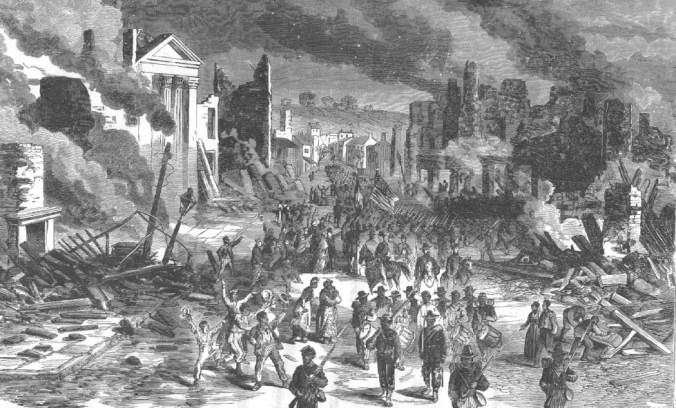
The Federal Army entering Richmond on April 3, 1895. From “History of the Civil War,” by Frank Leslie, 1895.
The reception of black troops entering the capital of the Confederacy was as divided as the nation. While there is still some dispute over the race of the troops first entering the city, author and historian, Jay Winik, wrote in his book, April 1865:
As white Richmond retreated behind shutters and blinds, black Richmond spontaneously took to the streets. From the moment Union troops entered the city – “Richmond at last!” Black Union cavalrymen shouted – crowds, the skilled and the unskilled, the household servants and household cooks, rented maids and hired millworkers jammed the sidewalks to catch a glimpse of the spectacle. No longer enslaved, they thrust out their hands to be shaken or presented the soldiers with offerings: gifts of fruit, flowers, even jugs of whiskey. Federal officers riding alongside promptly reached for the liquor bottles and smashed them with their swords. But the crowd was undaunted. Just a day earlier, they had been prohibited from smoking, publicly swearing, carrying canes, purchasing weapons, or procuring “ardent spirits.” Yet now… they jubilantly waved makeshift rag banners…
While 1st Lieutenant Rienzi Loud may have been one of the Federal officers who smashed the whiskey bottles, he was also an abolitionist, and the symbolic and historic significance of this moment surely swelled within him.
Then, I came to page 469 and Richard Loud.
The South
Now, would be a good time for a Loud refresher course, to gain a better understanding of Richard’s relationship to me.
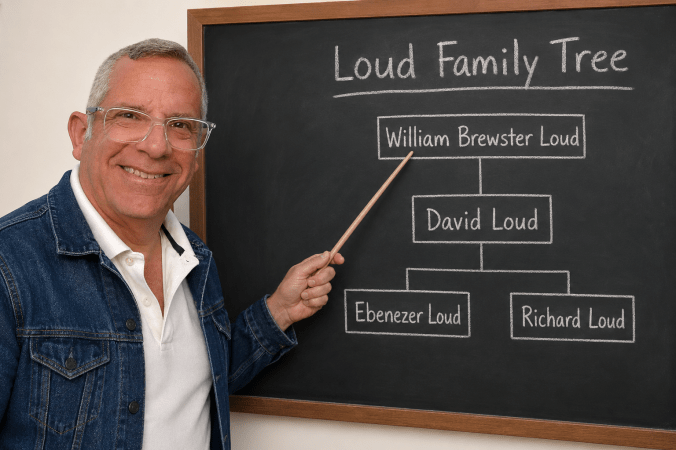
In Chapter 9 of 300 Years, dedicated to my 6x-great-grandfather, William Brewster Loud, there is an entry for his eldest child, David Loud, an American Revolution veteran who is also my 5x-great-grandfather. Below David’s name is a list of his children, including Ebenezer, my 4x-great-grandfather and War of 1812 veteran, and Richard Loud, whom I believe is my 4x-great-uncle and a Civil War veteran… a Confederate Civil War veteran.
That’s a plot twist I didn’t see coming. Louds were Yankees – strong New England stock, I thought, through and through. Learning this brought me back to my 9-year-old tantrum directed at my mother. Apparently, I should have shared that tantrum with my father.
Like so many other Louds, not-so-great Uncle Richard was born in South Weymouth, MA, and he moved with his parents to Braintree when he was just 3-years-old. At 20, his father sent him to Philadelphia to learn the woolen mill industry.
By 1825, Richard was married and in 1829, he and his wife and son moved to Lexington, KY, to open a carding and cloth mill on the Frankfort Pike. Additional mills were built and by all accounts, he was a very successful businessman, focusing on white jeans and linseys, durable products for plantation slaves. Here is his ad from 1841:
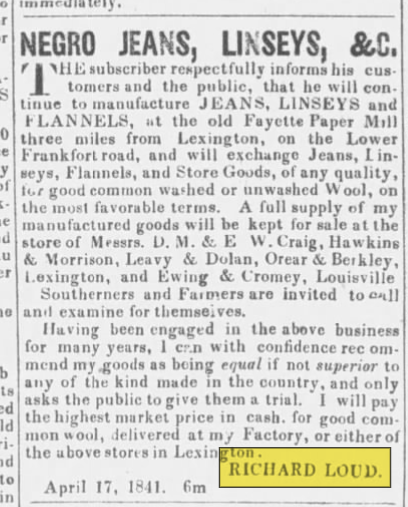
From The Kentucky Gazette, October 16, 1841.
As a border state, Kentucky was a conflicted place in the months leading up to the Civil War. It was, after all, the birthplace of both Abraham Lincoln and Jefferson Davis. While the state had adopted a policy of neutrality, that fell apart when Confederate and Union forces occupied different parts of the state.
Ultimately, Kentucky aligned itself with the Union and a formal secession never materialized. Citizens, though, remained divided and, as a result, families, like the Louds of Kentucky, were ripped apart. Richard Loud and five of his sons all enlisted in the Confederate army. One son, the oldest who had been born in Rhode Island, traveled west to California, and there enlisted with the Union Army.
The real shock for me, however, was in one sentence that C. Everett Loud wrote in 300 Years. After stating that Richard Loud died in Lexington at the age of 64, C. Everett wrote: “He had several negro servants that were named Loud.”
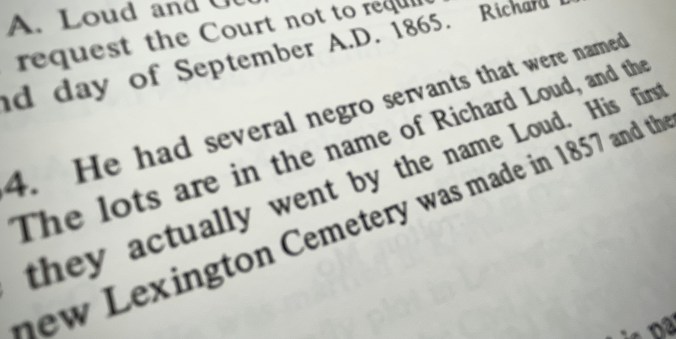
I’m not sure why C. Everett decided to use the word “servants” in his sentence. Perhaps, at the time, he was unable to research the full scope of my Confederate ancestor. Perhaps he thought it sounded gentler, a sort of kinder tribute for a member of the family tree.
My 21st-century mind, though, had different thoughts. To me, “servants” was just a polite word for “slaves.”
In time, I found a Kentucky slave schedule from 1850. There, at the halfway point of the second column labeled “Slave Owner,” was Richard Loud and a nameless list of the 10 humans he owned at that time… 3 females and 7 males… ranging in age from 55 to 3… no names… no indication of how they served him and his family.
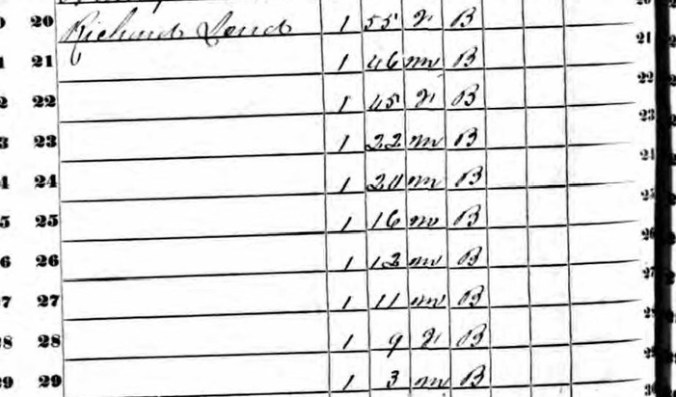
1850 Slave Schedule
Ten years later, he owned even more slaves – 6 females and 5 males, as well as what appears to be temporary ownership of 4 males from another slave owner.
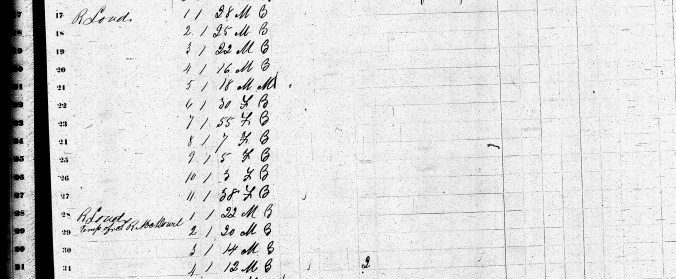
1860 Slave Schedule
I have no way of identifying slaves beyond the marks in the appropriate columns… or if any of them were listed on both the 1850 and 1860 slave schedules… or of their relationships to one another… or – and it’s something that has to be considered – with Richard Loud and his sons, particularly, because an 18-year-old male on the 1860 slave schedule is listed as mulatto.
I wanted to – I felt compelled to — give names to the slashes on those Kentucky slave schedules. I first contacted the Lexington Cemetery, where Richard Loud is buried. According to 300 Years, he paid for the plots of his “servants,” all of whom were buried under the name Loud. Were they buried close to Richard’s family plot or were they, in death, segregated in another part of the cemetery? I have yet to hear from the cemetery.
I then stumbled upon a website, Enslaved.org. I hoped its search engine could help me fill in the blanks, but when I searched for Richard Loud, nothing came up.
The Deep South
Then, I remembered my Louisiana connections, my Guillot ancestors on my maternal side. They were Acadians originally, but in Louisiana, they were Cajuns. By the time of the Civil War, they were firmly established in rural Lafourche Parish.
When I typed the name of my 4x-great-grandfather, Isidore Guillot, into the Enslaved.org search bar, there was a match. According to the website, on December 12, 1816, in Lafourche Parish, an Isidore Guillot purchased an “unnamed enslaved person” from Isaac Johnson.
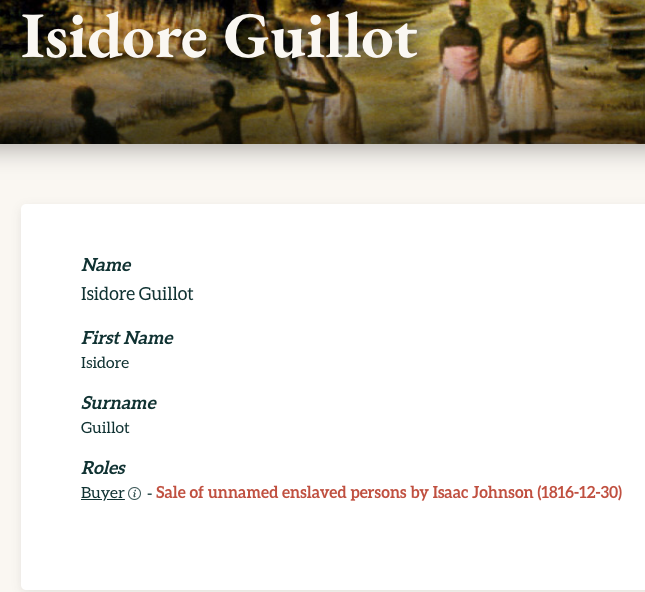
By the time of the 1840 census, my 4x-great-grandfather had been deceased for 6 years. On the other hand, my 3x-great-grandfather, also named Isidore, was 24, married and the father of three children. He was also the owner of three slaves: a man and woman between the ages of 24 and 55 and a girl under 10. Once again, I have no idea of their names. I also don’t know if they were a family.

An image from the 1840 Census. Each mark represents a slave.
About 12 years after the 1840 census, my 2x-great-grandfather, Ulysse Maxile Guillot, was born. On Fold3.com, a website focusing military history, I eventually found someone by that name who had enlisted as a private in Louisiana’s 26th Infantry on March 12, 1862. If this was my 2x-great-grandfather, he was 10-years-old at the time.
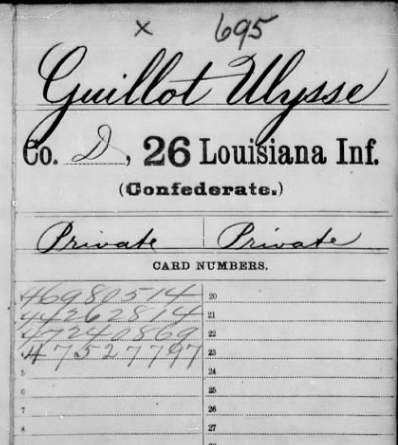
My mind was reeling. Could children enlist in the army? Would a family enlist their male children for the cause? The short answer, I learned, was yes. Boys – some lying about their ages, while others were clearly young – joined the Union and Confederate armies, mostly serving as fife and drum musicians, messengers, and battlefield and field hospital attendants. Some, though, were armed and sent into battle.
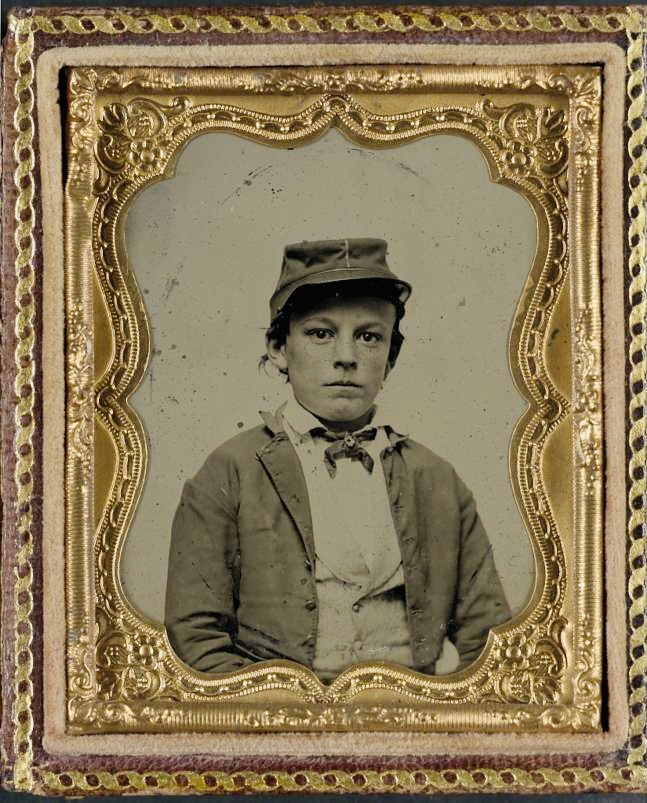
Unidentified Confederate child soldier, possibly a drummer boy. Courtesy of TheVintageNews.com.
One of the most important routes for supplies and communications during the Civil War was the Mississippi River. Vicksburg, MS, which sits on a bluff overlooking the river, was viewed by both the Union and Confederate command as key to its control. Knowing the Union Army had its eyes on the prize, Private Guillot and Louisiana’s 26th Infantry were sent there to defend the city alongside more than 30,000 other Confederate troops. From the north came more than 75,000 Union soldiers under the command of Major General Ulysses S. Grant.
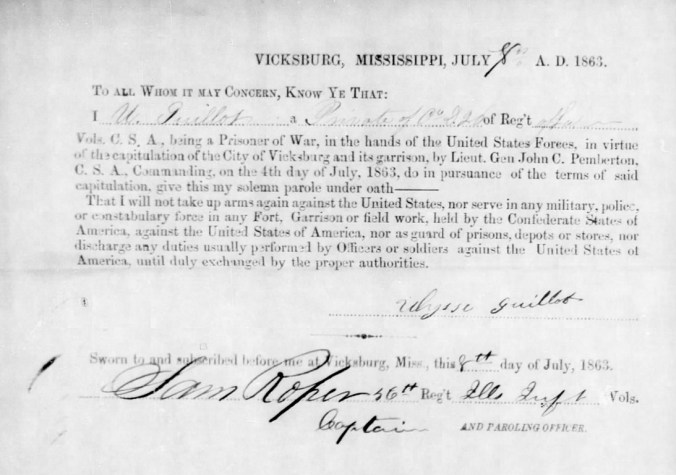
The Union siege of the city began on May 18, 1863, and ended on July 4 with a Confederate surrender. As a result, Grant successfully split the Confederacy in half, and Private Guillot became an 11-year-old prisoner of war.
I have no idea in what capacity Ulysse Guillot served the Confederacy, but I do know that four days after his capture, he swore an oath to “not take up arms against the United States…”
My Side
On the PBS series, “Finding Your Roots,” it’s inevitable that Dr. Henry Louis Gates will reveal to his celebrity guests that he or she is descended from a slave or a slave owner – and just as inevitable is his question: “How does it make you feel learning this?”
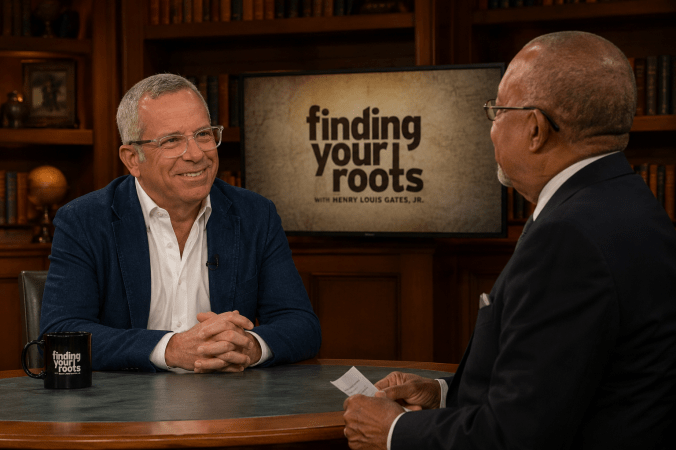
So… how does all of this make me feel? It’s complicated.
First and foremost, I’m very proud of Rienzi Loud. It’s a relief to know he was recommended through very strong abolitionist circles, which says a lot about his character. It gives me hope that he wasn’t a racist white officer put in charge of a black cavalry, but instead had great respect for the men he led into battle.
Then, there is Richard Loud in Kentucky. Living in a divided state, he consciously decided to profit off of slavery by sewing clothes for slave owners to purchase for their slaves. In addition, he bought and owned a fair amount of his own slaves.
It’s striking to me – and this may be naivety on my part – that a man with a New England upbringing could play a part in slavery and that he, along with most of his sons, could take up arms to defend it. Was it purely for personal, economical reasons, or was it a case of “When in Lexington, do as the Lexingtonians do, or did he truly believe in the institution of slavery?
Then, there’s the matter with his slaves. Frankly, I don’t care that his slaves “adopted” the name Loud or that Richard purchased burial plots for them. I don’t think this is as benevolent as C. Everett Loud thought it was when he wrote it in 300 Years. In my mind, these humans were robbed of their own identities and, as a result, the full scope of their lives remains unknown… at least to me, at this moment in time.
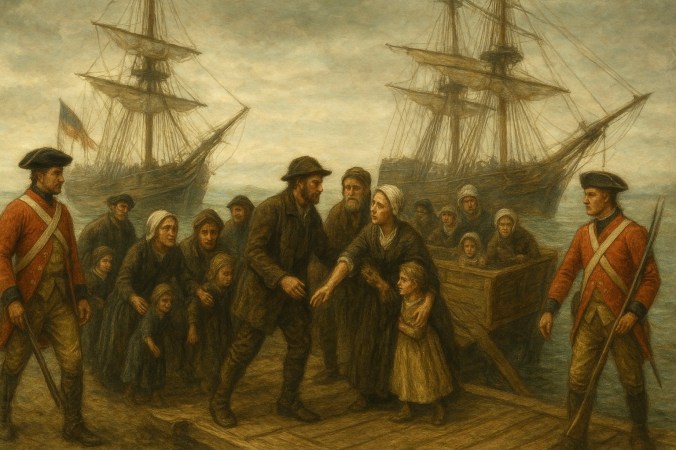
The Acadian Expulsion, also known as The Great Upheaval.
I think, though, I’m most discouraged and disappointed by the actions of my Cajun ancestors, a people displaced from their Acadian homeland by the British because of their religion and of who they were. Surely, they – of all the people in my family tree – should have understood the horrors and injustices of being viewed as less-than and unworthy… but perhaps these memories get lost after a few generations of assimilation into American life. I mean, just look at how many hyphenated Americans have forgotten their own immigrant ancestors’ experiences when they arrived here.
There’s also the case of young Ulysse Guillot, a child soldier. What battle horrors did he see as a 10-year-old… and then as an 11-year-old prisoner? How did this impact the rest of his life, or the lives of his own children?
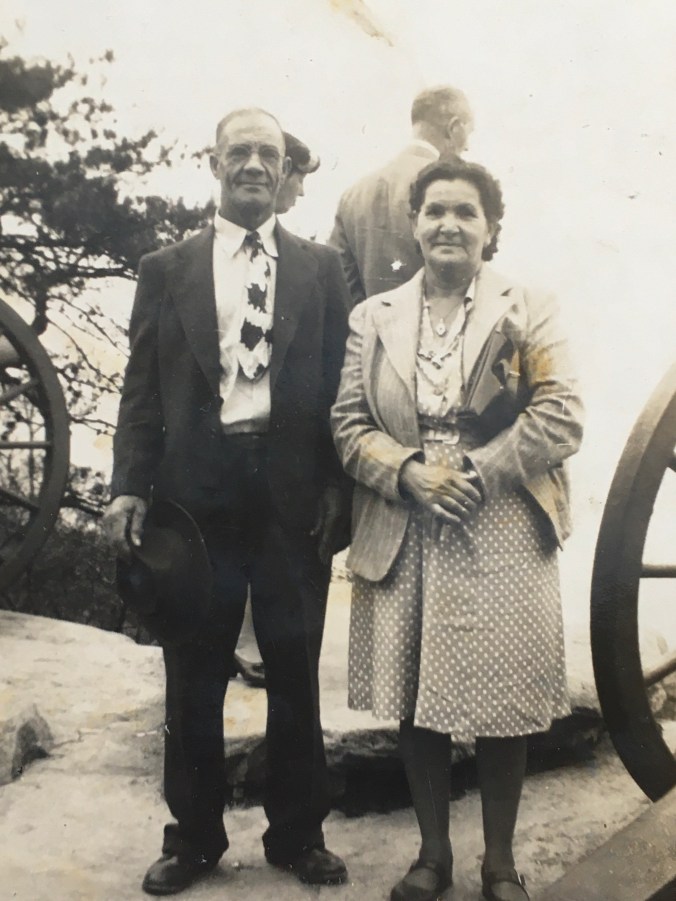
My Sicilian great-grandparents, Joe & Susie.
I would be remiss if I didn’t mention the role my Louisiana Sicilian ancestors played in the Civil War… They didn’t play a role. They arrived after the end of hostilities, settling in a region of the country facing a labor shortage as once enslaved people migrated northward or stayed behind to farm their own land.
With their dark skin and foreign language, my Sicilian ancestors were welcomed in that all-too-familiar American way – with discrimination, beatings, lynchings, and harsh and menial working conditions for the lowest pay. I wonder if my Cajun ancestors hired my Sicilian ancestors to work their land.
Closing Thoughts
When I started looking at my ancestry and writing about it for this blog, my hope was that by understanding the past and placing my ancestors in their time in history, I would be better able to make sense of the present.
It’s not a difficult stretch to think of the Civil War and our own time. We are as divided now as we were then. It’s something we’re reminded of each day. The Administration, Congress, and the media are doing nothing to ease those divisions. In our recent history, we have seen increases in political violence and rhetoric, normalization of hate speech, anti-Semitic, anti-Islamic, anti-migrant, and anti-LGBTQ violence, an open embrace of white nationalist and Christian nationalist propaganda and language, a rolling back of voting rights, civil rights, and human rights, partisan gerrymandering, and the un-ashamed appearance of Confederate and Nazi flags at political rallies.
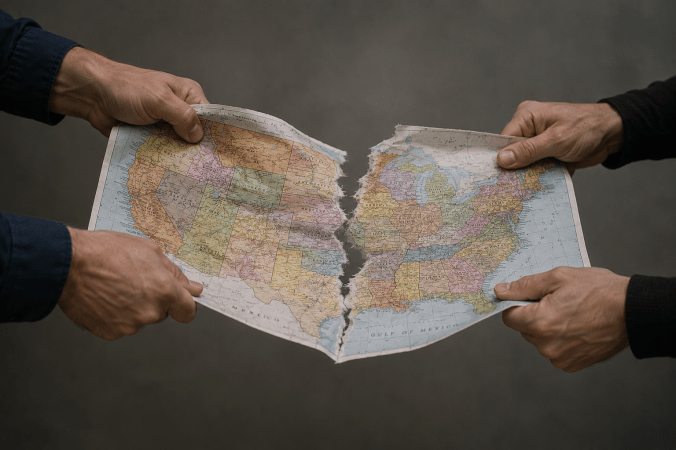
It’s exhausting. It’s horrifying. Could it be that the Civil War never actually ended… that it’s been an ongoing battle… simmering at times and boiling over at others… or is it a thread that’s been sewn into the American fabric since the nation’s founding?
Prior to the American Revolution, the Royal Governor of Virginia, Lord Dunmore, offered slaves their freedom in exchange for taking up arms for the King and against the rebels. That offer angered southern colonists, so much so that it was the push they, as Loyalists, needed to join the northern colonies in an open revolt. That’s how much preserving slavery meant to the southern colonies – and later the southern states… that they would take up arms for their right to own people in order to protect their way of life, their economy, and their profits.
This is as much of an indictment of the northern colonies, who agreed to appease the demands of the southern colonies in order to bring them into the Revolution fold. Slavery was present at the birth of the nation — and we’ve been tiptoeing around this issue ever since.
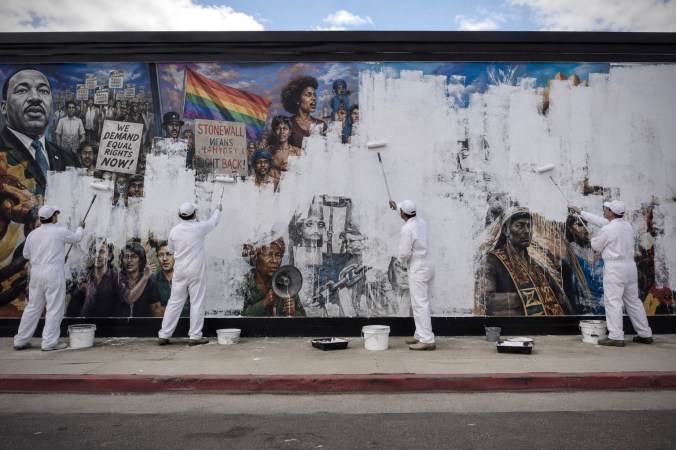
Even today, as we approach our 250th Anniversary, this Administration is going to great lengths to literally white wash our history by removing plaques that commemorate the contribution of African-Americans, banning books, and re-writing the American narrative. In Florida, where I live, the State revised its 2023-24 academic standards to require teachers to instruct students that enslaved people developed skills that they were then able to later use for their personal benefit.
While I understand the ridiculousness of blaming my parents for slavery and the Civil War, I’m left with a lingering question: If a 9-year-old can recognize the horrors of slavery, why can’t a 250-year-old nation?
My thoughts, though, keep returning to the nameless entries on the slave schedules. While I may not know the details of their lives, I know their DNA kept moving through time… and so I think, especially because it’s Memorial Day weekend, of the black community — any marginalized community, really, that has been called upon to serve this country in times of war and hardship, only to return home to find that their service didn’t advance their own right to be viewed as “created equal.”
What, exactly, does it take to get a place at the table… and once gotten, what does it take to not have that chair pulled out from under you?
I don’t know if it’s because I’m a member of the LGBTQ community and more sensitive to marginalized communities or that I’m well into my 60s and getting more crotchety by the minute, but I’m starting to think I don’t want a place at a table where those with a legacy chair determine if we sit or stand or get escorted out of the room. It’s tiring and humiliating to perform to be a member of this exclusive, members-only club.
Plus, they don’t seem like good hosts.
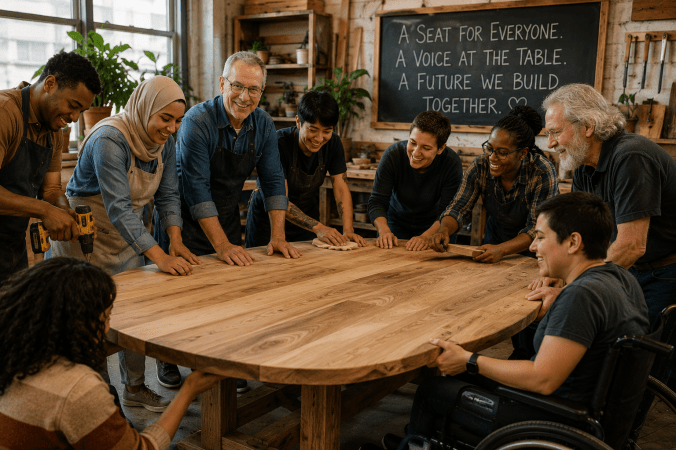
Instead, I want to sit at a new table, built by We, the People… a table with extra leaves… a table that welcomes all Americans and aims to fulfill the hopes and promises laid out 250 years ago. Then, as sung in the Battle Hymn of the Republic, “Glory, glory, hallelujah!”


I would be honored to sit at your new table, Kevin Loud. I’ll bring something delicious for all to share.
Dear CB… and what a splendid time it will be.
I envy your ability to trace your roots. My own ancestors are lost to the mists but for the stories I was told or the people I knew in the flesh. Go back far enough and we’re all related somehow. When I encounter prejudice I think of something a doctor friend of mine once said: If you needed a kidney transplant to live, you wouldn’t care if it came from a brown person, a yellow person, a black person, a woman, or a disabled person. We’re all human. So I believe in the Golden Rule: treat people the way I want to be treated.
Maybe I’m naive, but I find myself reaching for the wisdom of Mr. Rogers these days: Look for the helpers. Or, to quote that time honored phrase from the sixties, Think globally, act locally. The big stuff can be daunting, so begin wherever you are to make the world a bit kinder.
Anyway, thanks for the fascinating dive into your family’s history. It’s not just interesting, it’s thought provoking, and I appreciate you sharing what you’ve discovered.
Hello Linda… I do not think you’re naive. If you are, you’re in good company. Mr. Rogers was the sage of our childhood. I also believe in the Golden Rule. Once that’s mastered, everything else sort of falls into place. As for my ancestry, the published genealogy gave me a head start — thankfully — and it’s amazing what can be discovered online, from the comfort of home. I’m also happy to share what I’ve learned, as it helps me to make sense of it all. Thank you!
This is a fascinating read. I appreciate the links you shared to resources you found helpful. I will check them out. I too have slave holding ancestors, ancestors who fought on both sides of the Civil War, immigrant ancestors, and those who fought in the Revolutionary War. It’s a complicated family history. I’m glad to have found your blog…gardening and genealogy! Both interests of mine.
Hi Rooted Habitat… I’m glad you found me. I think these complicated family histories can give us an idea why our history, past and present, is a complicated one — but I believe we have to celebrate the successes while also examining and discussing our shortcomings, so we can better address our future. Be well.