
Every family tree has a story – or stories — to tell. That’s probably why I tend to get lost among the leaves and never get to the one leaf I was reaching for when I started my climb among the branches. I just never thought it would happen as soon as page 43 of 300 Years of Louds in America.
That’s when I met Annie Francis Loud.
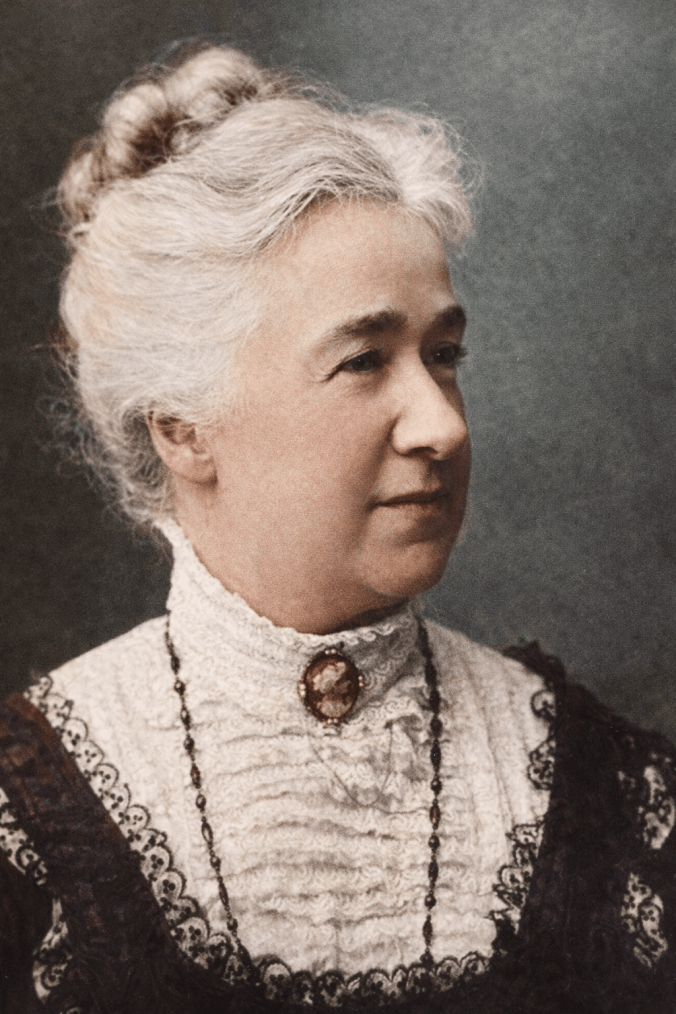
Annie Frances Loud
Annie and I aren’t directly related. 300 Years is organized according to the 13 children of Francis and Onner Loud. Naturally, the oldest, Jacob Loud – and Annie’s ancestor — is Chapter 1. By comparison, William Brewster Loud, my ancestor, is Chapter 9 – hundreds and hundreds of pages later. I think this makes Annie and I zillionth cousins, uncountable times removed.
Still, it was clear to me that there was something special about Annie. Although she was female and although she remained unmarried, C. Everett Loud, the man behind the 300 Years research and book, who tended to write very little – if anything at all about unmarried Louds, particularly unmarried women – devoted an entire page to Annie.
And I felt compelled to share her remarkable story.
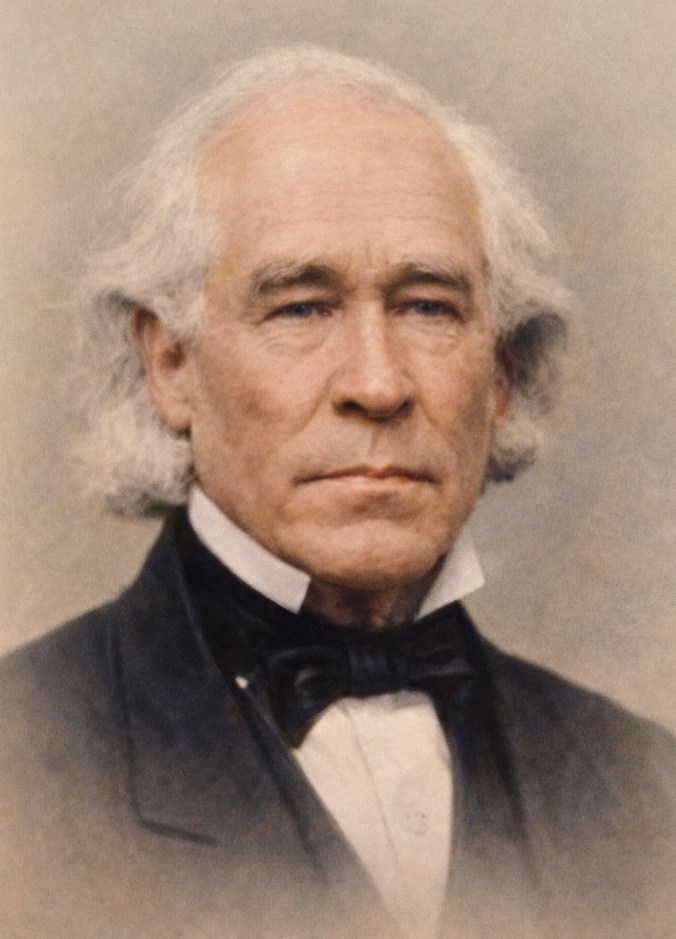
John White Loud
It could easily be said that everyone in the small town of Weymouth, MA, knew John White Loud and his family. Not only was he a descendant of William Brewster of the Mayflower and a grandson of Jacob Loud, Sr., who fought in the American Revolution alongside his five sons — the only family on record of having this distinction — professionally, he was Weymouth.
John W. Loud began employment as a cashier at Weymouth National Bank and eventually became president of the Weymouth Savings Bank. In his spare time, he was a member and chairman of the Weymouth School Committee, a major in the Weymouth Peacetime Militia, an active member in the Union Congregational Church, and, for two years, a Massachusetts State Senator.
In his personal life, he experienced immense joys and heart-wrenching tragedies. The townspeople still remember his February 1832 wedding – an icy cold day, they said – to Susan Harriet Torrey, a local girl who was the granddaughter of Dr. James Torrey, a surgeon in the War for Independence. In June the following year, the couple was blessed with a daughter, Susan Torrey Loud.
Sadly, two months after this happy event, John White Loud’s wife passed away, leaving him a 24-year-old widower with an infant daughter.
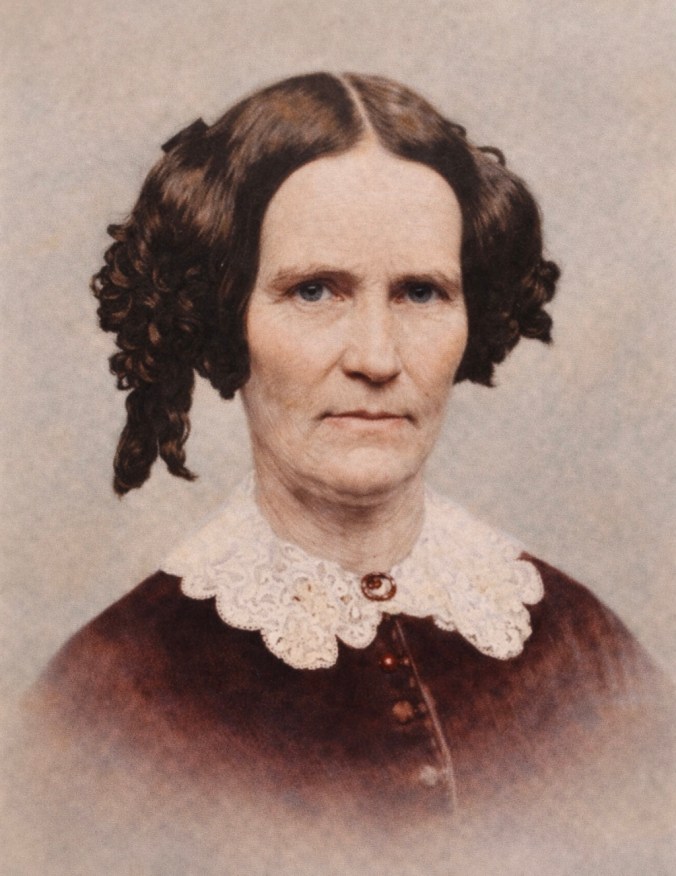
Sarah Humphrey (Blanchard) Loud
At the end of May 1834, John White Loud was married again, this time to Sarah Humphrey Blanchard, another Weymouth resident and a descendant of John Alden of the Mayflower. No one knows if this was a marriage of love or of necessity, but Sarah and John had 8 children – seven daughters, three of whom died in infancy — and one son – plus the one daughter from John W. Loud’s first marriage. Annie Frances was the youngest of the blended brood, 23 years separating her from Susan, her half-sister.
Despite the loss of children, one thing was clear: the Loud house was full of music. John and Sarah were both avid lovers of music, a trait passed down through generations – and this passion was shared with their own children. Their only son, John Jacob Loud, while studying law at Harvard, performed in the university’s Chapel Choir and Glee Club, as well as in Weymouth’s Village Glee Club.
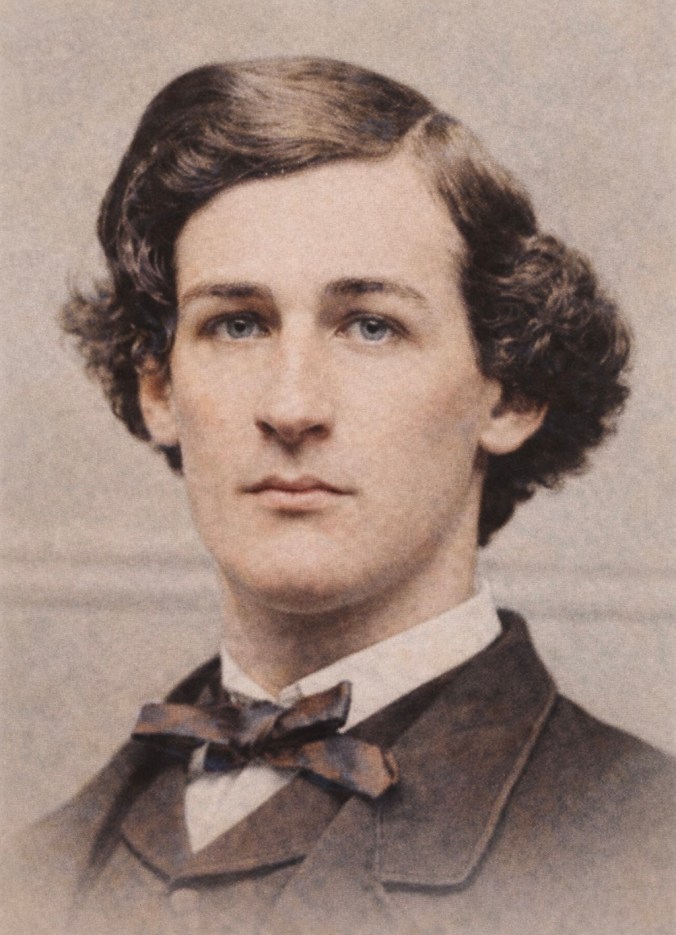
John Jacob Loud
The star of the family, though, was Annie Frances. According to 300 Years, Annie Frances was singing before she could even talk and began to compose music when she was 5 years old. Her preference was the pedal organ. To John and Sarah’s credit, they supported and encouraged her love of music. Because of their social standing, esteemed music educators, like Lowell Mason – famous for composing more than 1,500 hymns and setting the poem “Mary Had A Little Lamb” to music — were often invited to their home and gave young Annie lessons.
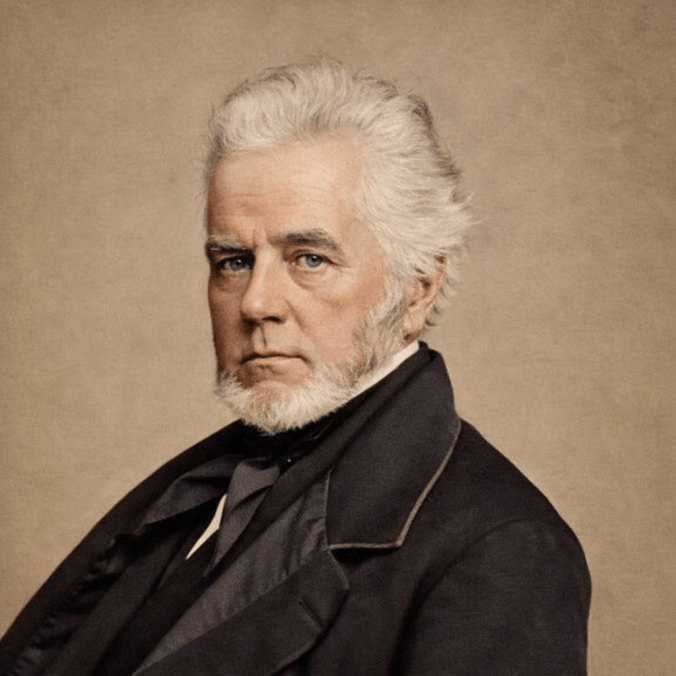
Lowell Mason
Then in 1860, when Annie was just 4, her 18-year-old sister, Mary Josephine, died of consumption, now known as tuberculosis. At the time, it was the leading cause of death in Massachusetts. Four years later, Annie’s mother, Sarah, succumbed to the same illness, which was marked by fever, weight loss, fatigue, and a wet, bloody cough. Once again, John White Loud, this time 55-years-old, was a widower.
Eleven months later, in August 1865, John W. Loud married his third wife, Martha Bond (Perkins) Vickery, a widow. They did not have children together, but Martha’s daughter from her previous marriage, Emily Keith Vickery, eventually married John Jacob Loud, Martha’s stepson. Annie was just 9.
I can only assume these events, traumatic at any age, propelled Annie deeper and deeper into her music. As a pre-adolescent, she was already studying piano, organ, and composition at the Boston Conservatory, and then a course of study in harmony and composition under famed music educator, John W. Tufts. By the age of 14, Annie had served as choir singer, church organist, and musical director. Church music was her passion, and at age 25, Annie had her first song published in Boston. According to 300 Years, “She never wrote any music that was not, in her opinion, elevating or inspiring in its character.”
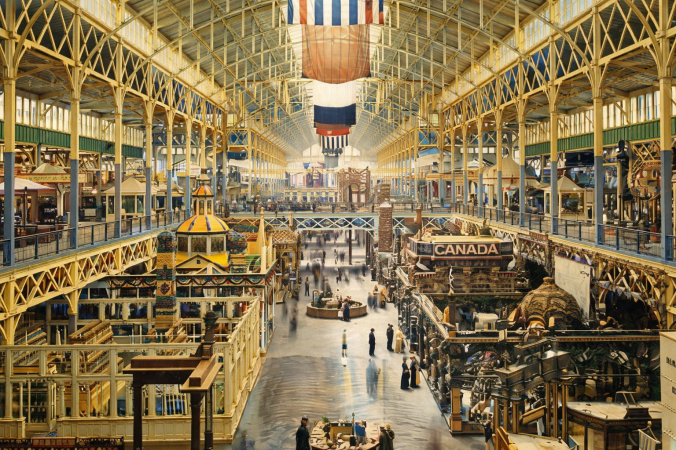
Chicago World’s Fair, Exhibition Hall
In the late winter of 1890, the US House of Representatives announced that they had selected Chicago to be the host city of the World’s Fair of 1893, also known as the Columbian Exposition to honor the 400th anniversary of Columbus’ arrival in America. The fair was scheduled to stretch from May 1 to October 30.

Chicago World’s Fair — The White City, thanks to Westinghouse.
As the Fair’s opening day approached, there was a growing excitement throughout the country. There was the promise of new technologies, like Westinghouse’s alternating current electric system to power the 100,000 incandescent lamps, which would illuminate the Beaux-Arts architecture of the Fair into “The White City”, and a new contraption called the Ferris Wheel.
The Fair also promised entertainment from around the world, including Weymouth’s Annie Frances Loud. After arriving at the Fair, 37-year-old Annie took the stage in one of the music hall venues and performed “An Exhibition of Sacred and Secular Music of Standard Valor and Interest Consisting of Solos and Choruses.” It was a mouthful, indeed, for which she was awarded a certificate and medal.
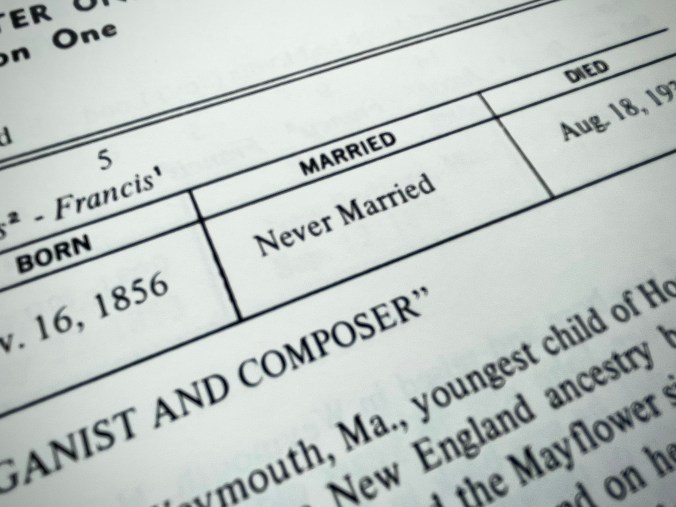
Throughout Annie’s entry in 300 Years are the words “never married” and “unmarried.” On the one hand, I understand why a genealogist would add this, a sort of period on the quest for descendants. On the other hand, though, it’s a phrase that may or may not identify something else.
There was a time when unmarried individuals were identified as spinsters, old maids, or confirmed bachelors – which was often the case in a time when people were not allowed to express love or to marry their love when that love dare not speak its name.
While Annie Frances may not have married, I have no way of knowing if she had ever been in love with anyone, male or female. Through census records, though, I was able to trace her whereabouts, living with various combinations of the women in her family, but usually with her married sister, Alice, and her family. As far as I can tell, she never lived with her brother, John Jacob Loud, and his family.
In March 1930, her sister Alice passed away and Annie Frances, 74, was alone.

Then, I discovered Annie Frances in the 1930 census. She was listed as “patient” – just one among pages and pages of other patients, all living at the McLean Asylum for the Insane, now known simply as McLean Hospital.
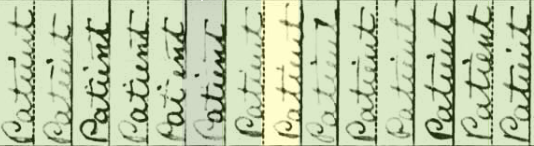
I have no way of knowing how and why she ended up there, no way of knowing who brought her there – a niece, a nephew, herself? In researching this post, I learned that in the 19th and early 20th centuries, women were frequently institutionalized, making them a larger proportion of patients in private and public psychiatric hospitals – and there were many reasons beyond what we consider today to be a true psychiatric diagnosis, from unmarried and pregnant to never married or widowed, from being a financial burden for their families to acting “outside social norms.”
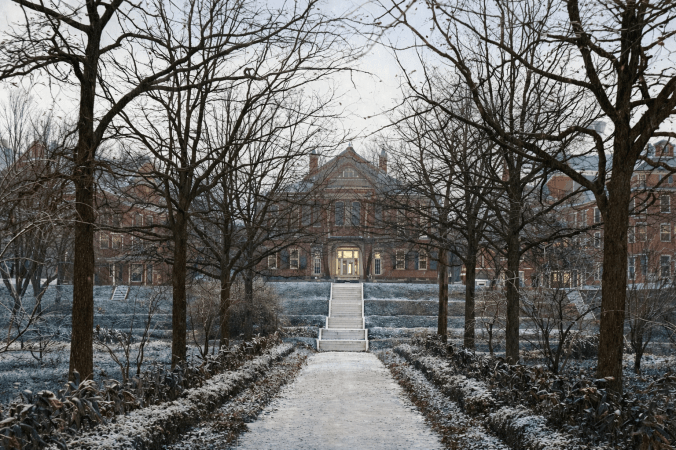
McLean Hospital, formerly known as the McLean Asylum for the Insane.
McLean, though, was a private facility, which held a certain appeal for the affluent. As a result, a broader definition of senility and nervous disorders was used to admit “socially inconvenient, eccentric, or elderly relatives.” There’s no way to know if Annie Frances struggled with mental illness, but based on research, it’s safe to say that she was from a wealthy family and was in need of care as an unmarried elderly woman.
I wonder how she passed the remainder of her days there? Did she walk the grounds, which were designed by Frederick Law Olmsted? Did she sing to herself? Did she perform for the other patients and staff?
I’ll never know these answers.
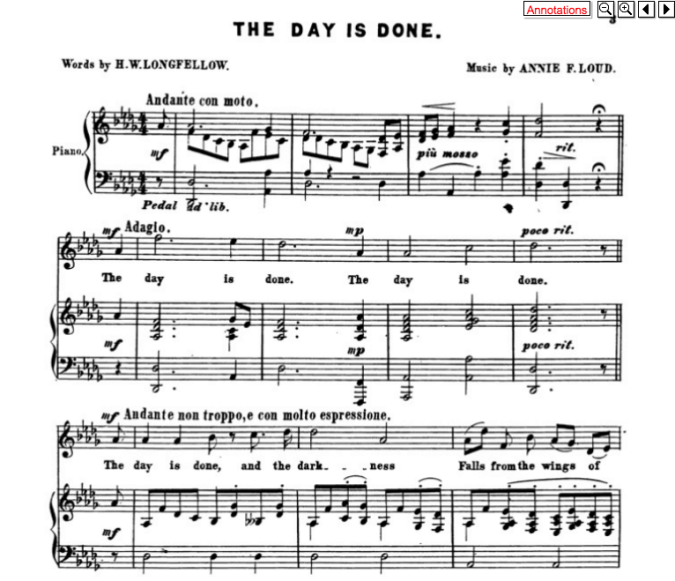
At the time of her death on August 18, 1934, at 77 years of age, Annie Frances Loud had written nearly 150 compositions, including hymns, songs, carols, processionals, children’s songs, mixed men’s and ladies’ quartets, and adult and children’s choruses, as well as compositions for the pedal organ and piano. Among her best-known songs are “Our Risen King,” “There Is a City Bright,” “The Day is Done,” and “What Shall We Children Bring.” Many of these are housed in libraries in Brookline, MA, and Weymouth, MA.
I think this is one of the reasons I wanted to share Annie’s story… there was so much more to her — and anyone, for that matter — than just “unmarried.” Bringing the lives of the unmarried is one of the reasons I embarked on ancestry research in the first place.
It’s fortunate that C. Everett Loud wrote so much about Annie Frances… especially because as I’ve searched the pages, so many unmarried Louds were mere blips, lives discounted because there weren’t descendants — or perhaps it was a sign of C. Everett Loud’s time and prejudices.
Again, I’ll never know… but these are the moments I wish I could time travel… or sit on a park bench and conjure up a visitor from the past, so we could have a chat.

 Nitty Gritty Dirt Man
Thanks for sharing Annie with us. I was sad to learn that she spend her last days in an asylum. Perhaps she had dementia. I shudder to think of her in an asylum if she had all her faculties and was simply an inconvenient relative.
Hi Linda… Her story really stuck with me… but when I saw the 1930 census, I was stunned. Of course, I have more questions than answers, but I think that’s something that probably happens with genealogy research. I’m also not sure if I contacted the hospital is they would share any information with me. I like to think, though, that she was there because she was an elderly, unmarried woman, who needed a place to live. Thank you for commenting.
Another great posting, Kevin — your introduction to Annie is a beautiful tribute. Thank you! C 🦋
>
Thank you for your kind words, Cathey. I think you would have enjoyed Annie’s company.